Does choosing the hardest night guard automatically give your teeth the best protection while you sleep? Many assume thicker, firmer plastic is always stronger and safer, while a soft tray is just a budget substitute. That assumption leaves out the two things that determine whether a night guard works: whether you'll keep wearing it every night, and whether it keeps your bite stable once you do.
Waking up with a tight jaw, dull morning headaches, or sensitive molars often pushes Miami adults to search for a dentist near me or compare hard vs soft night guard options online. Without an exam, picking by material alone is guesswork. A guard that feels bulky ends up in the nightstand drawer, while a guard that flexes too much under heavy clenching can warp and throw off how your teeth meet.
Working with a trusted dentist in Miami, FL turns that guesswork into a clear plan. When a clinician checks your enamel wear, jaw muscles, and any existing crowns, veneers, or dental implants, the choice between soft and hard stops being a coin flip and becomes a considered part of your long-term dental care.
Table of Contents
- Hard vs Soft Night Guards at a Glance
- Matching Your Grinding Pattern to the Right Guard
- Why Harder Is Not Always Better for Night Guards
- Protecting Crowns, Veneers and Your Bite
- How a Miami Dentist Chooses and Fits Your Night Guard
- Caring for Your Night Guard Between Visits
- Book Your Night Guard Consultation in Miami
Hard vs Soft Night Guards at a Glance
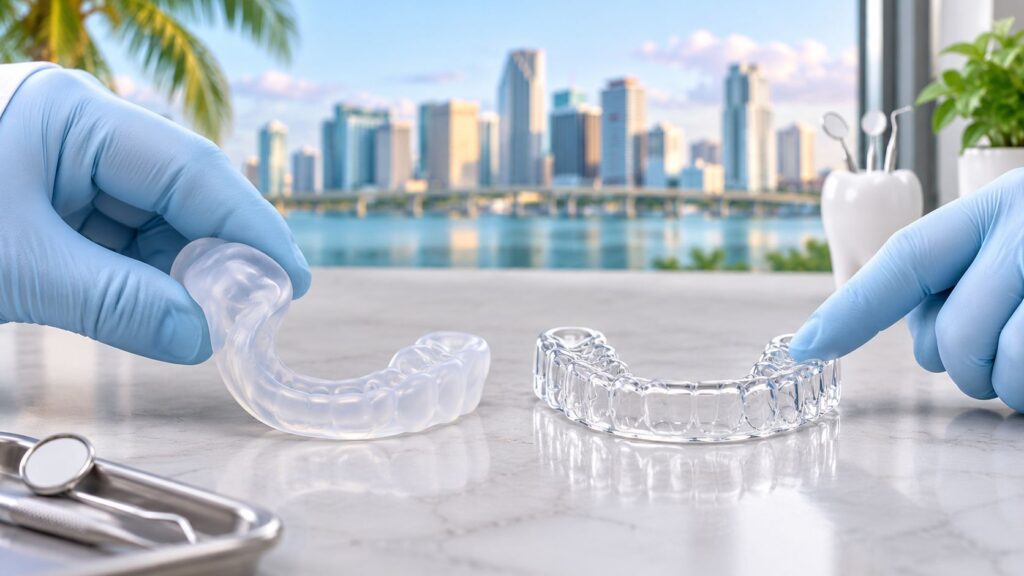
Two guards can sit side by side on a bathroom counter and still behave very differently once you fall asleep. A soft night guard is the comfort-first option, a hard guard is the stability-and-protection option, and neither material wins for every mouth. Comfort decides whether the appliance stays in past the first week. Stability decides whether it keeps shielding your teeth through months of nightly force.
| Criterion | Soft guard | Custom hard guard | Usually preferred when |
|---|---|---|---|
| First-night comfort | Softer, cushions teeth and gums | Firmer, may need a short adjustment period | Soft: sensitive mouth or first-time wearers |
| Ease of fabrication | Quicker and simpler to make | Custom-made from an impression, more steps | Hard: a dentist needs a precise, adjustable device |
| Resistance to deformation | Can thin, distort or tear under heavy grinding | Holds its shape longer | Hard: frequent or heavy nightly grinding |
| Stability of bite contacts | Contacts can shift as the material deforms | Flat, predictable surface that can be refined | Hard: bite changes or jaw symptoms need control |
| Reported effectiveness in one study | 93.33% | 82.14% | Single study, not a universal result |
Reading Clinical Percentages in Context
Clinical numbers can mislead when read without context. In a six-month clinical study of 58 people with sleep bruxism or clenching published on SciOpen, 28 patients wore hard occlusal splints and 30 wore soft splints, with reported effectiveness of 82.14% for hard splints and 93.33% for soft splints. The researchers noted that participants found soft splints more acceptable because they were simpler to make and more comfortable to wear.
Those percentages reflect an adherence advantage, not a universal verdict. One six-month study cannot prove a soft guard belongs in every mouth, especially for a patient grinding hard enough to flatten molars or fracture fillings. The same trade-off shows up outside dentistry: comparing which earplugs block night noise better comes down to matching material feel with sleep habits, and a night guard asks you to balance comfort against the force your jaw produces.
Local Guidance for Miami Patients
Across Downtown Miami, Midtown Miami, and Hallandale Beach, Ultra Smile DentalSpa checks bite patterns, enamel wear, and existing restorations during new patient exams and routine cleaning and exams before recommending a guard material. That recommendation follows what the clinical exam shows rather than a one-size-fits-all tray. For a patient who already has a crown, veneer, or implant, the fit check carries extra weight, because the guard has to protect natural enamel and the restoration around it.
Before your visit, notice which hurdle feels bigger: getting used to a firmer appliance on your teeth, or waking with a tight jaw and fresh wear on your enamel. That honest answer gives your dentist a practical starting point.
Matching Your Grinding Pattern to the Right Guard
Bruxism, the clinical name for involuntary teeth grinding and clenching, is the main reason adults start looking for overnight protection. Custom night guards are offered to protect teeth and jaw from the effects of bruxism, also known as teeth grinding, by placing a durable barrier between upper and lower arches. A guard doesn't switch off the grinding habit itself, so its real job is absorbing force that would otherwise chip enamel, fracture restorations, or strain jaw muscles.
Because grinding patterns vary widely from person to person, clinical evidence doesn't crown one material the winner for every case. A systematic review of 11 randomized controlled trials indexed on the Directory of Open Access Journals found that both hard and soft guards reduced pain, improved mandibular movement, and relieved symptoms tied to temporomandibular disorders and bruxism, with similar overall results. That overlap is exactly why someone searching for an emergency dentist after cracking a molar or a cosmetic dentist near me before getting veneers benefits from a hands-on bite check rather than choosing by price or softness alone.
| Situation | Usually better starting point | Why it fits |
|---|---|---|
| Occasional clenching with mild symptoms | Soft guard | Cushions teeth and is easier to get used to |
| Heavy nightly grinding with visible wear | Custom hard guard | Resists deformation over time |
| Jaw pain or temporomandibular joint symptoms | Decide with a dentist | Both types showed similar symptom relief in studies |
| Crowns, veneers or implants in place | Custom hard guard, fitted by a dentist | More predictable fit and contact around restorations |
| Strong gag reflex or bulk is hard to tolerate | Thinner soft guard | Less bulk, more comfortable to wear |
| Need comfort while a custom guard is made | Soft interim guard | Available sooner while the custom device is prepared |
Signs to Track Before Your Dental Exam
Grinding happens while you're asleep, so subtle daytime clues help a dentist gauge how much force your jaw generates and whether dental x-rays are needed to check roots and bone support. Jot down a quick note if you've noticed any of these patterns over the past month:
- Morning jaw fatigue: Tightness along the cheeks or in front of the ears right after waking up often signals sustained clenching overnight.
- Unexplained dull headaches: Tension centered around the temples in the morning frequently traces back to overworked chewing muscles.
- Chipped or flattened edges: Rough front teeth, tiny corner fractures, or flattened molar tips point toward repeated enamel-on-enamel contact.
- New tooth sensitivity: Sharp zings from cold water or sweet foods without a visible cavity can indicate microscopic enamel wear or hairline cracks.
- Partner reports of clicking or scraping: Audible grinding at night gives the clinician a direct clue about sliding versus static clenching.
Bringing these observations to an exam saves time and helps your dentist match the guard design to the exact mechanical stress your teeth face.
Why Harder Is Not Always Better for Night Guards
Most patients walk into a hard vs soft night guard conversation holding one firm belief: harder plastic always means better protection. That assumption makes intuitive sense. Dentistry itself moved in that direction over decades, shifting from the natural rubber, vinyl polymers, and latex appliances of the 1940s and 1950s toward rigid methacrylate-based hard polymers designed to hold planned bite contacts and resist deformation, as detailed in a historical review archived by the University of Regensburg.
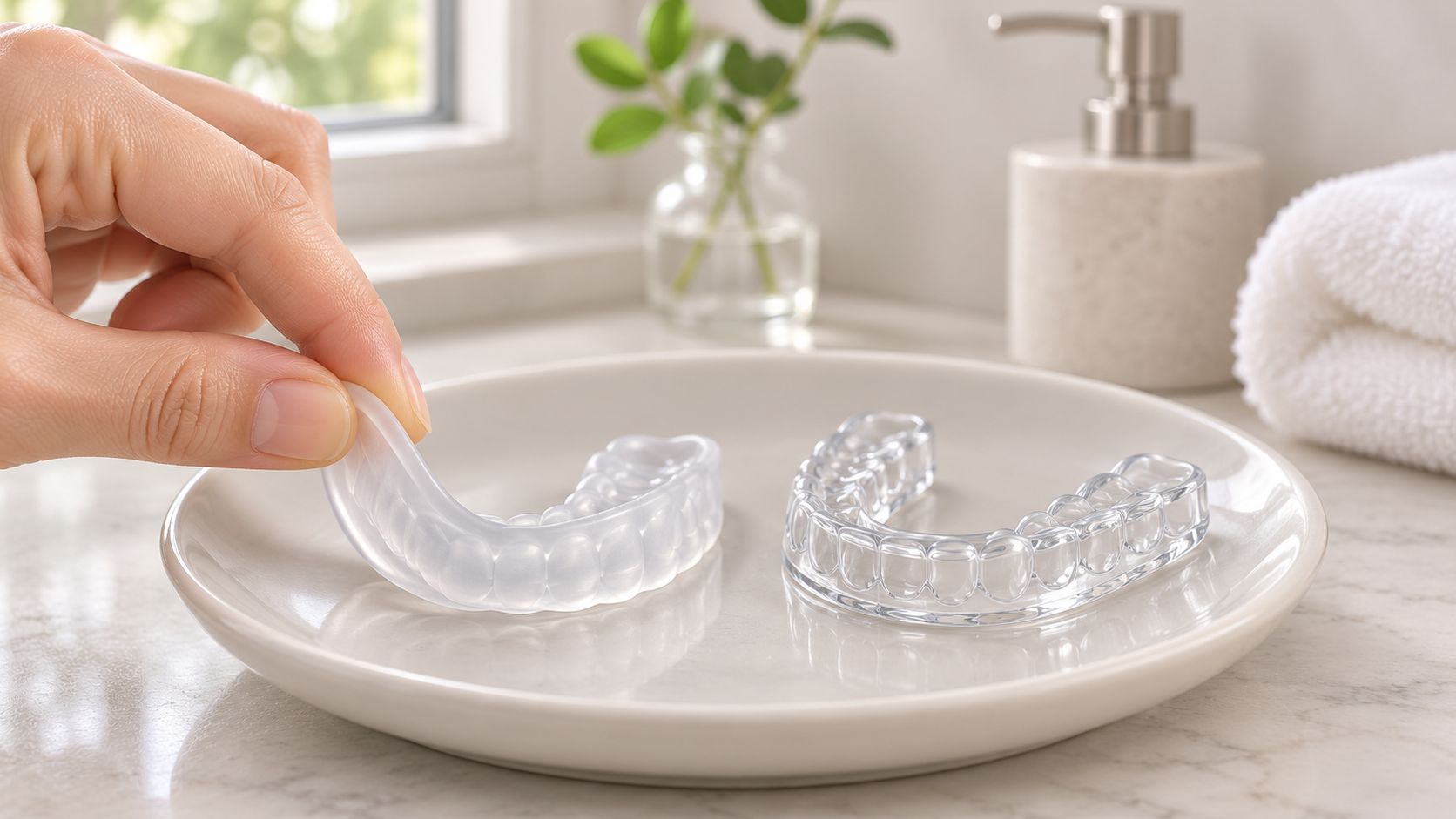
Where that assumption breaks down is in how real mouths respond to comfort, compliance, and wear. A rigid acrylic guard holds its shape well and gives a dentist a flat, predictable biting plane to refine, while a flexible soft guard cushions the teeth and feels gentler right away. Yet clinical comfort isn't a minor detail when a patient has to wear the device every night.
In comparative clinical research summarized in PubMed Central, hard splints produced substantially greater discomfort than soft splints, with mean discomfort scores of 3.38 versus 1.63. The same review notes that a Cochrane evaluation found insufficient evidence that occlusal splints cure sleep bruxism, even though they can protect teeth from wear, and highlights that newer adjustable or biofeedback designs may influence sleep-bruxism episodes more than material hardness alone.
Durability Versus Real Symptom Relief
Durability on a lab bench doesn't always translate to superior pain relief in bed. A 2024 randomized clinical trial reported by NewMouth found that a mixed hard-soft splint showed more appliance wear after six months than a rigid splint, yet both groups experienced similar relief from jaw-muscle and joint symptoms. Earlier randomized data cited in the Regensburg review also documented mixed-splint wear rates of 16.3% at six months and 5.3% at twelve months, again higher than rigid splints without sacrificing overall pain reduction.
Those numbers show why choosing a guard solely by toughness misses half the picture. Giving up some appliance longevity didn't mean giving up comfort or jaw relief. On the other hand, letting a worn or distorted guard stay in rotation creates a hidden problem: once thin spots or depressions alter how your upper and lower teeth meet, uneven bite contacts can shift pressure onto a handful of teeth and undo the protection you paid for.
Comfort decides whether you keep wearing the guard, and stability decides whether it keeps protecting you.
Judging Materials by Behavior Rather Than Hardness
Understanding what night guards are made of helps patients see past marketing labels like "heavy duty" or "ultra soft." Flexible ethylene vinyl acetate yields under pressure, which makes it forgiving on night one, though some heavy clenchers chew on the springy surface and thin it out quickly. Rigid acrylic resists flexing and spreads force across the entire arch, which supports long-term restorative dentistry work, even if it takes several nights for your tongue and cheeks to adapt.
Judge any guard by two practical standards: how reliably it holds its shape under your specific bite, and whether you'll wear it consistently without waking up to pull it out.
Protecting Crowns, Veneers and Your Bite
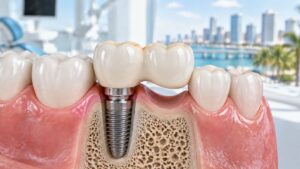
Adults across Miami invest heavily in cosmetic dentistry and restorative care, from porcelain veneers and teeth whitening to dental crowns and dental implants. If you've searched for dental implants near me or completed a smile makeover, a night guard stops being an optional accessory and becomes insurance for your dental work. A poorly fitted or unevenly worn guard can funnel clenching pressure directly onto a single veneer edge or crown margin, leading to chipped porcelain, loosened cement, or painful cracks.
Crowns protect and strengthen teeth that can't be restored with fillings or other restorations, and are ideal for teeth that have had root canal treatment, large fillings, or are severely worn or broken. When severe grinding fractures an unprotected tooth past the point of repair, a patient can end up facing a tooth extraction and later needing replacement options such as dental implants. Protecting existing restorations early avoids that cascade.
Why Harder Material Can Create Unexpected Wear
Choosing the hardest guard off the shelf isn't automatically safer when your mouth has exposed dentin or composite work. A laboratory wear study published in the Journal of Oral Rehabilitation found that opposing enamel, dentin, and many resin-composite materials showed higher wear against a hard composite splint than against a softer thermoplastic material, with dentin experiencing the greatest wear. While rigid splints give dentists stable retention and clean surface adjustment, the study underscores why material choice has to match what sits on the opposing arch.
Clinical check: A night guard protects enamel and restorations from grinding forces, but it never replaces a medical or dental evaluation for sleep disorders, persistent jaw pain, or sudden bite changes.
During a fit evaluation for cosmetic or restorative patients, a dentist verifies three specific details: whether the guard contacts every crown, veneer, and natural tooth evenly, whether the internal seating has changed after recent fillings or bonding, and whether your bite has shifted since restorations were placed.
Three Dental Milestones That Require a Fit Review
Certain treatments alter tooth shape or alignment enough that an older guard no longer seats properly. Knowing when to speak up protects both your comfort and your investment:
- Right after veneer placement. Porcelain veneers change the contour and thickness of front teeth, even by a fraction of a millimeter. Tell your dentist before impressions are taken for a guard, and request a fresh fit check once bonding is complete so tight edges don't pry against new porcelain.
- Following crowns or root canal therapy. A tooth rebuilt with a crown sits differently in your bite than the broken tooth it replaced. Bring your existing guard to the final crown delivery visit so the dentist can confirm whether it can be adjusted chairside or needs to be remade for an even bite.
- During or after orthodontic care. Invisible braces shift teeth week by week, meaning a rigid guard made beforehand won't fit partway through alignment. Ask your dentist how to time your final custom night guard once orthodontic movement finishes and retainers are set.
Share every crown, veneer, implant, filling, and recent orthodontic step before a guard is fabricated so the final appliance protects your smile rather than stressing it.
How a Miami Dentist Chooses and Fits Your Night Guard
Comfort decides whether you keep wearing a night guard, and stability decides whether it keeps protecting you. Store-bought boil-and-bite trays skip every diagnostic step that delivers both. A generic tray can't replicate the fine contours of your teeth, and nobody checks whether your opposing arch hits one back molar harder than the rest. In a dentist-led fitting, each step exists to prevent sore teeth, jaw strain, and a guard that ends up abandoned in a drawer.
The infographic below outlines the clinical sequence a Miami dentist uses to evaluate your bite and deliver a custom-fitted appliance.
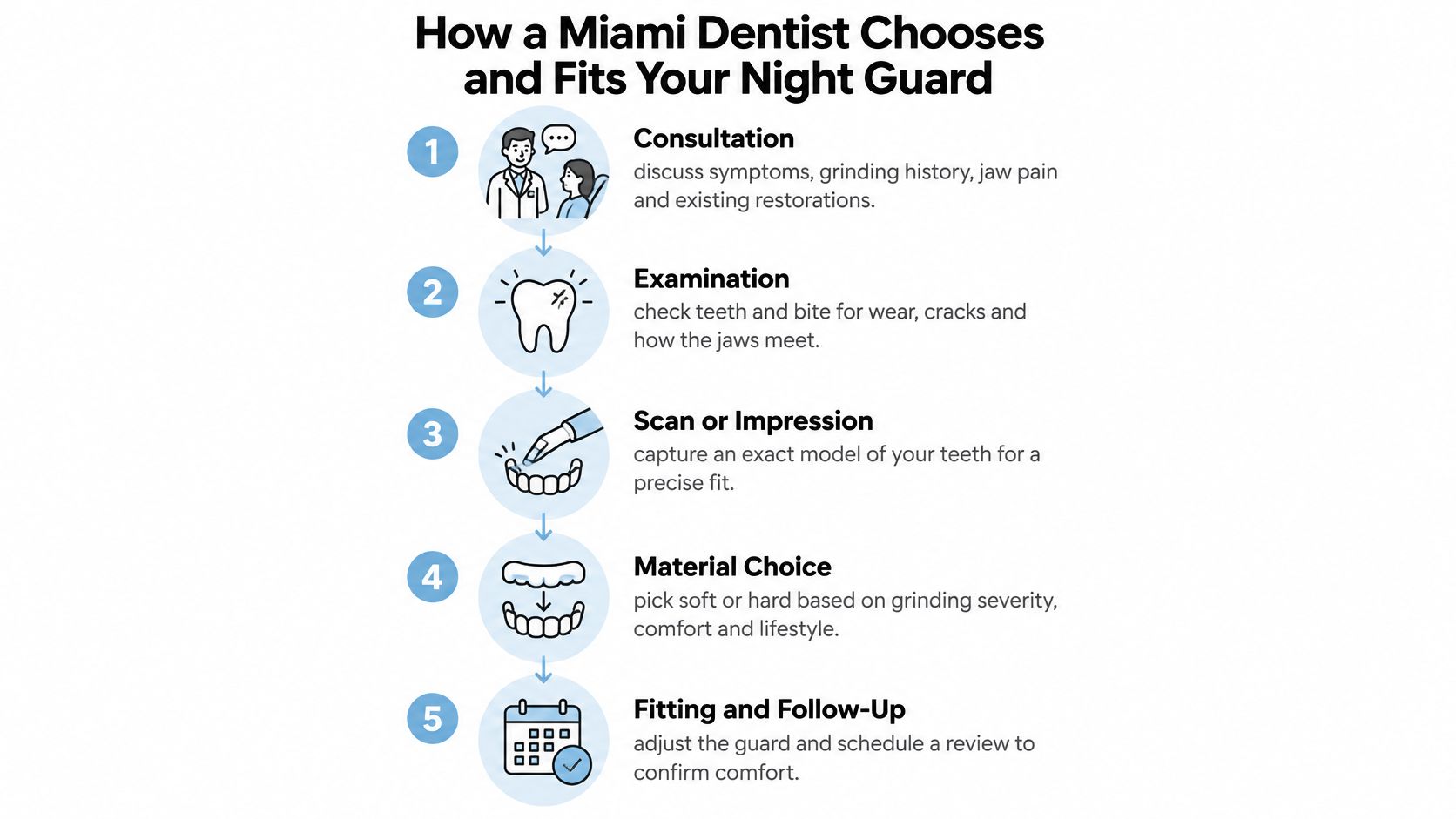
Seven Steps From Exam to Follow-Up
Ultra Smile DentalSpa in Downtown Miami, Midtown Miami, and Hallandale Beach follows this structured sequence for every custom night guard so the final device matches your anatomy and grinding severity:
- Consultation to review symptoms and history. The custom night guard process begins with a consultation to discuss your symptoms and an impression of your teeth, giving the dentist a clear picture of morning headaches, jaw soreness, sleep habits, and past dental work. A rushed history can mask signs of a deeper bite issue or a sleep-breathing concern that a guard alone won't solve.
- Examination of teeth, gums, and bite. The dentist inspects enamel wear facets, hairline cracks, gum recession, and how your upper and lower jaws meet when you close. Skip this bite examination and contacts can land unevenly on the finished appliance, which triggers fresh jaw muscle soreness rather than easing it.
- Precise impression of the upper or lower arch. The night guard is made from the impression so that it fits precisely over the upper or lower teeth without rocking or slipping during sleep. Over-the-counter guards can't capture exact tooth shapes, so they tend to shift overnight, rub gum tissue, or concentrate pressure onto two or three teeth.
- Selection of guard material and thickness. Thickness is a separate clinical variable from material choice, and both get weighed against your exam findings. In a randomized study of 115 patients with sleep bruxism published in Clinical Oral Investigations, participants assigned to 2-mm and 3-mm soft splints reduced maximum bite force and saw sleep-quality improvements starting in the first month and continuing into the second month. Guessing thickness at home overlooks how arch height, gag sensitivity, and clenching strength work together.
- Custom fabrication from your impression. The appliance is fabricated from your impression in a material chosen to suit your exam findings, so the design matches how hard you grind and in which direction your jaw moves. Cutting corners with thin, unverified mail-order plastic raises the odds of early tearing, warping, or poor retention.
- Chairside fitting and bite adjustment. After the night guard is ready, the team checks that it fits comfortably and makes any necessary adjustments so opposing teeth touch evenly across the surface. This step carries extra weight for patients with crowns, veneers, or implants, because restored edges need balanced contact rather than a single high spot. Accepting a guard that pinches the gumline is one of the fastest ways to stop wearing it.
- Routine follow-up check-ups. Regular check-ups are recommended to assess the fit and condition of a night guard, so the dentist in Miami, FL can inspect wear tracks on the plastic, verify that teeth haven't shifted, and refine contacts as needed. Ignoring follow-up care leaves small cracks or bite changes unnoticed until jaw pain returns or emergency dental services are needed for a fractured tooth.
For a closer look at how hard and soft custom designs compare in daily use, watch this short walkthrough before your fitting visit.
What a Properly Fitted Guard Should Feel Like
Once adjusted, a custom night guard should seat with a snug, even grip and zero sharp pinching against your gums or front teeth. Extra saliva during the first few nights is normal while your mouth adapts. Over the first couple of weeks, your jaw should feel noticeably less fatigued when you wake up, and removing the guard shouldn't leave any single tooth throbbing.
If veneers, crowns, or implants are part of your smile, the delivery visit matters even more, since the guard has to share space and biting force with restorations. Veneer patients are advised to avoid biting on hard objects or using their teeth as tools, and telling the team about every restoration helps them fine-tune contact points. Speak up if anything feels tight, high, or uneven. A small chairside polish takes minutes, while months in an ill-fitting appliance can stress the very dental work it was meant to protect.
Caring for Your Night Guard Between Visits
A custom night guard sits in a warm, moist environment for hours every night, so daily habits directly shape how clean it stays and how long it holds its fit. Care instructions covering cleaning, storage, and usage are provided for each night guard, so be sure to review those written directions at your delivery appointment. Following practical night guard care instructions keeps bacteria from building up and prevents accidental warping.
Rinse the appliance in cool water right after taking it out each morning, then brush it gently with a soft toothbrush. Avoid hot or boiling water, which softens flexible materials and distorts precise acrylic margins, and skip abrasive regular toothpaste that scratches smooth surfaces. Let the guard air-dry completely before placing it in a clean, ventilated case away from sunny windowsills, car dashboards, or curious pets, and wear it strictly as your dentist directs.
Why Material Condition Changes Over Time
Both soft and hard guards need routine visual checks because chewing forces gradually reshape plastic. In a four-month clinical comparison of a 2-mm vacuum-formed elastic splint and a flat hard acrylic splint archived on PubMed Central, researchers noted that while either material can deliver short-term symptom relief, flat hard acrylic maintains a more dimensionally stable biting surface over time, whereas elastic guards need periodic inspection for distortion, perforation, and changing contacts.
Regular check-ups are recommended to assess the fit and condition of a night guard alongside your routine cleaning and exams. Waiting until a guard snaps in half makes it far harder to keep wearing it consistently, and a loose or uncomfortable appliance quickly loses its place in your bedtime routine.
Maintenance habit: Pack your night guard case whenever you visit the dentist for cleanings, even if the appliance still feels fine to you. Wear patterns on the surface act like a map of how hard and where you grind.
Warning Signs That Mean Booking a Visit Soon
Catching wear early often allows a simple polish or adjustment instead of a full remake. Contact your dental office if you spot any of these changes:
- Cracks, holes, or thin spots: Book a visit soon, because a compromised surface can't cushion heavy clenching and may split further overnight.
- A shift in how your bite meets: Schedule promptly, since uneven contacts on a warped guard can undo muscle relief and stress individual teeth.
- A guard that feels loose or rocks: Arrange a fit check so the dentist can assess retention and decide whether adjustment or replacement is safer.
- New pain in your jaw or a single tooth: Book an exam and note the exact day the ache started so the clinician can pinpoint any high contact spot.
- Visible grooves or rough wear patches: Bring the guard to your next scheduled check-up so the team can smooth rough edges and track grinding intensity.
Staying ahead of small wear signs keeps your appliance comfortable enough to wear every night and protects the rest of your dental care investments.
Book Your Night Guard Consultation in Miami
Picking between a soft, dual-laminate, or custom hard guard becomes straightforward once a clinician looks closely at your teeth, bite, and sleep symptoms. At Ultra Smile DentalSpa, Dr. Neda Bahmadi, DMD and her bilingual team serve patients across Downtown Miami, Midtown Miami, and Hallandale Beach in a calm, spa-like setting designed to take the stress out of visiting a dentist near me. The first visit centers on a thorough consultation to talk through your symptoms and an examination of your teeth and bite, and a free consultation can be requested through the form on the treatment pages.
Preparing for Your Consultation
Arriving with a few practical details helps your new patient exams run smoothly and gives the dental team everything needed to build a clear recommendation:
- Symptom notes: Write down when jaw tightness, morning headaches, or tooth sensitivity show up most often.
- Any previous night guard: Bring store-bought trays or older custom guards so the dentist can see existing wear patterns and what felt uncomfortable.
- Restoration history: Share details about crowns, porcelain veneers, dental implants, root canals, or recent orthodontic treatment.
Consider asking three focused questions while you're in the chair: which guard type fits your specific grinding pattern, how often the appliance should be checked, and what daily cleaning steps keep that material in top shape.
Transparent Planning and Cost Expectations
The cost of a custom night guard depends on the guard type recommended for your bite and the number of fitting or adjustment visits required. Ask for a written treatment plan during your consultation before any treatment begins. Ultra Smile DentalSpa provides transparent treatment planning, accepts dental insurance, and walks patients without coverage through clear payment options so there are no surprises.
Schedule your consultation today so the team can examine your bite, walk through every material option in plain language, and help you protect your smile comfortably before any treatment begins.
Ultra Smile DentalSpa combines thorough clinical diagnostics with a calming, spa-like setting across Downtown Miami, Midtown Miami, and Hallandale Beach, offering custom soft, hard, and dual-laminate night guards designed for your bite and existing restorations. Whether you're waking up with jaw soreness or protecting porcelain veneers, crowns, or implants from nighttime grinding, the team walks you through clear options before treatment begins. Visit Ultra Smile DentalSpa to request your free consultation and find a night guard built to fit your mouth comfortably.