Often yes. Gum recession is common among adults, and many people who have some recession still qualify for veneers once gum inflammation is controlled and the veneer edge can be kept clean. The periodontal exam, not the recession measurement on its own, makes the final decision.
The advice patients hear most often is to fix the gums first with surgery and only then think about porcelain. That advice is sometimes right and sometimes expensive and unnecessary. The gums do come first, but as a decision step, not as an automatic operation.
A shallow, stable recession with firm, pink tissue often needs no graft at all, because the tissue around the future veneer margin is already doing its job. A deep recession sitting over thin, inflamed tissue is a different case. Placing porcelain there works like building a fence on soil that is still eroding: the veneer edge lands exactly where the gum is moving, and every bit of further recession exposes it. A dentist who skips the gum assessment is planning a restoration on a moving foundation.
Table of Contents
- Can You Get Veneers With Gum Recession?
- What Gum Recession Changes in Veneer Planning
- Which Gum Conditions Suit Veneers
- Alternatives When Veneers Are Not the Right Fit
- Margins, Prep and Long-Term Risks
- How Treatment Works When Gums Have Receded
- Keeping Veneers and Gums Healthy Over Time
- Book a Gum Check Before You Choose Veneers
Can You Get Veneers With Gum Recession?
The advice most patients expect is a flat no until the gums are fixed. The answer is more useful than that: recession is a measurement the dentist plans around, not a verdict.
Gum recession is gum tissue pulling back from the crown of a tooth and exposing the darker root underneath. Dentists measure it in millimeters, most often on the cheek-facing surfaces where brushing pressure lands hardest. The depth matters, but it is read together with what the tissue itself looks like. Shallow recession over firm, pink gum usually earns a monitoring note in the chart. Deeper recession over thin or inflamed tissue usually means gum treatment comes before anything cosmetic, because a veneer bonded beside moving, swollen tissue is a restoration built on a shifting edge.
Here is the verdict that clears up most of the confusion. Recession alone does not rule out veneers. Active inflammation does. Three conditions decide the answer: gum tissue that is healthy or at least stable, no bleeding or active infection, and a veneer edge the patient can keep clean with a brush and floss.
That third condition is the one patients underestimate. A margin placed where floss cannot reach will collect plaque against tissue that is already retreating, so the dentist checks the cleaning path before agreeing to the design. The gum line is the first decision in the plan, and everything else follows it.
Veneers change the shape, color and apparent length of the visible tooth. They don't rebuild lost gum tissue, and they don't stop recession from progressing. Candidates for porcelain veneers typically have cosmetic issues such as discoloration, minor misalignments or irregular shapes, and recession is a separate finding layered on top of that list.
The reassurance sits in the long-term data. A retrospective study of 68 patients receiving 312 ceramic veneers, including people with advanced periodontitis at stage III or IV, found that veneer survival did not differ significantly from veneers placed in periodontally healthy patients over a mean follow-up of 8 years (Clinical Advances in Periodontics). Carefully selected and maintained patients reached comparable outcomes once their condition was managed.
For those seeking a dentist in Miami, FL, the practical first step is a gum exam and smile photographs at a consultation with Ultra Smile DentalSpa, which serves Downtown Miami, Midtown Miami and Hallandale Beach. Bring notes on any bleeding, tenderness or sensitivity noticed in the past few months, because those details steer the plan.
For background reading before the appointment, the Ringway Dental gum health guidance walks through how gum disease and porcelain restorations interact over time.
What Gum Recession Changes in Veneer Planning
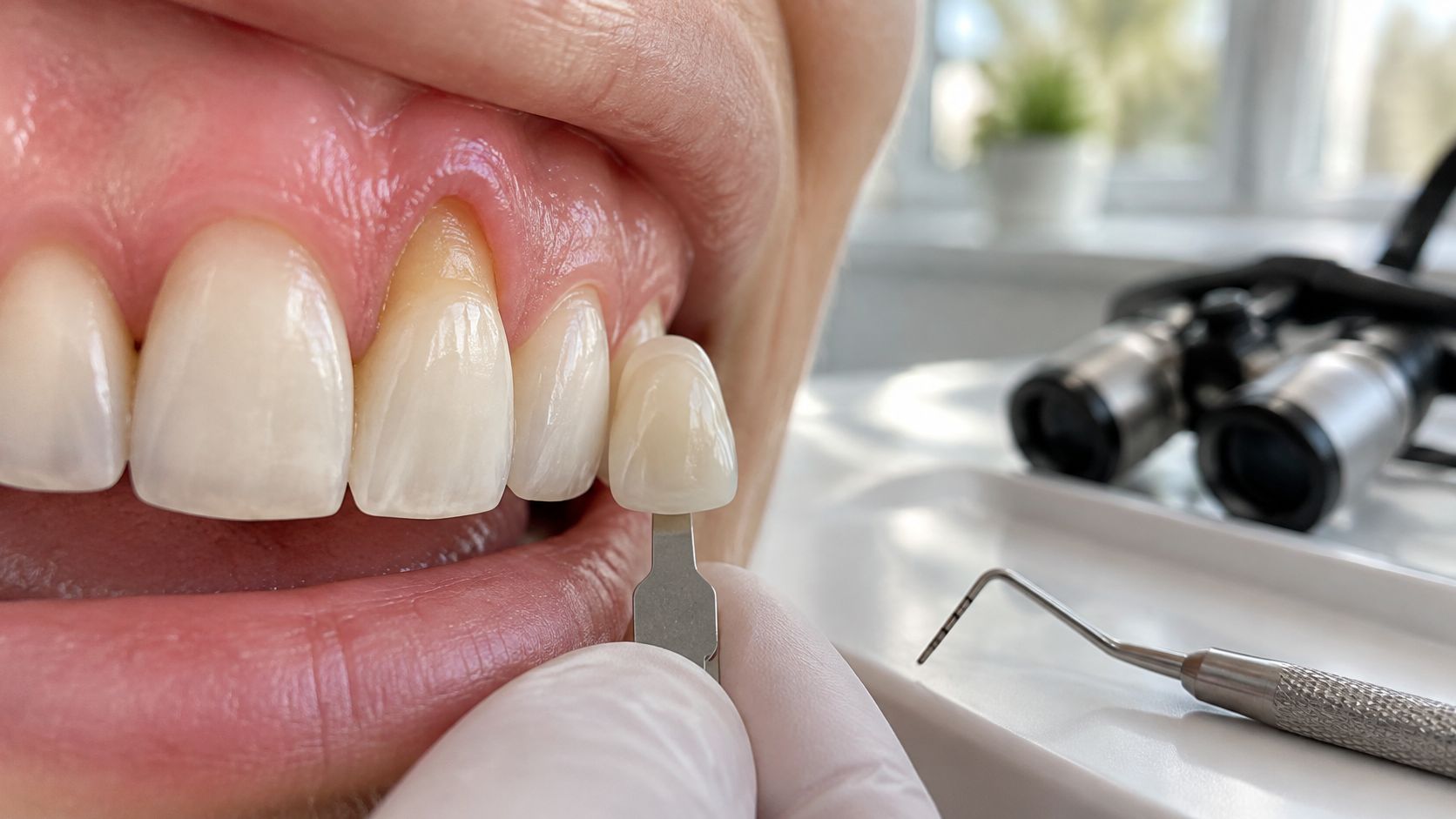
Recession moves the planning conversation from the front of the tooth to the gum edge. The exposed root is softer than enamel, it conducts cold and sweetness more sharply, and the gum edge that remains can sit awkwardly against a veneer margin.
That single change ripples through every design decision that follows. A margin tucked deep under the gum may hide a dark root line for a year or two, then collect plaque where a brush can't reach. An over-contoured edge that looks full and bright on the model can trap biofilm against tissue that is already retreating.
Why the exposed root changes the math
Enamel is the hardest tissue in the body. Root dentin is far softer, so it wears under the same brushing that enamel shrugs off. It also stains faster and bonds differently, which means the margin cannot be pushed to wherever the old gum line used to be.
Recession is also common enough to treat as routine. A 2022 systematic review and meta-analysis of 15 studies involving 37,460 people found a pooled global prevalence of gingival recession of 78.16% using studies' minimum reported thresholds and 84.92% at a threshold of at least 1 millimeter (PubMed). The same review rated overall certainty as very low because study designs and measurement methods differed substantially.
The five checks, in order
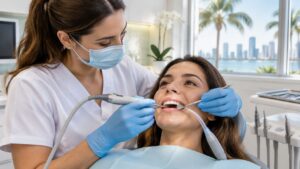
Veneer treatment starts with a detailed consultation to assess the patient's dental needs and cosmetic goals, and with recession the exam follows a fixed sequence.
- Measure gum levels and pocket depths around each tooth. Pocket depth in millimeters shows whether the attachment holding the tooth is stable enough for elective work.
- Map where recession sits and how deep it runs. Cheek-facing surfaces are charted tooth by tooth, because a 2 mm loss on a canine and a 2 mm loss on a premolar are different cosmetic problems.
- Look for brushing trauma, inflammation and exposed roots. A scrubbing motion with a hard bristle leaves a distinct wear pattern at the gum line, and it has to change before any prep.
- Photograph the smile at rest and while smiling. Gum-line visibility changes completely between the two, and the photos decide whether the gum line belongs in the smile design at all.
- Take digital X-rays. Bone support and decay near the gum line don't show up in a mirror, and hidden decay under a planned margin changes the treatment order.
Here's how those findings translate into a decision.
| Finding | How it is measured | Why it changes the veneer plan |
|---|---|---|
| Gum level around each tooth | Probe and millimeter ruler at the gum edge | Sets how much root is exposed and where the margin can sit |
| Pocket depth | Periodontal probe in millimeters | Shows whether the gum attachment is stable enough for elective work |
| Recession depth and pattern | Millimeter measurement, cheek-facing surfaces mapped | Decides supragingival vs equigingival margin and whether gum treatment comes first |
| Gum tissue thickness | Visual and probe assessment | Thin tissue tolerates margin placement and contour changes poorly |
| Brushing trauma and inflammation | Bleeding on probing, wear marks at the gum line | Must be controlled before preparation |
| Bone support and decay near the gum line | Digital X-rays | Rules out hidden decay or bone loss before cosmetic planning |
| Gum-line visibility at rest and on smile | Photographs at rest and smiling | Decides whether the gum line is part of the smile design |
Rule of thumb: a 1 mm recession is a monitoring note. A 3 to 5 mm recession over thin tissue usually means gum treatment or a graft is planned before the veneer.
Heavy bite forces and grinding add another variable, since wear at the gum line often tracks with clenching. Where jaw strain is part of the picture, this explanation of when bite reshaping helps TMJ shows how bite correction gets assessed alongside cosmetic work.
Two questions are worth asking at the consultation: which teeth have recession, and how the gum line is expected to look once the veneers are seated. The answers should be specific, tooth by tooth.
Which Gum Conditions Suit Veneers
| Gum condition | Typical veneer outlook | What the dentist confirms first |
|---|---|---|
| Healthy gums, no recession | Usually suitable | Gum exam, bite and enamel condition |
| Mild recession with healthy, stable gums | Often suitable with planning | Margin position that can be cleaned and sensitivity check |
| Active inflammation or bleeding | Delay until controlled | Gum therapy and re-evaluation before any preparation |
| Exposed root surfaces with sensitivity | Case by case | Cavity risk, margin position and whether bonding suits better |
| Advanced periodontitis (stage III or IV) under management | Possible if stable | Stable tissues and a written maintenance plan |
| Thin gum tissue or unstable gum margin | Consider gum treatment first | Root coverage or graft planned before cosmetic work |
Read the middle column as a starting point, not a verdict. The exam moves a patient between rows, and it does so more often than expected. Veneer candidates typically have good overall oral health and a commitment to veneer care, and that commitment is what keeps a borderline case in the suitable column years later.
What the evidence actually shows
The earliest controlled look at this question came from a 1994 study in the Journal of Clinical Periodontology, which followed 9 patients (7 women, 2 men, mean age 30) after they received 35 porcelain laminate veneers (PubMed). Plaque index dropped significantly after placement, and plaque-bacteria vitality fell too, but gingival-crevicular-fluid volume rose significantly. The gums were not damaged. They were reacting, and they needed watching.
That pattern repeats in later cosmetic cases: even in supervised samples, some patients show bleeding on probing after veneers are placed, while recession itself rarely appears as a new problem when tissues start out healthy. The warning inside that finding is simple. Bleeding gums signal active inflammation, and inflammation is the condition that reliably spoils veneer margins. So inflammation control comes before the first bur touches enamel, whatever the recession measurements say.
Inflammation and unstable attachment delay veneers. Recession depth alone does not.
That one line replaces a lot of hand-wringing. A patient with 3 mm of clean, firm, non-bleeding recession is a different candidate from a patient with 1 mm of recession and bleeding in several sites. The first patient is often ready to plan. The second is a periodontal case until the tissue settles.
Three questions to ask in the chair
- Is the gum inflamed? Bleeding on probing answers this in seconds, and it decides the treatment order.
- Is the recession stable? Comparing measurements across two visits, or against old photographs, separates a settled gum line from one that is still moving.
- Can the veneer edge be cleaned? If keeping the margin clean depends on a brushing angle the patient cannot reproduce at home, the margin needs redesigning before any tooth is prepared.
Notice how none of the three questions asks "how deep is the recession" in isolation. Depth matters, but it matters through stability and cleanability. A stable 4 mm defect on firm tissue can carry a veneer margin for years. A shallow defect that keeps creeping will expose any edge placed on it, no matter how carefully it was bonded.
A patient who gets clear answers to those three questions knows more about their prognosis than any before-and-after gallery can show.
Alternatives When Veneers Are Not the Right Fit
| Option | Best when | Main trade-off |
|---|---|---|
| Porcelain veneers | Shape, color, length or gap changes with healthy, stable gums | Enamel removed and a gum margin that must be kept clean |
| Composite bonding | Small chips or minor gaps where less tooth change is preferred | Stains and wears faster than porcelain |
| Preformed composite veneers | Recession cases where a supragingival margin is planned | Results depend on careful case selection |
| Gum therapy | Inflammation or periodontal disease present | Controls disease but does not restore lost gum height alone |
| Orthodontic alignment | Crowding or rotation that affects veneer fit | Adds months before any cosmetic work |
| Root coverage or connective-tissue graft | Main goal is covering exposed roots | Surgery with recovery time and a result that is not guaranteed |
The order of these options matters more than the list. Gum therapy comes first whenever inflammation or periodontal disease is present, because it controls infection before any cosmetic work begins. Placing margins on bleeding tissue buys a temporary result and a long-term problem.
Orthodontic alignment earns its place when crowding or rotation changes how a veneer would sit. Straightening first often means less enamel removed later, though it adds months to the timeline. Composite bonding suits a small chip or a minor gap with minimal tooth change, and it stains and wears faster than porcelain, so it's a repair-and-review choice rather than a permanent one.
Conservative options exist even in recession cases. A reported recession-restoration approach using preformed composite veneers placed the margin supragingivally and recorded healthy soft tissue and favorable periodontal readings at a 12-month recall (Clinical Case Reports). Results depend on case selection, but the principle holds: the margin can sit where it can be cleaned.
Root coverage or a connective-tissue graft fits a different goal entirely. When the primary objective is predictable coverage of an exposed root rather than camouflage, surgery is the more honest recommendation. It carries a recovery period and a cosmetic result that isn't guaranteed, and a gum grafting procedure is worth understanding in detail before committing to it.
The best option protects the gums first and still meets the smile goal. When those two pull in different directions, the gums win, because a beautiful restoration on unstable tissue has a short shelf life.
Margins, Prep and Long-Term Risks
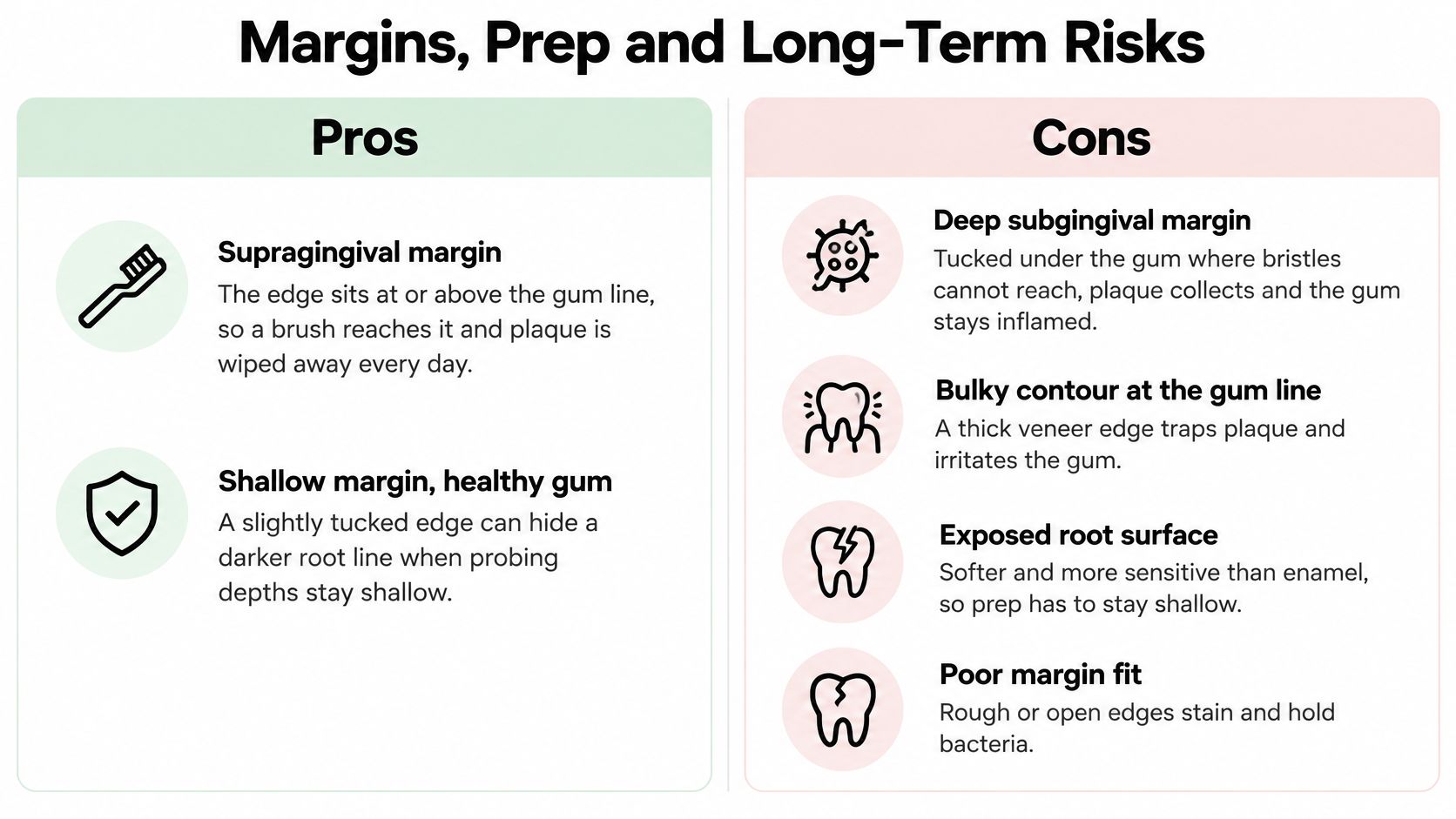
The margin is the edge where the veneer meets the tooth, and it decides whether plaque can be brushed away or whether it settles in for the long term. A margin placed under the gum, or a bulky contour at the gum line, traps plaque against tissue that is already receding.
A clinical study comparing prepared and unprepared porcelain veneers found that the position and protrusion of the gingival margin influenced periodontal effects, and subgingival margins were considered potentially harmful to periodontal health (PMC). Slight gingival inflammation appeared within two years in 4 cases with unprepared veneers and 1 case with prepared veneers, a difference that was not statistically significant.
Why the margin decides the outcome
A toothbrush can reach a supragingival edge. It cannot reach an edge buried 2 mm under the gum, and neither can floss. The result is a slow accumulation of biofilm exactly where the tissue is most fragile.
Contour matters just as much as position. An over-contoured cervical profile creates a shelf where plaque collects and the gum stays irritated. A well-shaped emergence profile lets the brush glide from tooth to gum without a catch.
The four mechanisms behind the risk
- Subgingival margin placement. Tucking the edge under the gum hides a dark root line but removes it from daily cleaning.
- Overcontoured cervical profile. A thick edge at the gum line traps plaque and inflames the margin.
- Microleakage at the cervical edge. The cervical region is vulnerable to leakage, and a rough or open seam stains and holds bacteria.
- Cement left behind. Unremoved bonding cement acts as a plaque trap and irritates the tissue until it's polished away.
Published figures give context rather than a personal probability. A review summarized one long-term evaluation in which gingival recession was present around 27% of assessed porcelain laminate veneers, while another cited study reported recession in 7.7% of treated teeth (review summary). The gap between those two numbers reflects study design, patient selection and follow-up length, not two different versions of the same risk.
A five-year retrospective of 28 patients with six-to-ten-unit E-max cases reported no recession at 96.4% of evaluated sites and healthy gingival status without bleeding in 64.3% of patients, while a systematic review of preparation and cementation methods put five-year success between 85.08% and 97.5% (five-year veneer review).
| Finding | Figure reported | Study design and size |
|---|---|---|
| Recession present around assessed porcelain laminate veneers | About 27% of assessed veneers | One long-term evaluation summarized in a review |
| Recession in treated teeth | 7.7% | Another cited study in the same review |
| No recession at evaluated sites | 96.4% of sites | Five-year retrospective, 28 patients, E-max veneers, 6-10 units |
| Healthy gingival status, no bleeding | 64.3% of patients | Same five-year retrospective, 28 patients |
| Slight gingival inflammation within 2 years | 4 unprepared vs 1 prepared case, p = 0.342 | Clinical study of prepared and unprepared porcelain veneers |
| Five-year veneer success across methods | 85.08% to 97.5% | Systematic review of preparation and cementation methods |
The planning rule that follows
A minimal amount of enamel is removed to make space for veneers, and that removal has to be balanced against a clean, inspectable finish line. One clinical protocol described approximately 0.4 to 0.6 mm of facial reduction and a 0.3 to 0.5 mm cervical shoulder, with exact dimensions individualized to material, occlusion, tooth position and remaining enamel (PMC). If you've wondered how much enamel is removed for veneers, those are the numbers behind the answer.
From there the rule is simple: a supragingival or carefully controlled equigingival margin wherever the tissue allows, a polished finish line, and cleanability verified before preparation begins. Existing recession, thin gum tissue, brushing trauma, periodontal disease, contour and home hygiene are the factors that decide how much margin room is available.
How Treatment Works When Gums Have Receded
The sequence changes when recession is on the chart, because the gum work comes before the cosmetic work rather than after it.
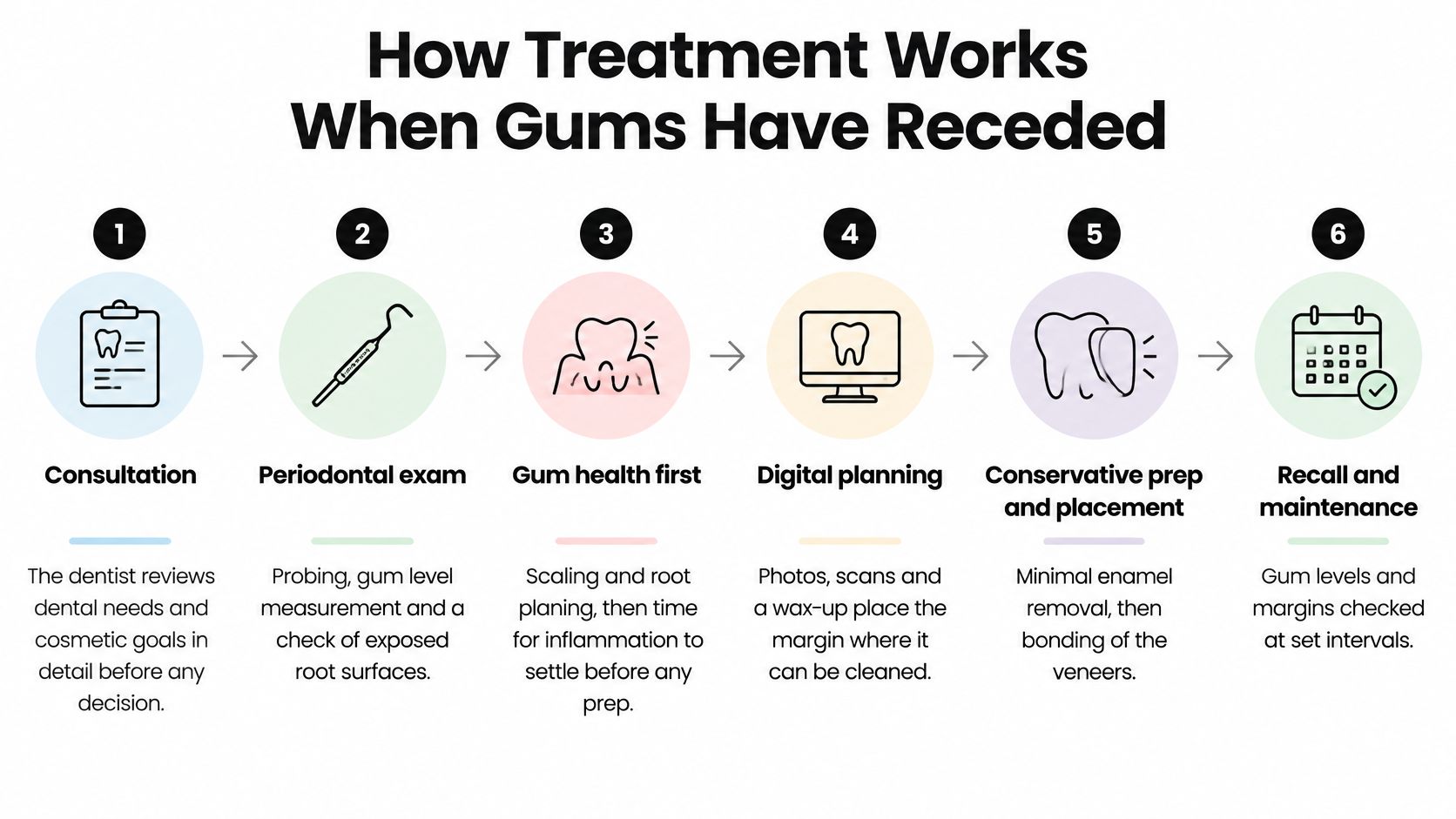
- Consultation. Veneer treatment starts with a detailed consultation to assess the patient's dental needs and cosmetic goals. Skipping straight to shade selection is the common slip here, because the shade is the least important decision in a receding mouth.
- Periodontal exam. Probing, gum-level measurement and a check of exposed root surfaces establish the baseline. A dentist who doesn't probe can't tell a stable 2 mm from a moving 2 mm.
- Digital X-rays and photographs. These plan both the margin and the smile, and they catch decay near the gum line that a visual exam misses.
- Gum stabilization when needed. Therapy or root coverage comes first, followed by healing time before any preparation. Rushing this step places margins on inflamed tissue and undoes the work.
Here is what the clinical sequence looks like from the patient's side.
- Conservative preparation. A minimal amount of enamel is removed, and the margin is placed where it can be cleaned. Over-reducing the tooth to chase a brighter result is the mistake that turns a reversible case into a sensitive one.
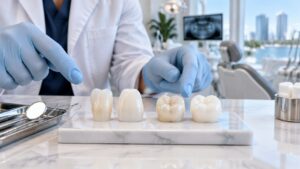
- Impressions. An impression of the teeth is taken and used to custom-make the veneers.
- Placement and bonding. Once the veneers are ready, they are carefully placed, adjusted and bonded to the teeth.
- Bite and gum-fit review, then maintenance. The bite check is where rushed appointments cause trouble later. A high spot on a new veneer produces sensitivity and clenching within weeks, so it gets adjusted before the patient leaves.
A successful result looks unremarkable in the best way: a comfortable bite, a gum line that's easy to clean around, and a smile that matches the plan discussed at the consultation rather than a photograph from a magazine.
Keeping Veneers and Gums Healthy Over Time
Daily care decides whether the margin stays clean. After veneer placement, patients receive guidance on maintaining their veneers, including brushing and flossing techniques, and the technique matters more than the effort. A soft-bristle brush with low-abrasion toothpaste, moved in small circles along the gum line, cleans without wearing the exposed root.
Interdental cleaning follows the same principle. Floss should slide between the teeth and hug each surface without snapping down onto the gum, and interdental brushes sized to the gap do the job faster around bridgework and tight contacts.
Habits that protect both
Veneer patients are advised to avoid biting on hard objects or using their teeth as tools, and that includes ice, pen caps and packaging. Veneer patients are also advised to avoid substances that stain veneers, such as coffee, tea or tobacco, which matters more when a margin sits close to the visible gum line.
A restoration gets one good day in the chair. The next ten years are decided at the sink.
Routine dental check-ups are used to monitor veneers and overall oral health, with professional periodontal reviews scheduled according to gum status rather than a fixed calendar. A patient with stable recession may need a review every six months. A patient with thin tissue and a history of inflammation may need closer intervals.
Warning signs to report promptly
- Bleeding when brushing, which signals inflammation that can be treated early.
- New sensitivity to cold or sweet, often the first sign that a root surface is more exposed.
- A visible edge at the gum line, meaning the margin has become exposed.
- A chip or a loose veneer, which needs assessment before the tooth underneath is affected.
Maintenance, not the one-time procedure, decides the long-term result, and patients with recession need a monitoring plan for exposed tissue and root areas rather than a single cosmetic appointment.
Book a Gum Check Before You Choose Veneers
For those seeking a cosmetic dentist near me or a dentist in Miami, FL, the first appointment should be a gum check rather than a veneer consultation. Contact Ultra Smile DentalSpa through its website at ultrasmilemiami.com to request a consultation at the Downtown Miami, Midtown Miami or Hallandale Beach location.
Bring a short list of any bleeding or sensitivity noticed while brushing, a few photographs of the smile at rest and smiling, dental history, current medications, and any questions about alternatives such as bonding, alignment or grafting. The visit runs in order: periodontal exam, digital X-rays, gum measurements, and a treatment plan that compares veneers with gum therapy and other options, including a clear answer on whether veneers should wait.
Sore gums in the days before an appointment are worth mentioning too, and a Peroxyl rinse for sore gums from Vitamin Planet is a commonly used over-the-counter option while waiting to be seen.
Book the gum check first, so the veneer decision rests on a verified plan rather than a guess about how much recession is too much.
Ultra Smile DentalSpa approaches veneers with a periodontal exam, digital X-rays and gum measurements before any cosmetic planning, so patients with receding gums get an answer built on their own tissue rather than a general rule. If you've been told that recession rules out porcelain, request an evaluation and find out whether gum therapy, a graft or a carefully placed margin is the right path for your smile. Visit Ultra Smile DentalSpa to schedule a consultation in Downtown Miami, Midtown Miami or Hallandale Beach.