One dental implant can replace two adjacent missing teeth in carefully selected cases, with front-tooth studies reporting implant survival between 96.6% and 100%, though this approach doesn't fit every mouth. Whether a single post works safely depends on your bite force, jawbone volume, and the exact width of the gap.
Why do so many adults assume that cutting the number of implants in half automatically cuts long-term risk and expense in half? When you're dealing with chewing discomfort, shifting neighboring teeth, or self-consciousness about a visible gap, searching for dental implants near me in Miami, FL often turns up quick promises that leave out the physics.
Replacing two missing teeth on one post creates a mechanical load trade-off and a shared maintenance routine that two separate implants don't face. Understanding how that design behaves before committing to surgery helps you have a sharper, more honest conversation with a trusted dentist near me so your restoration holds up for years.
Table of Contents
- Can One Implant Replace Two Teeth?
- Who Should Choose One Implant and What Shifts the Decision
- One Implant Versus Two Implants at a Glance
- How a Cantilever Bridge Is Built on One Implant
- Caring for a Shared Restoration Over Time
- Frequently Asked Questions About One Implant for Two Teeth
- Book Your One-Implant Consultation in Miami
Can One Implant Replace Two Teeth?
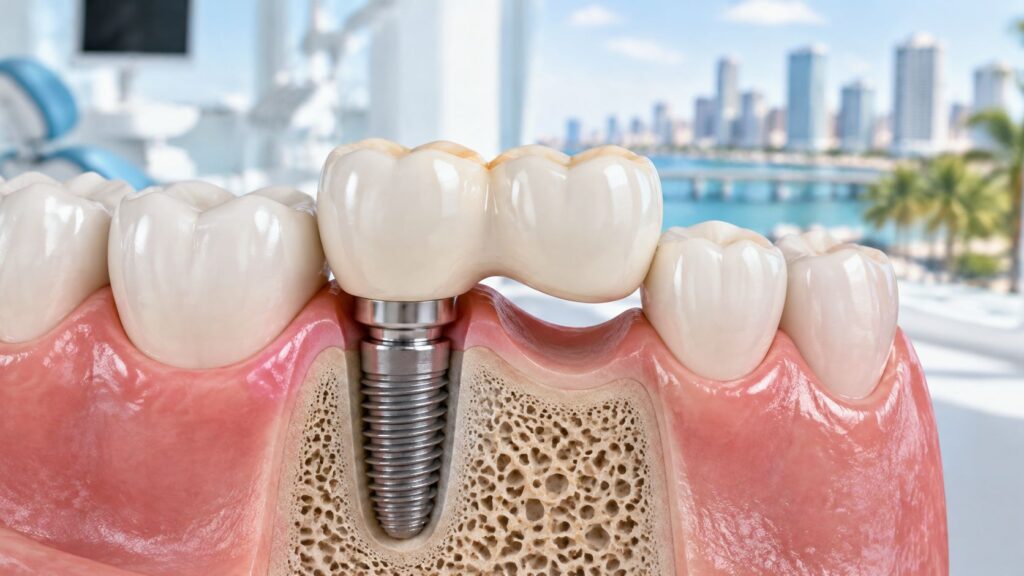
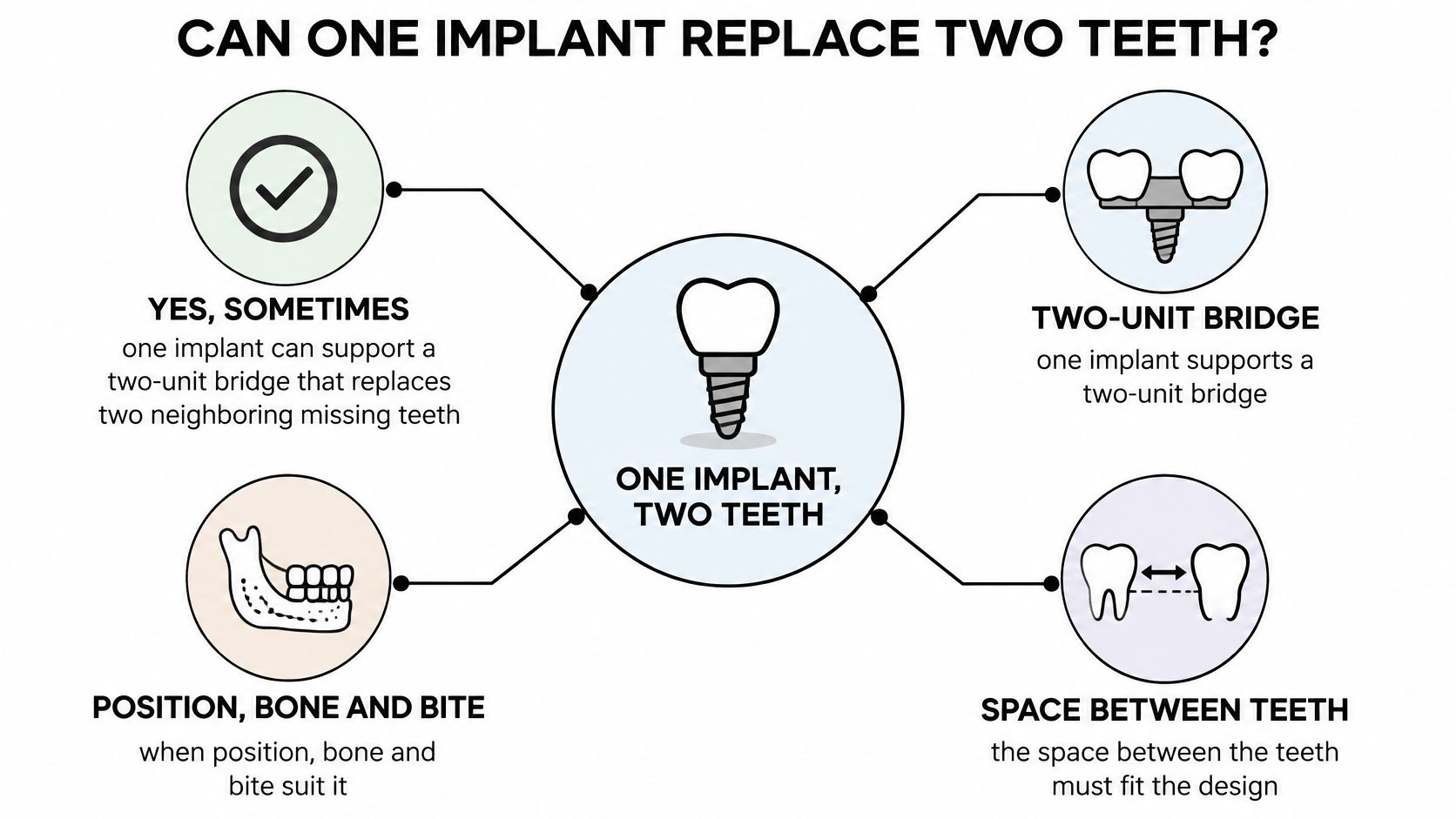
Yes, sometimes. One implant for two teeth works when a single titanium post supports a connected two-unit fixed bridge, provided the gap's location, bone density, and bite pattern can handle the design.
In this setup, the implant replaces the root of one missing tooth while the second crown extends beside it as a cantilever with no separate post underneath. Because the two crowns are fused into one piece, they move, chew, and take pressure together instead of acting like independent natural teeth.
The diagram below outlines the four clinical conditions that determine when a single post can hold a two-unit bridge.
How the Diving Board Effect Works
Picture a diving board bolted securely to a pool deck at one end while the other end hangs freely over the water. Standing right above the bolts puts straight downward pressure on the anchor, which handles weight easily. Walking out toward the free tip bends the board, increasing the force on those same bolts and the concrete around them.
A cantilevered crown behaves just like that free tip. Every time your opposing teeth press against the unsupported crown, sideways and tipping forces travel back through the connector into the single implant and the crestal bone holding it in place.
A single-implant cantilever isn't a shortcut around standard implant care. It's a targeted anatomical solution for tight spaces where two posts simply won't fit safely side by side.
Where Evidence Supports This Design
Dentists consider this design most often in the front of the mouth, especially when an upper central and lateral incisor are missing and the space between neighboring roots is too tight for two separate implants. In a systematic review and five-year prospective comparison published in the Journal of Oral Rehabilitation, single-implant two-unit restorations in the esthetic zone showed 96.6% to 100% implant survival, making the approach a viable alternative when narrow mesiodistal space, anatomical limits, or a goal of fewer surgeries favors one fixture.
That same review stresses that favorable survival rates don't make a single post a universal substitute for two implants. Planners still have to evaluate bone volume, crown-to-implant ratio, bite contacts during side-to-side jaw movement, and cantilever length, because nonaxial contacts raise bending forces and leave the bridge open to screw loosening, ceramic fracture, or bone loss over time.
Sample size matters too. A five-year comparative pilot study from the University of Groningen tracked bone levels, gum probing depth, papilla shape, and patient satisfaction in front-tooth cases, yet it compared only five patients with a single-implant cantilever against five patients with two separate implants. Five cases per group show what's possible in ideal front gaps, not what works for every mouth or molar space.
No photo or phone description can measure bone thickness or bite pressure. For adults searching for a dentist in Miami, FL, settling whether one post can safely carry two crowns starts with an in-person exam and dental X-rays.
Who Should Choose One Implant and What Shifts the Decision
Choosing between one post and two comes down to one clear trade-off: fewer surgical sites now versus heavier mechanical strain on a single anchor later. Pushing chewing weight out onto a cantilevered crown multiplies the lever arm acting on the implant neck and surrounding bone.
Back teeth prove why that lever arm matters. In a randomized five-year clinical trial reported in Clinical and Experimental Dental Research, researchers followed 36 patients missing two adjacent back teeth who received either one 6-mm implant with a cantilever or two 6-mm implants. Both groups ended five years with similar clinical and radiographic measurements, yet failures in the cantilever group tended to happen earlier, a pattern consistent with mechanical overload.
Broader bridge outcomes add another layer of caution. A review indexed on PubMed examining implant-supported cantilever fixed partial dentures found a five-year prosthesis survival range of 89.9% to 92.7%, with a weighted mean of 91.9%, and identified implant fracture as the primary cause of failure across reviewed studies.
Patient Factors That Shift the Plan
No single trait automatically disqualifies a patient from a single-implant bridge, yet stacking multiple risk factors quickly tilts the safer choice toward two separate posts. During an evaluation, your dentist checks side-to-side jaw movements to keep heavy excursive contacts off the cantilevered tooth while weighing the factors below.
| Patient Factor | Why It Matters | Effect on One-Implant Plan |
|---|---|---|
| Teeth grinding or clenching | Adds repeated force to the single implant | Often favors two implants or a night guard |
| Strong bite force at back teeth | Greater bending load on one post | Usually favors two implants |
| Thin or low bone at the site | Less support for a single implant | Needs bone assessment before choosing |
| Smoking | Slows healing and raises bone loss risk | Calls for extra caution and planning |
| Difficulty cleaning around teeth | Connected crowns are harder to maintain | Needs strict hygiene plan |
| Narrow space between teeth | Two implants may not fit comfortably | Favors one implant |
If you want to weigh how implants stack up alongside bridges and partial dentures before your appointment, reviewing the full range of options for replacing missing teeth helps clarify which restoration matches your gap and bone health.
When a Single Implant Fits Best
A one-implant cantilever earns strong consideration when a patient checks most of these clinical boxes:
- Two adjacent missing teeth: The gap spans exactly two neighboring teeth rather than three or more, keeping the lever arm short and predictable.
- Tight space or anatomical constraints: Placing two posts side by side would crowd neighboring roots or pinch the gum papilla between front crowns, reducing natural appearance.
- Solid bone volume at the anchor site: Dense, tall jawbone gives the single fixture primary stability from day one.
- Desire for one surgical site: Patients hoping to limit oral surgery benefit when their anatomy already supports a single post.
- Calm, balanced bite without heavy grinding: Light front-tooth contacts without bruxism protect the implant-abutment screw from fatigue.
Even with those boxes checked, evidence doesn't prove that one post is always better, cheaper, or safer than two. A systematic review in Clinical Oral Implants Research noted that direct evidence for a single implant carrying a two-unit cantilever remained insufficient in some analyses to draw firm conclusions, while newer reviews still report tendencies toward slightly lower survival and greater marginal bone loss in cantilever groups.
For patients who clench or grind at night, wearing a custom night guard made from an exact impression of the upper or lower teeth cushions repetitive force after restoration. Anyone experiencing sudden pain, facial swelling, dental trauma, or active infection should see an emergency dentist to stabilize the site before mapping out implants. Final candidacy always requires an in-person exam, dental X-rays, and three-dimensional imaging when nerve pathways, sinuses, or thin ridges need a closer look.
One Implant Versus Two Implants at a Glance
Putting both plans side by side strips away the guesswork. While the visible crowns can look nearly identical in a mirror, the support underneath changes how your mouth handles pressure, daily cleaning, and future repairs.
| Factor | One Implant (Cantilever Bridge) | Two Implants (Separate Crowns) |
|---|---|---|
| Implants placed | 1 | 2 |
| Surgical sites | 1 | 2 |
| Reported survival in studies | 96.9% (mean follow-up 3.4 years) | 97.6% (mean follow-up 3.0 years) |
| Load on each implant | Higher, due to the cantilever lever arm | Shared across two posts |
| Best fit | Narrow space, limited bone, front teeth | Heavy bite, back teeth, strong bone |
| Hygiene access | Requires special tools under the shared crown | Separate crowns, usually simpler to clean under |
| Effect of a problem | One issue can affect both teeth | Problems usually limited to one crown |
| Main risk to watch | Overload, screw loosening, bone loss | Standard implant maintenance |
Look closely at the survival row first. In a systematic review and prospective comparative study published by the University of Groningen focusing on upper front teeth, single-implant cantilevers reached 96.9% implant survival over a mean follow-up of 3.4 years, compared with 97.6% for two adjacent implants over 3.0 years. That narrow gap wasn't statistically significant (p = .79), which tells you something practical: survival percentages alone shouldn't dictate your plan.
What separates the two columns in everyday life is how they handle wear and repairs. Because one post absorbs every pound of chewing force across two joined crowns, any mechanical hiccup, whether a loose abutment screw, chipped ceramic, or bone loss around the post, affects both teeth at once. Separate implants isolate those events so repairing one crown leaves the neighboring tooth untouched.
Daily flossing behaves differently too. Two independent crowns let standard floss slide straight between the teeth down to the gumline, whereas a fused cantilever blocks normal flossing at the connector and requires threading beneath the suspended crown.
Rule of thumb: One implant suits tight front-tooth spaces and patients hoping to limit surgical sites, while two implants suit heavy chewing forces, back teeth, and anyone seeking the widest mechanical safety margin.
How Non-Implant Alternatives Compare
Implants aren't the only way to close a two-tooth gap, and comparing them against non-implant restorative dentistry options keeps expectations grounded:
- Traditional three-unit or four-unit bridge: Cemented bridges prevent remaining teeth from shifting, yet they require reshaping healthy natural teeth on both sides of the gap to serve as anchors.
- Removable partial denture: A clasp-retained partial avoids oral surgery altogether, though it must come out daily for soaking and cleaning and doesn't stimulate the jawbone underneath.
- Coordinated cosmetic care: Patients pairing front-tooth replacement with teeth whitening or consulting a cosmetic dentist near me usually brighten natural enamel first so the new porcelain crowns match the lighter shade permanently.
Treat the comparison table as a conversation starter with your dentist, not a final verdict. Because published data don't confirm that a single-implant bridge costs less over its lifetime than two separate implants, ask for itemized written estimates comparing both paths before deciding on price alone.
How a Cantilever Bridge Is Built on One Implant
Knowing each appointment ahead of time takes the mystery out of implant surgery and explains why careful healing can't be rushed. A dental implant begins with a titanium post placed in the jawbone, followed by a healing phase of several months, and then a custom-made crown is attached to the post.
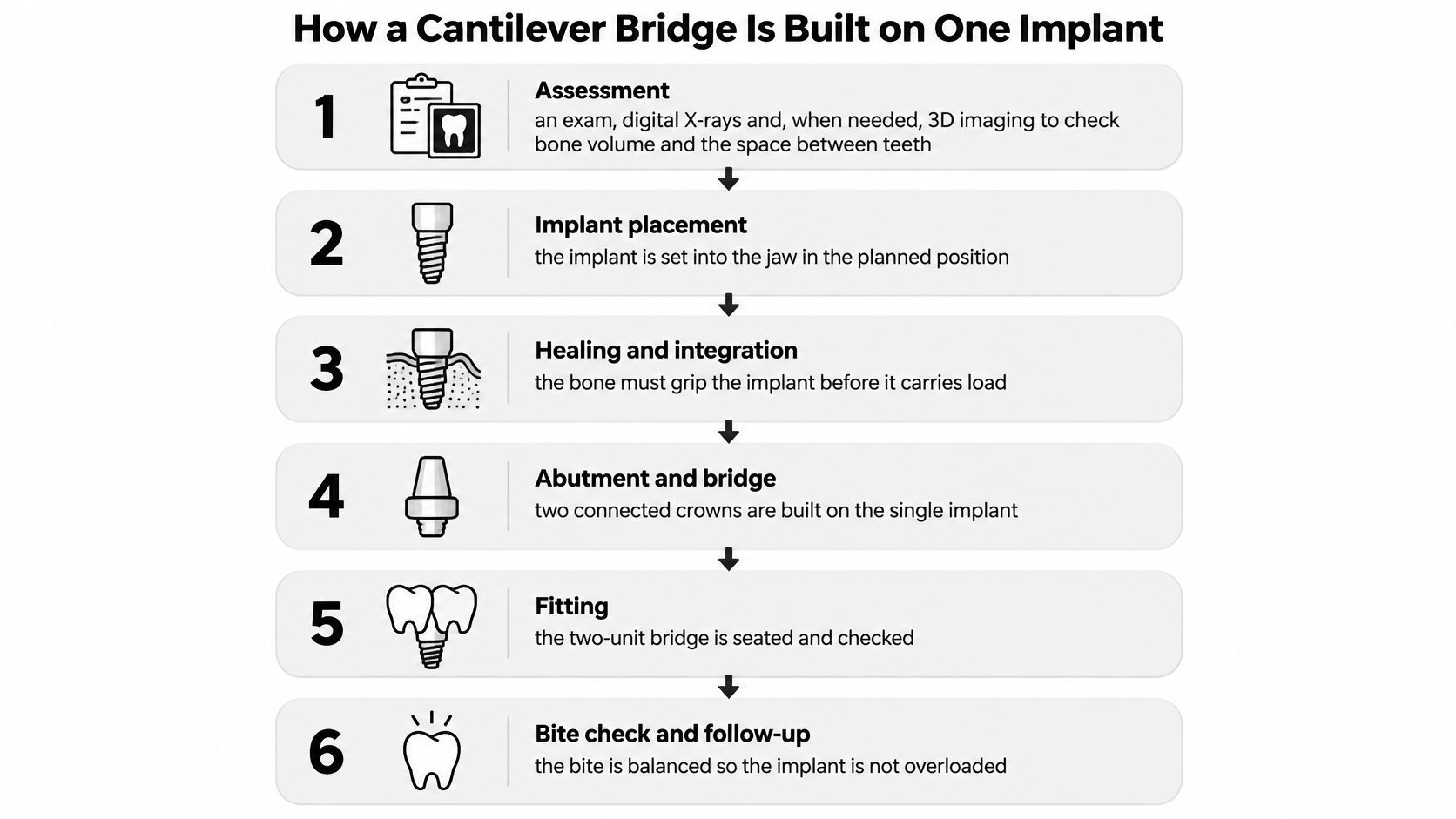
The visual guide below maps out how your dentist moves from initial diagnostics to a balanced, two-unit bite.
Five Stages From First Scan to Final Bite
- Assessment and imaging: Your dentist performs a complete oral exam alongside dental X-rays and, when bone width or nerve proximity requires extra precision, a 3D CBCT scan. This visit confirms bone height, measures the gap between neighboring roots, and checks whether a damaged tooth needs a gentle tooth extraction or bone graft before placement.
- Implant placement: Under local anesthesia, the dentist positions the single titanium post into the planned anchor spot in the jawbone. Most patients feel steady pressure rather than sharp pain, and precise angulation at this stage keeps future lever forces as close to vertical as possible.
- Healing and bone integration: Over the next several months, your jawbone grows tightly around the titanium surface in a biological bond called osseointegration. Waiting until that lock is solid prevents early movement, which is the fastest way an overloaded implant loses stability.
- Abutment connection and bridge fitting: Once healing checks out, the dentist attaches a connector piece called an abutment to the implant and seats the custom-crafted two-unit bridge. One crown screws or cements onto the post while its joined neighbor extends neatly into the adjacent space, shaped so gum tissue looks natural and both crowns act as one unified structure.
- Bite balancing and ongoing maintenance: Before you leave, the dentist marks your bite with thin articulating paper while you tap and slide your jaw side to side, smoothing any high spots on the cantilevered crown so heavy sideways pressure never hits the free tip. Follow-up checkups then track gum health, screw tightness, and bone stability over time.
Watching how a cantilevered implant bridge sits over a single fixture helps make those steps concrete.
Timeline and What Shapes Your Estimate
Expect the full journey from consultation to final bridge to span several months rather than a single week, with the bone-healing window standing as the longest wait. Rushing that stage puts the entire two-tooth restoration at risk.
Total fees vary from patient to patient based on diagnostic scans, the implant post and abutment, custom ceramic lab work for two joined crowns, any temporary tooth worn during healing, and whether a bone graft is required to build up thin bone. Request an itemized written estimate breaking down each stage, and check how your dental insurance benefits or monthly payment plans apply before scheduling surgery.
Caring for a Shared Restoration Over Time
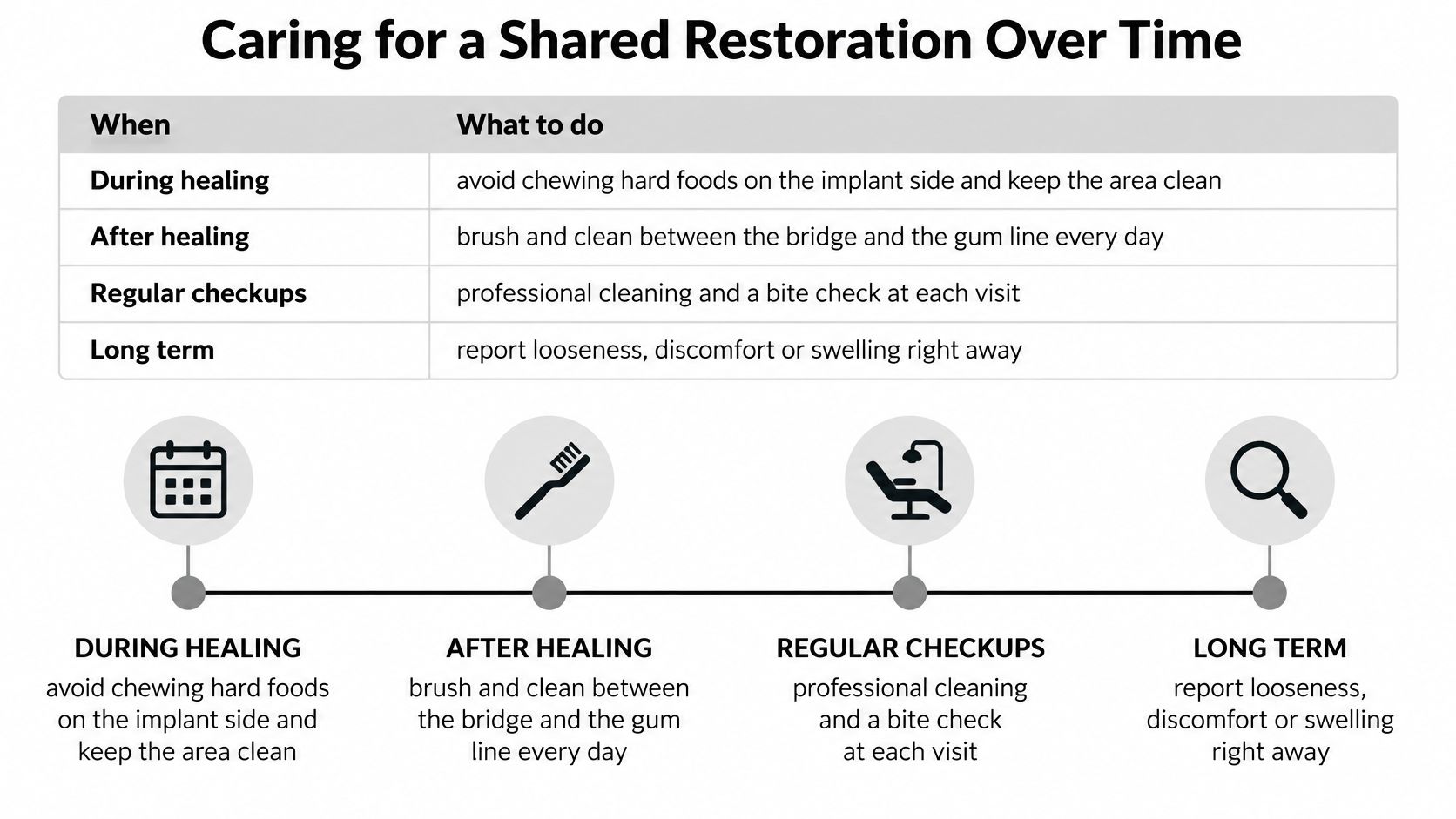
Putting the bridge in place is only half the work; keeping the gum seal tight around a single post carrying two crowns determines how smoothly it ages. Follow this stage-by-stage schedule so plaque and uneven pressure never get a head start.
| When | What to Do | Why It Matters |
|---|---|---|
| First 1-2 weeks | Eat soft foods, clean gently near the site | Protects the healing area |
| Healing period, about 3-6 months | Avoid hard chewing on the implant side | Lets the bone bond to the post |
| Daily after the bridge is fitted | Clean under the connection with floss threader, interdental brush or water flosser | Prevents gum inflammation at the connection |
| Every 6 months | Professional cleaning and gum check | Catches early problems |
| Yearly or as advised | X-rays of the bone around the implant | Tracks bone levels over time |
This care timeline summarizes how daily habits shift from initial surgical healing into long-term maintenance.
Why Daily Tools Go Beyond a Toothbrush
A 2024 meta-analysis discussed in Clinical Case Reports noted that single-implant cantilever restorations didn't show lower implant survival than two implants supporting individual crowns, yet survival figures alone leave out maintenance appointments, prosthetic repairs, and the day-to-day effort of keeping a shared bridge clean. While some single-implant designs give easier finger access than tight bridges anchored on two implants, standard brushing still can't sweep plaque out from beneath the joined pontic.
Slipping Super Floss or a floss threader under the cantilevered crown once a day clears food debris where the porcelain meets the gumline. Pairing that routine with a soft interdental brush or a Waterpik water flosser flushes the tight underside cleanly without scratching titanium or porcelain. For step-by-step demonstrations of brushes, threaders, and gentle polishing motions, review this guide on how to clean dental implants.
Professional cleaning and exams every six months protect what home tools can't see. Hygienists use implant-safe instruments to clear hardened tartar, check gum pockets for early inflammation, and verify that your bite hasn't shifted onto the cantilever tip. Clinical cleanliness matters on both sides of the chair: just as the infection-control standards outlined in Arelli Cleaning's dental practice cleaning safety guide safeguard patients during routine visits, steady daily care keeps bacteria from threatening the bone around your post.
Warning Signs and Questions to Ask Before Consenting
Because both replacement teeth depend on one fixture, small changes deserve quick attention rather than a wait-and-see approach. Call your dental office right away if you notice any wiggle or movement in the bridge, bleeding or swollen gums around the post, sharp pain when biting down, or a tiny chip along the porcelain edge.
Before signing a treatment plan, bring four direct questions to your consultation:
- Removability for maintenance: Can the dentist unscrew and remove the two-unit bridge if the tissue underneath ever needs deep cleaning or a screw needs tightening?
- Repair and replacement fees: What do common adjustments, porcelain repairs, or a replacement crown typically cost if wear happens years later?
- Nighttime bite protection: Would wearing a custom night guard extend the life of the post and connector?
- Backup plan if the post fails: If bone loss or overload ever compromises the single implant, what are the next clinical steps and recovery timeline?
Plan for slightly closer upkeep than two independent crowns require. Catching a loose screw or minor bite shift at a routine checkup costs far less than rebuilding a fractured bridge.
Frequently Asked Questions About One Implant for Two Teeth
Patients researching tooth replacement online frequently run into overlapping terms like cantilever bridge, implant bridge, and single-tooth implant, a search habit highlighted in AISEOGrow's dental keyword guide when mapping how people look up local care. Straightforward clinical answers cut through that terminology before you step into the exam room.
Does Placing the Implant Hurt?
Implant placement is performed under local anesthesia so the surgical site stays thoroughly numb throughout the visit. Most patients report mild soreness or tenderness for a few days afterward, which is typically manageable with the written comfort plan and over-the-counter or prescribed guidance your dentist reviews ahead of time.
How Long Does a One-Implant Bridge Last?
Multi-year implant survival in carefully selected front-tooth cases is high, while broader five-year data for cantilevered bridges run somewhat lower because of added stress on the connector and post. No dental restoration carries a lifetime guarantee, so consistent home flossing, six-month checkups, and keeping heavy biting off the free crown play a major role in longevity.
What Happens if the Implant Fails?
If a single implant loosens or loses bone support, both connected crowns come out together because they share that anchor. Your dentist evaluates why the failure occurred, measures the remaining jawbone, and walks through recovery options, which often include bone grafting and placing a replacement implant or two separate implants once the area heals.
Is the Treatment Covered by Dental Insurance?
Dental insurance coverage for implants, abutments, and bridges differs widely by policy, annual maximum, and missing-tooth clauses. Before you commit to a plan, the coordinators at Ultra Smile DentalSpa verify your specific benefits, explain expected out-of-pocket portions clearly, and review payment options for uninsured care.
What Should You Do if Your Bridge Feels Loose or Breaks?
Contact your dental office promptly rather than trying to glue or snap the piece back into place yourself. A tiny amount of movement lets chewing forces hammer the internal abutment screw, turning a quick re-tightening into a fracture. Patients in Miami, FL can schedule an urgent evaluation with an emergency dentist to protect the implant before further damage develops.
Book Your One-Implant Consultation in Miami
Deciding whether one implant for two teeth belongs in your mouth shouldn't hinge on guesswork or generic averages. During new patient exams, your dentist performs a thorough clinical evaluation, captures digital X-rays, orders 3D imaging when bone thickness or sinus anatomy needs closer mapping, and checks gum health alongside how your teeth meet in every jaw motion.
From those measurements, you receive a clear, written comparison of a one-implant cantilever bridge versus two separate implants, complete with honest mechanical trade-offs, stage-by-stage timelines, and transparent estimates. Every comfort detail is reviewed upfront, from digital imaging and local anesthesia during placement to a personalized post-visit comfort plan, and the team welcomes every question about the technology used before you say yes to treatment.
Ultra Smile DentalSpa serves patients across Downtown Miami, Midtown Miami, and nearby Hallandale Beach from two convenient Miami offices in Downtown Miami and Midtown Miami. Beyond implants and bone grafts, the practice provides crowns and bridges, night guards, wisdom teeth extraction, dental cleaning, general dentistry, composite fillings, partials and dentures, root canals, cosmetic dentistry, veneers, invisible braces, teeth whitening, injectables and fillers, and prompt visits for urgent dental pain.
Clear communication starts at the front desk, especially in a diverse city like Miami where bilingual teams and specialized tools such as rednea's multilingual reception support for dental offices help patients ask questions and schedule dental care in the language they prefer. Bringing a few basics to your consultation makes the appointment even more productive:
- Current medication list: Note all prescriptions, vitamins, and blood thinners so surgical planning stays safe.
- Previous dental X-rays: Recent films from a past dentist help show how your bone levels have changed over time.
- Written questions: Bring your questions about cleaning tools, healing milestones, insurance coverage, and comparing one implant against two.
Replacing two neighboring missing teeth deserves a plan built around your exact bone structure, bite forces, and long-term comfort rather than a one-size-fits-all pitch. With two Miami offices in Downtown Miami and Midtown Miami offering digital diagnostics, implant-supported restorations, custom night guards, and gentle spa-inspired care, Ultra Smile DentalSpa walks you through one-implant and two-implant choices with complete transparency. Schedule your personalized consultation today by visiting Ultra Smile DentalSpa to find the safest, longest-lasting path back to a confident smile.