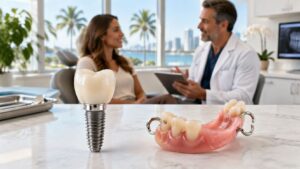
For planning, use national benchmarks rather than a Miami headline price: roughly $1,000 to $3,500 for one crown and about $3,000 to $6,000 for a conventional three-unit bridge before insurance. The number that matters is the all-in estimate after units, material, preliminary treatment, and the plan's annual maximum are counted, placed next to the price of each material so like is compared with like.
A search for a dentist near me can make a crown fee look simple. The plan may also include an exam, dental X-rays, decay removal under an old filling, a core buildup, or care for a painful nerve. A higher written estimate can mean those steps were included, so compare complete plans tooth by tooth.
Table of Contents
- Dental Crowns and Bridges Cost in Miami, FL
- Materials Same-Day Crowns and Added Treatment
- How Insurance and Add-Ons Change Your Bill
- Financing Options for Crowns and Bridges
- What to Expect at Your Miami Visit
- Get a Written Estimate Before You Book
Dental Crowns and Bridges Cost in Miami, FL
For planning before a first visit, national benchmarks give patients a realistic frame. In U.S. private-practice settings, an individual crown commonly costs approximately $1,000 to $3,500 before insurance, while a conventional three-unit bridge may cost about $3,000 to $6,000, according to Persistence Market Research's dental crown and bridge market overview.
Those aren't Miami quotes from a specific practice. They're national planning bands that help a patient spot whether a local estimate needs more explanation. Material, laboratory work, preparation complexity, and added treatment can move a fee inside or outside the range. A dentist in Miami, FL should be able to explain, in writing, which of those factors applies to a particular tooth.
A second national benchmark shows why bridge estimates vary so widely. In 2024, CareCredit's Cost Study reported a U.S. national average of $5,197 for a traditional dental bridge, with a range of $4,100 to $9,650.
That range looks surprising until the restoration is broken into parts. A bridge isn't one false tooth sold on its own. It's usually a connected set of units, designed and made as one piece, and priced by the total number of units involved.
A Cap and a Span Are Different Jobs
The simplest distinction is this. A crown covers a tooth that's still present. A bridge fills a space where a tooth is missing.
The NHS guide to dental treatments describes a crown as a cap that completely covers a natural tooth, while a bridge is a fixed replacement for one or more missing teeth. Crowns may be made from metal, ceramic, or porcelain fused to metal, and bridges stay fixed in the mouth rather than coming out like a denture.
Crowns protect and strengthen teeth that can't be restored with fillings or other restorations, and they're ideal for teeth that have had root canal treatment, large fillings, or are severely worn or broken. Think of a molar with a large old filling and a cracked cusp. A filling patches part of the tooth. A crown wraps around what's left and holds it together under chewing pressure.
A crown answers the question, "Can this tooth be saved and protected?" A bridge answers a different question, "How should this gap be filled?"
Why One Missing Tooth Often Means Three Units
A traditional bridge for one missing tooth usually has three units. The tooth in front of the gap gets a crown, the tooth behind the gap gets a crown, and a solid replacement tooth, called a pontic, sits between them over the gum.
The two natural teeth are the abutments. They carry the chewing load for the whole span. That's why a bridge quote can't be read as a single-tooth fee, even though only one tooth is missing. The patient is paying for two prepared supporting teeth, one replacement tooth, the laboratory or digital design work, and the fitting of the full piece.
Bridges also prevent the remaining teeth from shifting into an empty space. That matters for the bite. When a back tooth is missing, neighboring teeth can tip, the opposing tooth can drift down or up, and food can pack into new gaps. Filling the space is partly cosmetic, but for back teeth it's mainly about stable chewing.
2026 Crown and Bridge Planning Ranges
The table below uses U.S. private-practice ranges only. It doesn't present a Miami per-material price band for any specific practice, because that kind of figure should come from a confirmed local fee schedule given after an exam.
| Restoration | U.S. private-practice range | What the fee usually includes |
|---|---|---|
| Porcelain-fused-to-metal crown | Often inside the $1,000 to $3,500 crown band | One custom cap, preparation, and cementation |
| All-ceramic or all-porcelain crown | Often inside the $1,000 to $3,500 crown band | One tooth-colored cap for a visible or chewing tooth |
| Zirconia crown | Often inside the $1,000 to $3,500 crown band | One high-strength ceramic cap |
| Any single crown, planning band | $1,000 to $3,500 | The crown itself, not exams, buildups, or root canals |
| Traditional three-unit bridge | $3,000 to $6,000 | Two abutment crowns plus one pontic |
Read the last column as carefully as the price column. The crown band covers the cap, its preparation, and cementation. It doesn't automatically include everything needed to make the tooth ready for that cap.
Charges That Sit Outside the Headline Fee
Patients comparing dental crowns and bridges cost estimates should ask whether each of these items is included or billed separately.
- Exam and dental x-rays: The diagnostic visit that confirms whether the tooth can hold a crown, or whether neighboring teeth can support a bridge.
- Core buildup: Added material that rebuilds a broken-down tooth so the crown has a strong shape to grip.
- Root canal treatment: Needed when the nerve is infected, inflamed, or too close to deep decay.
- Temporary crown: A short-term cover worn while a laboratory makes the final restoration.
- Tooth extraction: Removal of a hopeless tooth before a bridge or implant plan begins.
- Gum treatment: Care for inflamed or infected gum tissue around the tooth being restored.
An itemized estimate should separate the restoration, core buildup, endodontic treatment, temporary restoration, imaging, and any sedation or technology fees. Without that breakdown, two quotes for the "same crown" may not describe the same treatment at all.
Where Implants Fit Into the Conversation
A search for dental implants near me leads to a different cost structure. An implant doesn't use neighboring teeth for support. A post is placed in the jaw, and a crown is attached after healing.
Because of that, implant surgery, the connecting abutment, possible grafting, and the final tooth can each be billed separately. A fair comparison puts the full implant plan beside the full bridge plan, not beside a single crown fee.
Patients in Downtown Miami, Midtown Miami, and Hallandale Beach can use the same framework with any provider. Count the units first. Then list the preparatory treatment. Then apply insurance. The dental crowns and bridges cost becomes much easier to judge once those three steps stay in that order.
Materials Same-Day Crowns and Added Treatment
Material choice isn't only about color. It changes how a crown handles chewing force, how it wears, and how likely it is to chip. A front tooth and a back molar don't do the same job, so they don't always need the same material.
The infographic below pairs common materials with reported survival figures.
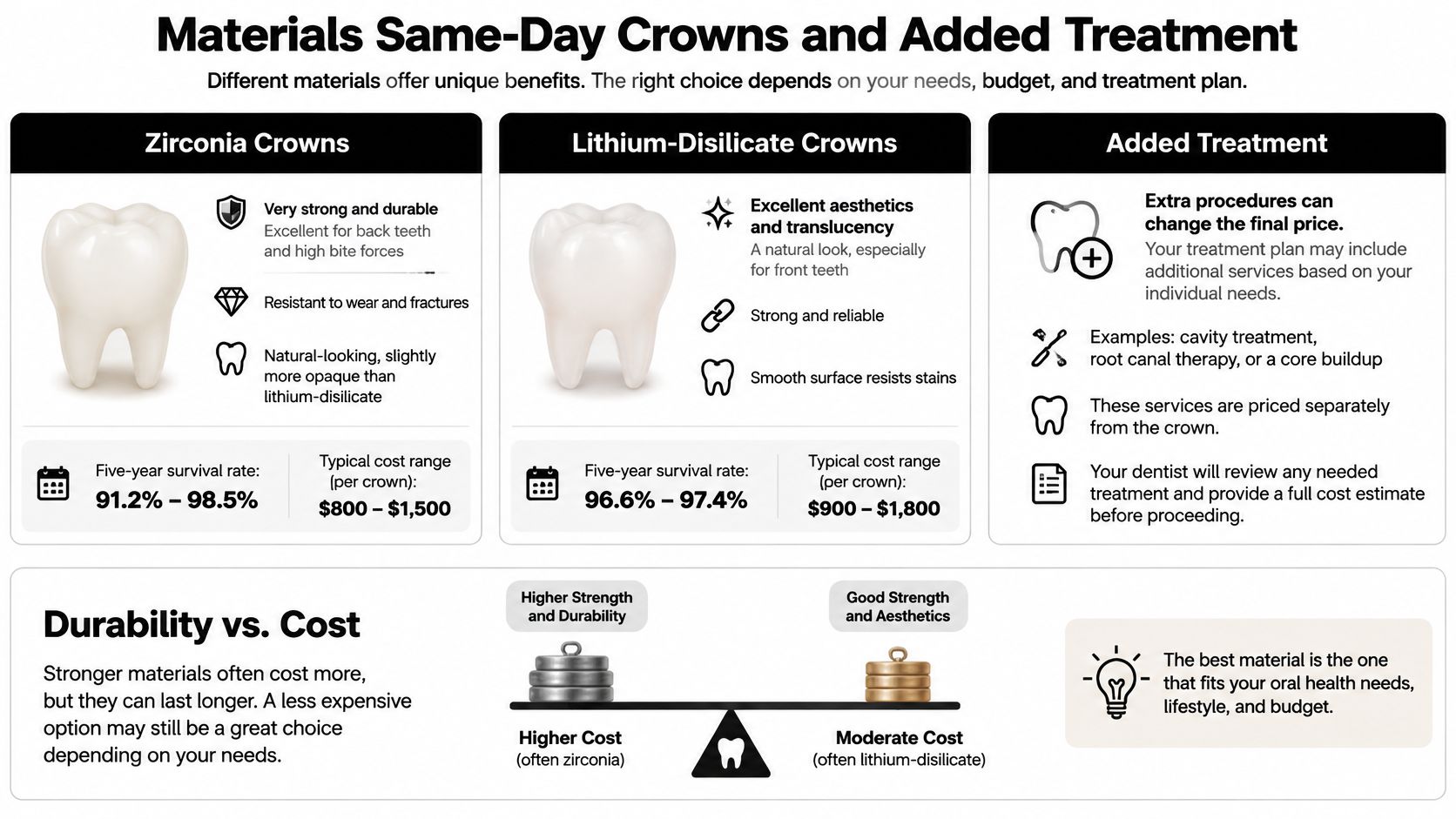
The American Dental Association's material data for indirect restorations reports five-year survival of roughly 91.2% to 98.5% for zirconia crowns, 96.6% to 97.4% for lithium-disilicate or leucite-reinforced ceramics, and approximately 97% for some metal-ceramic crowns. One zirconia dataset in that data shows about 67.2% survival at 10 years, and metal alloys have historically averaged about 18 to 20 years of service.
Reading Those Survival Numbers Calmly
Five-year success isn't a lifetime promise. It shows how restorations performed in the groups studied, under their chewing habits, hygiene, and follow-up care. A patient who clenches at night doesn't present the same risk as a patient with a light bite.
Location matters too. Front teeth usually need a tooth-colored ceramic that blends with the smile, which is one reason patients searching for a cosmetic dentist near me ask about all-ceramic options. Back molars can prioritize strength, since they take heavy chewing force and show less. Metal lasts well but is visible, so many patients accept it only on out-of-sight teeth.
One useful question is whether the ceramic is monolithic, meaning one solid piece, or layered, meaning porcelain baked over a core. Layered porcelain can look very natural, but the outer layer can chip. A solid piece removes that layered surface, which is often preferred where bite force is high. Patients comparing porcelain crowns versus metal crowns should ask that question before comparing prices.
Material Price and Durability at a Glance
| Material | Typical price before insurance | Survival and longevity context | Best fit |
|---|---|---|---|
| Full-metal crown | $600 to $1,000 (2024 market average) | Metal alloys average about 18 to 20 years of service | Out-of-sight molars; least natural look |
| Porcelain-fused-to-metal crown | $700 to $1,200 (2024 market average) | About 97% at five years for some metal-ceramic crowns | Teeth that need a strong core and tooth-colored outside; porcelain can chip |
| Ceramic crown | $800 to $1,500 (2024 market average) | About 96.6% to 97.4% at five years | Front teeth and premolars where color matters |
| Zirconia crown | Often inside the $1,000 to $3,500 crown band | About 91.2% to 98.5% at five years; about 67.2% at 10 years in one dataset | Molars and bridges that need strength |
The 2024 material averages in the table come from Dataintelo's dental crowns and bridges market report, which reported U.S. ceramic crowns averaging $800 to $1,500, porcelain-fused-to-metal crowns averaging $700 to $1,200, and full-metal crowns averaging $600 to $1,000. They're published market averages, not quotes for a specific Miami tooth.
Lab Crowns, Same-Day Crowns, and Add-Ons
A laboratory crown usually means a temporary crown and a second visit to cement the final piece. A same-day crown is designed and made in the office. Ultra Smile DentalSpa creates crowns and bridges with CEREC technology in one visit, without temporary solutions or multiple appointments, and provides same-day crowns to patients.
For busy Downtown and Midtown patients, fewer trips can matter. Same-day care doesn't remove the basics, though. The tooth underneath still needs to be sound, decay still needs to come out, and the gumline still needs daily cleaning afterward.
Practical rule: A lower sticker price that leaves out the lab work, the temporary, or decay under an old filling isn't a lower total. It's an incomplete quote.
Add-ons that commonly sit outside the crown fee include the exam and x-rays, a core buildup, a post after a root canal, gum treatment, tooth extraction of a hopeless tooth, and a night guard for clenching. A metal or plastic rod or post is often placed in the root canal to retain the core filling, which supports the restoration, usually a crown or filling. Each item should appear as its own line so the material price can be compared like with like.
How Insurance and Add-Ons Change Your Bill
Insurance helps with crowns and bridges, but it rarely pays the whole bill. The reason sits in how most plans sort dental care into tiers.
The chart below shows how those tiers and common add-ons combine.
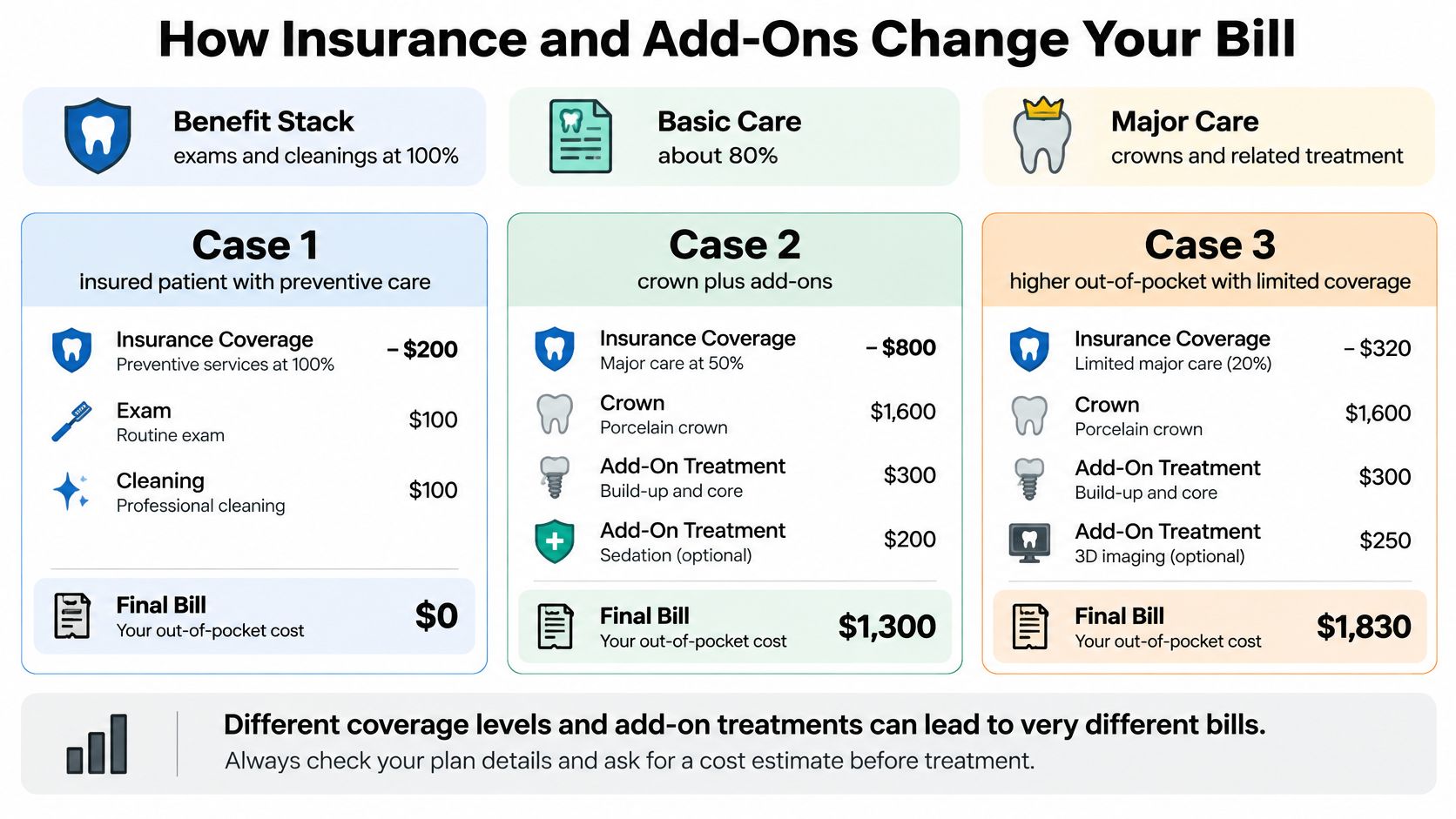
According to ADA News coverage of dental insurance, many plans cover preventive services such as examinations and cleanings at 100%, basic procedures at roughly 80%, and major procedures including crowns and bridges at about 50%. The ADA example also uses a $1,500 yearly limit as an annual maximum, after which the patient generally pays additional eligible costs.
The Benefit Stack in Plain Numbers
Start with a simple example. Say a zirconia crown costs $1,600, the deductible is already met, and the full annual maximum is still open. At 50%, the plan pays $800 and the patient owes $800. Clean arithmetic, no surprises.
Now apply the same plan to a bridge. Say a three-unit bridge costs $5,000. At 50%, the expected benefit would be $2,500. But a $1,500 annual maximum caps the plan's payment at $1,500. The patient then owes about $3,500, plus any deductible that hasn't been met.
That's the moment that's easy to misjudge. A bridge doesn't just cost more than a crown. It can also use up the entire year's benefit in one treatment, leaving later cleanings or fillings to be paid differently. Asking "what's my remaining maximum today?" matters as much as asking "what percentage does the plan pay?"
Why the Advertised Price Isn't the Exposure
GoodRx's guide to self-pay dental options places crowns at roughly $800 to $2,500 and bridges at about $1,000 to $5,000 per tooth, while noting that the final bill can also involve examinations, x-rays, buildup or core treatment, temporary restorations, root canal therapy, and periodontal treatment. A bridge can also consume the plan's annual maximum, leaving the patient responsible for the remainder.
That framing changes the right question. Instead of "what does a crown cost?", a more useful question is "what's the estimated all-in cost after the deductible, coinsurance, annual maximum, waiting period, and preliminary work?" A quote that excludes the laboratory fee, temporary crown, diagnostic work, or decay under an old restoration can't be compared with one that includes them.
The cheapest headline quote may not be the lowest total-cost option once insurance limits and prerequisite treatment are included.
Three Common Cases
Case A is a cracked molar with a healthy nerve. The plan usually includes an exam, x-rays, removal of any failing filling material, a core buildup if the tooth is short on structure, and one crown. Patients typically plan in the low-to-mid $1,000s before insurance. With 50% coverage and an open maximum, the patient's share often lands near half the crown fee, plus any buildup portion the plan treats differently.
Case B is the same cracked molar, but the nerve is infected. Now a root canal comes first, possibly with a post and core, and the crown follows. The crown fee hasn't changed. The total has, because a second major procedure now sits under it. On a plan with a modest annual maximum, the root canal and crown together can reach the cap, so the second half of treatment may be largely out of pocket.
Case C is one missing tooth with healthy neighbors. The plan is a three-unit bridge, planned from the $3,000 to $6,000 band and higher with premium ceramic. Because the benefit is capped, the patient's remaining balance after insurance is usually the larger share of the fee. Patients sometimes stage this kind of work across a benefit-year boundary, and a dental office can explain whether that's clinically sensible or risky for the supporting teeth.
Three All-In Planning Sketches
| Case | Main restoration | Often added | Planning total before insurance |
|---|---|---|---|
| Cracked molar, nerve healthy | One single crown | Exam, x-rays, core buildup | Low-to-mid $1,000s plus any buildup |
| Cracked molar needing a root canal | Same crown after the root canal | Root canal, post and core, imaging | Crown band plus the full root canal fee |
| One missing tooth, natural neighbors | Three-unit bridge | Two abutment crowns and one pontic, possible temporaries | About $3,000 to $6,000 and up if premium ceramic |
| Color-only front tooth | Elective crown or a veneer instead | Cosmetic work may be excluded | Patient may owe the full fee |
These sketches are illustrations, not quotes. They show which charges stack on top of a restoration fee and where insurance tends to stop helping.
Cosmetic Reasons and Pretreatment Estimates
Plans often exclude crowns chosen only for appearance. A crown placed because a tooth is cracked or heavily filled is judged differently from a crown requested to change color or shape. Patients exploring cosmetic dentistry or teeth whitening alongside restorative care should keep those categories separate, because elective work may be fully out of pocket even when restorative work on another tooth is partly covered.
Before treatment starts, a pretreatment estimate can be submitted to the insurer. It clarifies the expected contribution, though it isn't always a guarantee of payment. For anyone comparing a dentist in Miami, FL, or calling an emergency dentist about a broken tooth, that written estimate should show the procedure fee, deductible, coinsurance, annual maximum, waiting-period rules, and whether the plan treats the restoration as necessary or cosmetic. The detailed checklist for requesting that document appears in the final section of this article.
Financing Options for Crowns and Bridges
Financing works best after the written estimate exists, not instead of it. Once the all-in figure and the likely insurance payment are known, the remaining balance is a known number. That number is what a patient is financing.
Three routes cover most situations. Paying in full at the visit keeps things simple and avoids interest entirely. An in-office payment plan, where a practice offers one, spreads the balance through the practice itself. Third-party healthcare credit lets patients pay over time through an outside lender, which can help when a bridge or root canal plus crown can't wait for a new benefit year.
Each route answers a different problem. Paying in full suits a patient with savings set aside. A payment plan suits a patient who can manage steady monthly amounts. Healthcare credit suits urgent treatment, such as a tooth that hurts now, where delaying care risks a tooth extraction later.
Comparing Any Offer the Same Way
Say a $1,600 zirconia crown has $800 expected from insurance. That leaves $800 to finance. The comparison then comes down to three questions.
- Monthly amount: What leaves the account each month, and for how many months?
- Total repaid: Does the full amount paid over the plan exceed $800, and by how much?
- Start date: Do payments begin before or after insurance pays its share?
Promotional offers deserve a careful read. Some charge interest if the balance isn't cleared within the promotional window, and that interest can apply in ways patients don't expect. Comparing the total amount owed, not only the monthly payment, keeps the decision honest. Patients weighing outside borrowing can also compare loans for medical expenses and set those terms beside any dental financing offer.
A dental office can review payment plans for dental care with patients who are paying themselves, without pressure to commit the same day. The sensible order is estimate first, financing second, signature last. Reading the full financing terms before signing any agreement protects the patient long after the crown is cemented.
What to Expect at Your Miami Visit
For a nervous patient, the unknown parts of a visit usually cause more worry than the treatment itself. A crown or bridge appointment follows a predictable order, and knowing that order helps.
The consultation image below reflects the first step, a conversation before any numbing.
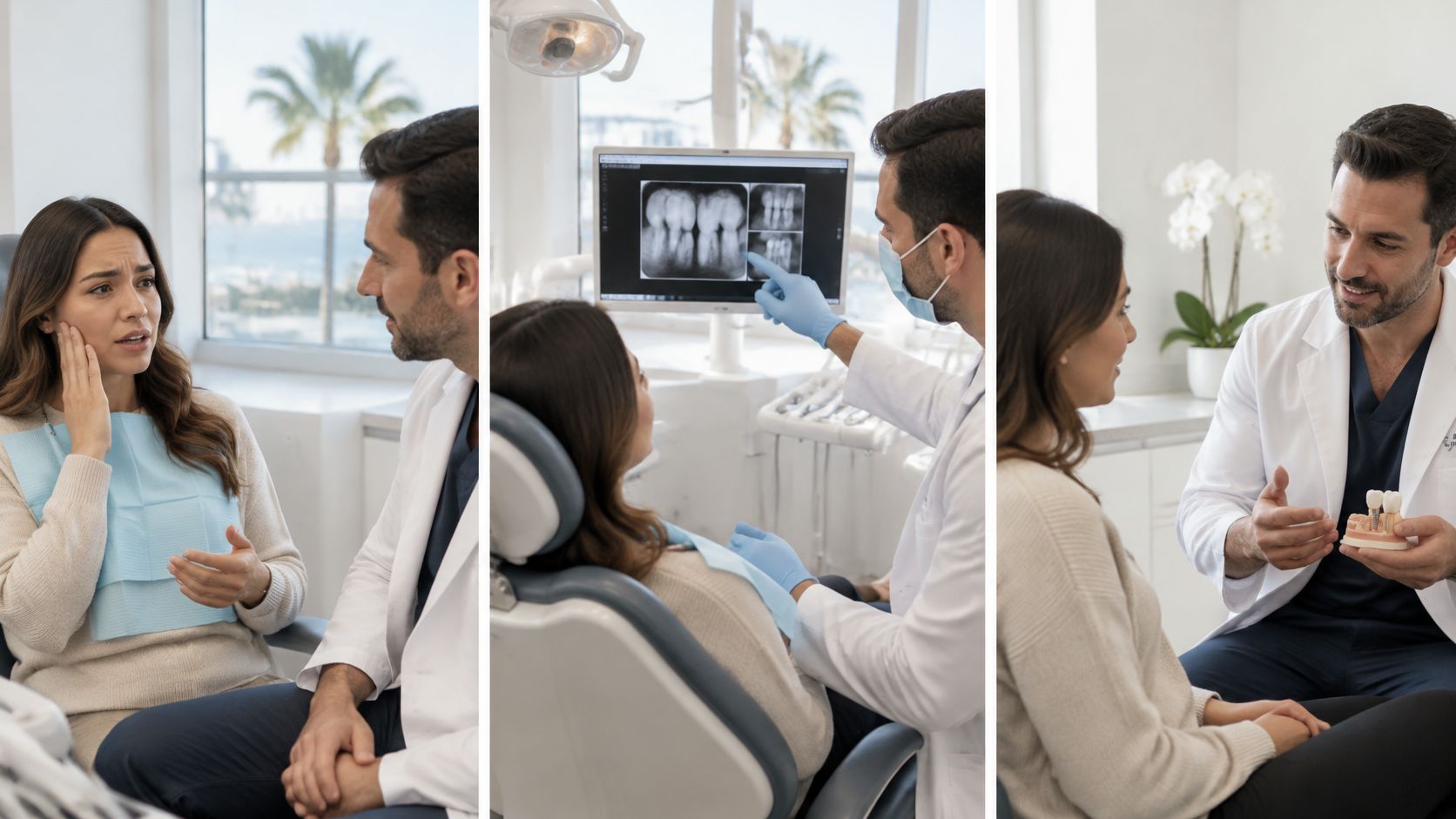
The visit starts with a conversation about the actual problem. That might be pain when biting, a broken edge that catches the tongue, trouble chewing on one side, or a gap where food collects. A new patient exam or focused exam follows, with digital x-rays to show decay, cracks below the gumline, and the bone around the tooth.
Good candidates generally have healthy gums and enough tooth or bone to hold the restoration. Ideal candidates for crowns and bridges should have good oral health and sufficient bone structure to support the restorations. If gum disease or deep decay is present, that gets addressed first, because a crown placed over an unstable foundation doesn't last.
Shaping, Scanning, and Fitting
Once the tooth is numb, the dentist shapes it so the crown can fit over it with the right thickness. Decay and weak filling material come out. A scan or impression then records the shape.
The short video below gives patients a visual sense of how a crown visit flows.
With CEREC, many crowns are designed and placed the same day, so there's no temporary to pop off at home before a second visit. A laboratory-made bridge, or any case involving a root canal, tooth extraction, or implant, may take more than one appointment. An implant crown also waits through months of healing after the post is placed, because the bone needs time to hold the post firmly.
The payoff is everyday and concrete. A crown stops a weak tooth from splitting further, restores comfortable biting, and can be shaded to sit naturally beside neighboring teeth. A bridge fills a gap, so food traps less and neighboring teeth stay in place. Regular cleaning and exams afterward protect the margins where crown meets tooth, and dental cleaning is particularly beneficial for people who have had previous dental work such as fillings or crowns.
Comfort During Care
Ultra Smile DentalSpa, led by Dr. Neda Bahmadi, DMD, sees patients from Downtown Miami, Midtown Miami, and Hallandale Beach. Comfort touches include refreshments on arrival, aromatherapy, something to watch during treatment, and a hot towel at the end of the visit.
Bilingual staff explain the plan before anything is numbed, including what each step will feel like and how long it should take. For patients with dental anxiety, that order matters. Understanding comes first. Treatment follows.
Get a Written Estimate Before You Book
The ranges in the tables are planning tools. Bring them to the visit, but don't treat them as the bill. A personal fee only exists after a dentist has examined the tooth, seen the x-rays, and confirmed what preliminary treatment is needed.
A written plan worth signing lists specific items. Ask for each one by name.
- Each tooth involved: The crowned tooth, or both abutments plus the pontic for a bridge.
- The material: Ceramic, zirconia, porcelain-fused-to-metal, or metal, and whether it's solid or layered.
- How it's made: Same-day in the office or by an outside laboratory, and whether a temporary is included.
- Preliminary work: Any buildup, root canal, tooth extraction, or gum care, each priced separately.
- The insurance estimate: Expected payment after the deductible and annual maximum, plus the patient's remaining balance.
One clinical check belongs on that list too. Before choosing a bridge over an implant, confirm that the supporting teeth are strong enough to carry the span. A bridge anchored to weak teeth can cost more in repairs than an implant plan that looked pricier at the start. That's a clinical judgment, not a sales point, and it should be explained with the x-rays on screen.
Ultra Smile DentalSpa accepts insurance and can review options for patients who are paying themselves. A free consultation can be requested on the treatment-page form, and completing that form secures a 30% discount on dental treatments. Patients in Downtown Miami, Midtown Miami, and Hallandale Beach can use that consultation to turn a national range into a fee for their own tooth.
That's the endpoint of a dentist near me search. Not a headline price, but a personal estimate, a comfort plan, and a date to fix a tooth that's already affecting chewing or confidence. Restorative dentistry works best when the cost conversation happens before the numbing, in plain language, with every line item visible.
Patients dealing with a cracked, worn, or missing tooth can get a clear, itemized plan for dental crowns and bridges cost at Ultra Smile DentalSpa, where same-day crowns, bridges, dental implants, and restorative care are explained before treatment begins. The team serves Downtown Miami, Midtown Miami, and Hallandale Beach with transparent estimates and a calm, spa-like setting. Requesting a consultation is the simplest next step toward comfortable chewing and a complete smile.