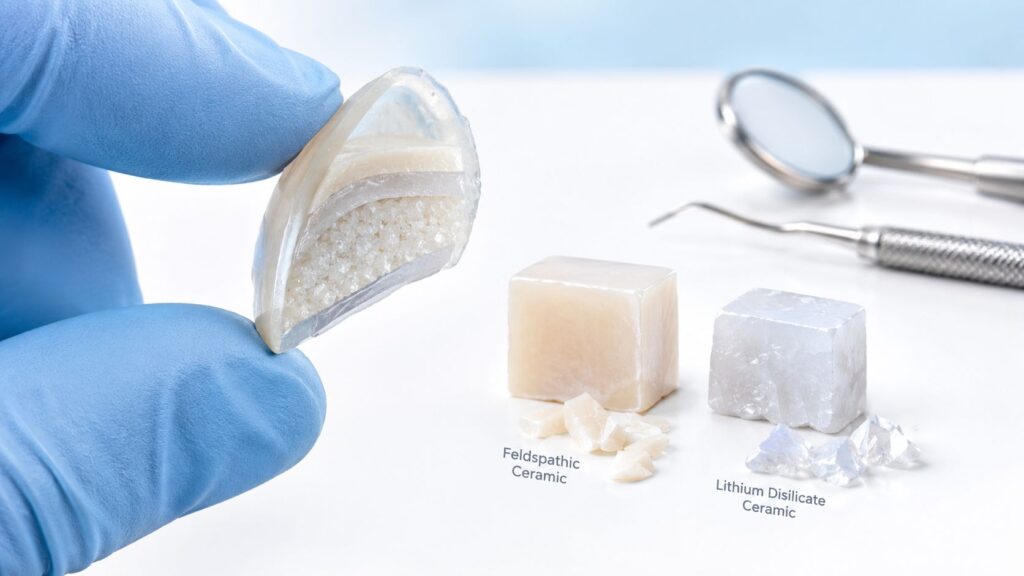
A lot of Miami patients start in the same place. They're looking in the mirror, noticing chips, worn edges, uneven color, or a smile that looks tired in photos, then searching cosmetic dentist near me or dentist in Miami, FL and finding page after page that says veneers are “made of porcelain. That answer sounds simple, but it leaves out the part that affects the result.
“Porcelain in dentistry isn't just one thing. It's a category of ceramics, and the specific ceramic matters. For someone comparing smile makeovers in Downtown Miami, Midtown Miami, Miami Beach, Brickell, Coral Gables, or Hallandale Beach, that difference can shape how natural veneers look, how much tooth preparation is needed, how they hold up under bite pressure, and why treatment plans can vary from one office to another.
Patients searching for cosmetic dentistry, teeth whitening, new patient exams, or even an emergency dentist often want the same thing. Clear answers before committing to treatment. That's especially true with veneers, because they sit right at the intersection of health, function, and appearance.
Table of Contents
- Why Miami Patients Ask What Porcelain Veneers Are Made Of
- The Basics of Dental Porcelain and How It Works
- Feldspathic Porcelain vs Lithium Disilicate Veneers
- How Porcelain Veneers Are Fabricated and Bonded
- Longevity, Strength, and What the Research Shows
- What to Expect at Your Veneer Consultation in Miami
- Caring for Porcelain Veneers and Booking Your Visit
Why Miami Patients Ask What Porcelain Veneers Are Made Of
Miami is a city where smiles matter. Professionals in Brickell want a polished look at work. Patients in Miami Beach care about photos and first impressions. Adults in Coral Gables and Midtown often want cosmetic improvements that still look natural up close. So when someone searches what are porcelain veneers made of, they usually aren't asking out of curiosity alone. They're trying to avoid a result that looks opaque, bulky, or fragile.
Why the word porcelain creates confusion
Many dental websites use porcelain veneers as a catch-all term. The problem is that several different ceramic families can fall under that label. Two veneers can both be called porcelain and still behave very differently in the mouth.
That's where confusion starts:
- Shade confusion because one ceramic can look more translucent and enamel-like than another
- Strength confusion because one material may handle bite stress better
- Cost confusion because lab process, material selection, and case difficulty all affect pricing
- Longevity confusion because survival and complication patterns aren't identical across materials
Patients usually don't need more jargon. They need clearer distinctions.
The question behind the question
When a patient asks what porcelain veneers are made of, the question is often something closer to this: which material fits this smile, this bite, and these goals?
The four ceramic families that matter most in veneer conversations are feldspathic, leucite-reinforced glass ceramic, lithium disilicate, and zirconia-based options. Each sits at a different point on the spectrum of translucency and strength. That's why one patient may be guided toward ultra-conservative esthetic veneers, while another may need a material that better tolerates functional stress.
For patients looking for a dentist near me in Miami, FL, that material conversation should happen before any preparation begins. It belongs in the consultation, right alongside smile photos, bite evaluation, dental x-rays, and discussion of related care like whitening, Invisalign, restorative dentistry, or even a tooth extraction if another issue is affecting the plan.
The Basics of Dental Porcelain and How It Works
A coffee mug and a porcelain veneer share a word, but they're not the same kind of material. A veneer uses a dental ceramic engineered to look like enamel, bond to tooth structure, and handle life in a wet, high-pressure environment.
What porcelain means in dentistry
Dental porcelain is usually a glass-ceramic. In plain language, that means it contains two basic parts. One part is a glassy matrix, which helps the material transmit light and creates that lifelike depth patients want in front teeth. The other part is a crystalline filler, which adds structure and helps the ceramic resist fracture.
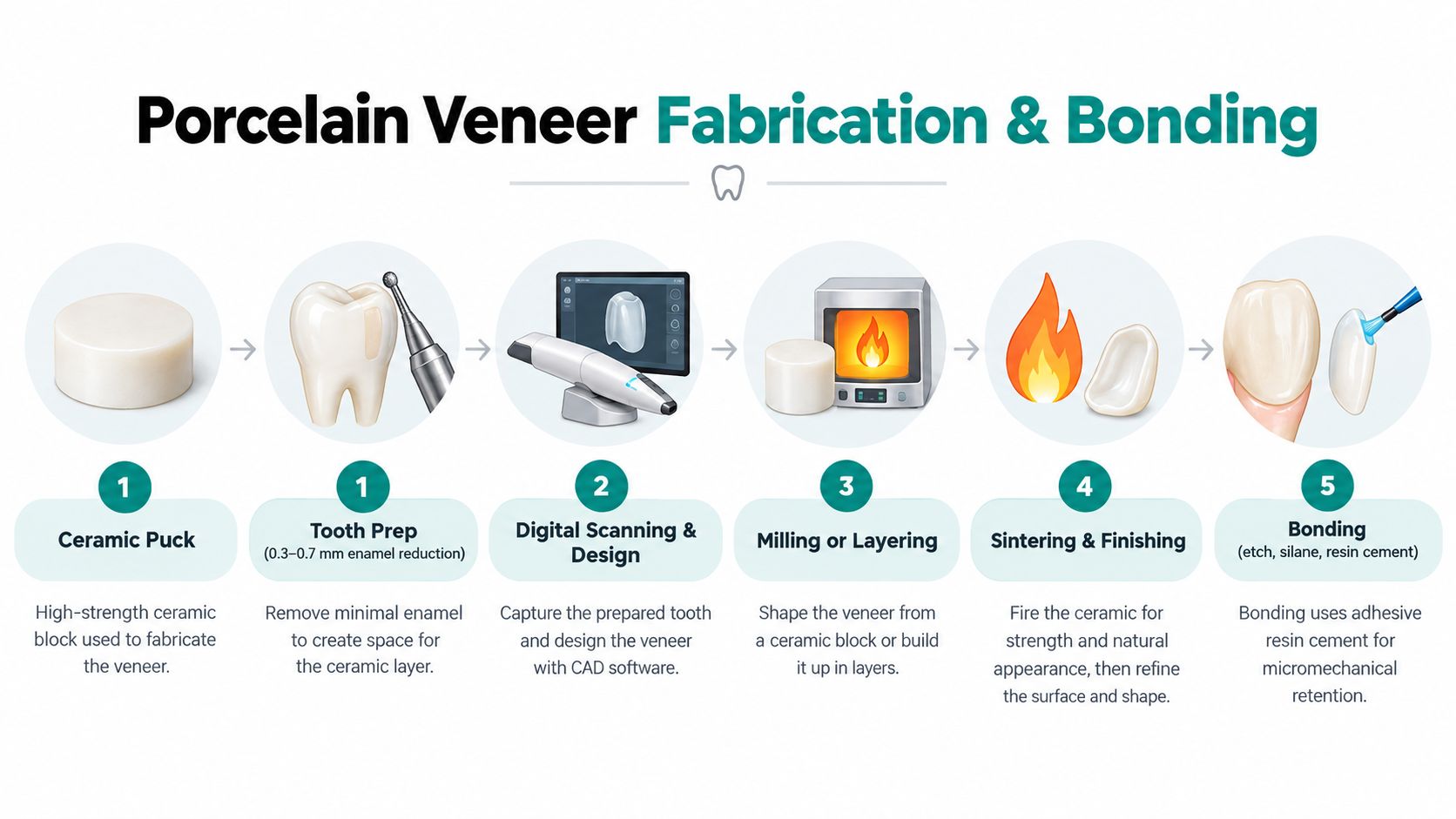
That balance changes from one material family to another. Feldspathic porcelain leans more heavily toward esthetics and light transmission. Lithium disilicate includes a stronger crystalline phase within a glass matrix, which helps it handle more functional demand. Patients who want a deeper look at modern ceramics can review advanced dental materials used in esthetic dentistry.
The four ceramic families patients hear about
Modern veneers are commonly discussed in four groups:
- Feldspathic porcelain for maximum translucency and fine characterization
- Leucite-reinforced glass ceramic for a middle ground within the glass-ceramic category
- Lithium disilicate for a stronger glass-ceramic option that still keeps good esthetics
- Zirconia-based ceramics for situations where strength matters more than the most delicate translucency
The underlying chemistry also helps explain behavior. A review of veneer materials describes feldspars as roughly 60% to 64% silicon oxide and 20% to 23% aluminum oxide, and notes that porcelain veneer structure may include fluorapatite crystals in an aluminum-silicate glass matrix, which affects shade and translucency in a clinically useful way, according to this review of ceramic veneer materials.
A short visual helps many patients connect the science to the final smile.
Why light matters so much
Natural enamel doesn't look flat because light doesn't just bounce off the surface. Some light reflects, some passes through, and some scatters back. Veneers try to mimic that behavior. That's why the ceramic itself matters, and so does the shade of the tooth underneath and the resin cement used during bonding.
Practical rule: The thinner and more translucent the veneer, the more the underlying tooth color and cement shade influence the final result.
That's one reason material choice is never just a lab detail. It directly affects whether a veneer disappears into the smile or announces itself.
Feldspathic Porcelain vs Lithium Disilicate Veneers
A patient in Miami often sits down wanting a brighter smile, then asks a very practical question: “Are all porcelain veneers basically the same? They are not. Even within the ceramic family, two of the most common veneer materials behave differently in the mouth, under light, and under bite pressure.
Feldspathic porcelain and lithium disilicate can both look beautiful on front teeth. The better choice depends on what matters more in that specific smile. Fine optical detail, very conservative shaping, added resistance to stress, or a balance of all three.
What feldspathic porcelain is made of
Feldspathic porcelain is the classic artist's ceramic. It is a silica-based glass ceramic with ingredients such as silicon oxide and aluminum oxide, plus smaller components that help the material fuse during firing. A review of veneer materials also describes fluorapatite crystals within an aluminum-silicate glass matrix, which helps explain why this ceramic can look so lifelike in the right case, as outlined in this review on feldspathic porcelain veneers.
In plain language, feldspathic porcelain has more glass and less crystal structure than stronger modern ceramics. That gives a ceramist more control over translucency, surface character, and the small light effects that make a veneer resemble natural enamel instead of looking flat.
That beauty has a trade-off. Feldspathic porcelain is usually chosen when appearance is leading the decision and the bite is relatively friendly.
What lithium disilicate is made of
Lithium disilicate belongs to a different ceramic family. It is still a glass ceramic, but it contains a much more developed crystal phase inside the glass matrix. That internal structure is a big reason dentists use it when a veneer needs more support against everyday function.
A clinical review notes that feldspathic porcelain and lithium disilicate are the two main veneer materials used in long-term practice, and describes lithium disilicate as offering higher strength while still keeping pleasing esthetics, according to this clinical review of ceramic veneers.
Patients usually notice the practical difference faster than the chemistry. Lithium disilicate tends to give a little more margin for error in teeth that see more force, while feldspathic porcelain gives the ceramist more room to chase the most delicate enamel-like effects.
Side-by-side comparison
| Property | Feldspathic Porcelain | Lithium Disilicate |
|---|---|---|
| Material type | Silica-based glass ceramic with high glass content | Glass ceramic with a stronger crystalline phase in a glass matrix |
| Main advantage | Very refined translucency and surface characterization | Better resistance to functional stress with strong esthetics |
| Fabrication style | Commonly hand-layered and fired | Commonly pressed or milled, then crystallized |
| Typical use | Highly cosmetic front-tooth cases with conservative goals | Esthetic cases that need more durability support |
| Clinical trade-off | More delicate mechanically | Optical effects may be a little less customizable than feldspathic |
Which one tends to fit which patient
A simple way to picture the difference is this. Feldspathic porcelain works a bit like custom stained glass. It is prized for the way it handles light. Lithium disilicate is closer to architectural glass. It still looks attractive, but it is built to tolerate more stress.
For a Miami patient with naturally translucent enamel, minor shape concerns, and a stable bite, feldspathic porcelain may be the better artistic match. For someone with edge wear, slightly heavier function, or teeth that need a veneer material with more built-in strength, lithium disilicate is often the safer choice.
This section only compares two ceramic families, and that matters. Many veneer articles use “porcelain as if it were one material, but it is really a category. Feldspathic and lithium disilicate are only part of the picture. Leucite-reinforced ceramics and zirconia-based ceramics fill different roles too, especially when cost, translucency, and bite forces all pull in different directions.
A good veneer consultation sorts that out before any tooth is touched. The material should fit the smile, not the other way around.
How Porcelain Veneers Are Fabricated and Bonded
A veneer doesn't start as a “shell. It starts as a treatment plan. The dentist evaluates enamel, bite, gum symmetry, tooth color, and how much space the ceramic will need. Only after that does the lab process begin.
From tooth preparation to lab fabrication
A typical porcelain veneer is thin. Commonly cited thickness for feldspathic porcelain veneers is around 0.3 to 0.7 mm, and one clinical source notes that fabrication below 0.3 mm is very difficult, according to this clinical guide to veneer types and thickness.
That thinness is why preparation has to be controlled. The dentist reduces a small amount of enamel to create room for the ceramic and avoid a bulky result. After that, the office captures the case with a digital scan or impression and sends the design to the lab.
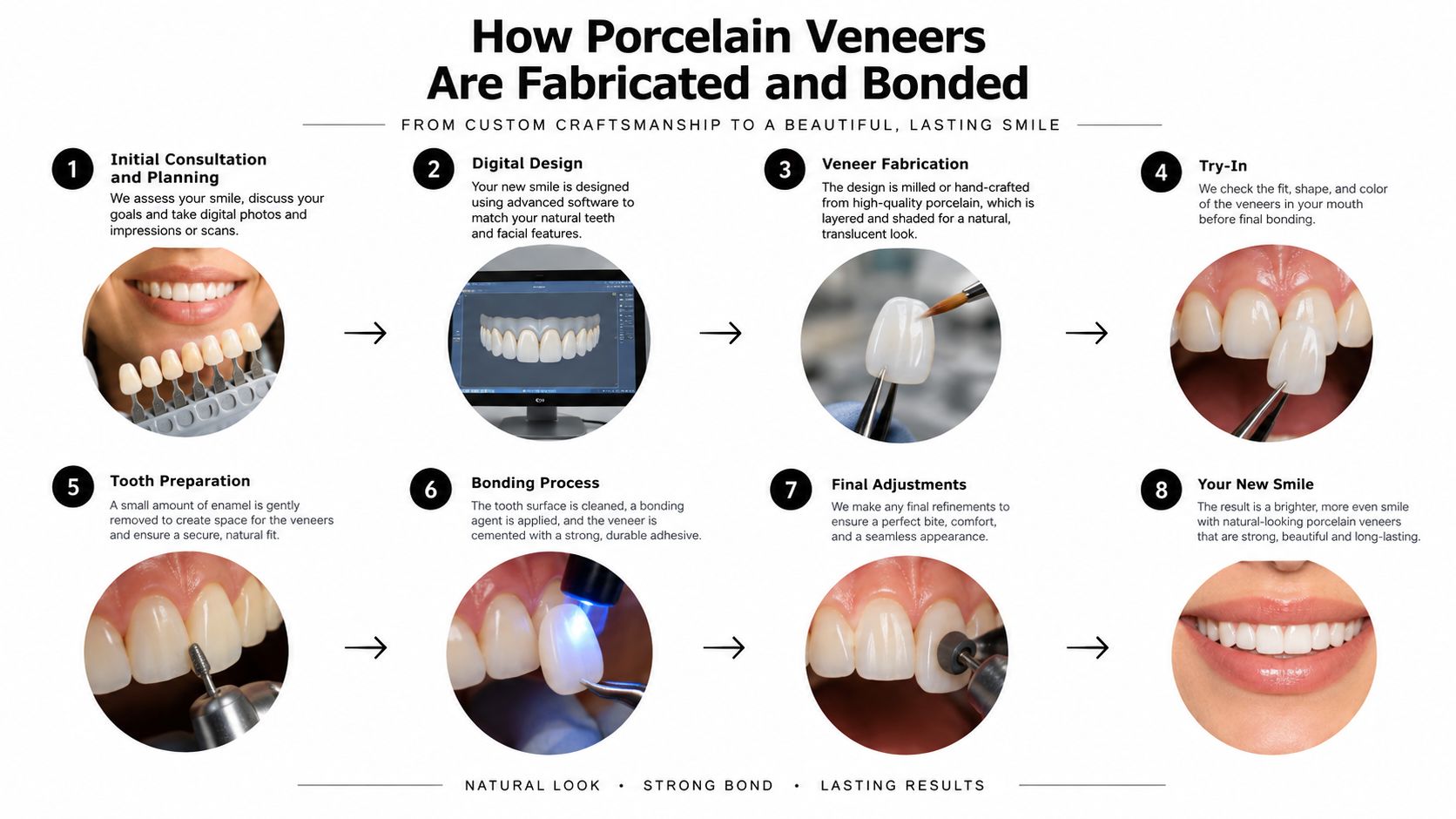
Fabrication depends on the material:
- Feldspathic porcelain is typically built in layers of powder and liquid, then fired
- Lithium disilicate is typically pressed or milled and then crystallized to increase strength while preserving translucency, as described in this summary comparing veneer materials
The bonding step is where precision matters
Veneers aren't stuck on. They are bonded with adhesive resin cement, and the ceramic surface is conditioned first. One review explains that the inner surface is usually etched with hydrofluoric acid and then treated with silane to improve chemical bonding to the resin cement, as detailed in this review of porcelain laminate veneer cementation.
For feldspathic veneers, an ADA-described bonding protocol uses about 9.5% hydrofluoric acid for roughly 90 seconds on the intaglio surface, followed by pure silane primer to improve wettability and chemical interaction with resin cement, according to this veneer bonding handout describing the ADA protocol.
Bonding is one of the biggest reasons veneers can look delicate but function reliably. The strength comes from the ceramic and the adhesive system working together.
Once the veneer is tried in and approved for fit and shade, the tooth is prepared, the resin cement is placed, and the veneer is seated under controlled pressure. That adhesive interface is a major part of why conservative veneers can be so effective when placed on healthy enamel.
Longevity, Strength, and What the Research Shows
A patient in Miami will often ask this in very plain terms. “Will these veneers hold up, or am I going to be fixing chips in a few years?
That is the right question. A veneer can still count as “surviving in a study even if it needed polishing, repair, or replacement along the way. So if you want a realistic picture, you have to look at two things together. How long the veneer stays in service, and what kinds of problems tend to happen during that time.
Survival rates matter, but complication rates matter too
Earlier in this guide, we noted that feldspathic and other glass ceramics can both show strong medium-term survival in the literature. That is useful, but it does not tell the whole story for someone choosing a material for front teeth.
A newer meta-analysis is more helpful because it separates longevity from day-to-day performance. It reported similar long-term survival, around 10.4 years, across feldspathic, leucite-reinforced, and lithium disilicate veneers. But the complication profile was very different. Lithium disilicate showed technical complications of 6.1%, esthetic complications of 1.9%, and biological complications of 0.45%, compared with technical complications of 41.48%, esthetic complications of 19.64%, and biological complications of 6.51% for feldspathic veneers, according to this meta-analysis on ceramic veneer outcomes.
That difference matters in real life. Two materials may both “last, but one may ask for fewer repairs, fewer edge chips, and fewer cosmetic touch-ups.
Material comparison at a glance
| Material | What it usually means for longevity and strength | Appearance | What a Miami patient should know |
|---|---|---|---|
| Feldspathic | More delicate than reinforced ceramics, but often very successful in the right case | Highest lifelike translucency | Excellent for small cosmetic changes when enamel is healthy and bite forces are controlled |
| Leucite-reinforced | Sits between traditional feldspathic porcelain and stronger modern ceramics | Natural-looking with more strength than feldspathic alone | Often chosen when you want a balance of beauty and added reinforcement |
| Lithium disilicate | Stronger and more fracture-resistant than the more glass-heavy ceramics | Still very esthetic, with good translucency | A common choice for patients who want durability without giving up a natural look |
| Zirconia | Strongest ceramic family in this group, but usually less translucent | More opaque than the most enamel-like porcelains | Better for selected high-stress cases than for every cosmetic veneer case |
What strength really means for veneers
Patients sometimes hear “stronger and assume stronger is always better. Veneers do not work like floor tile or a countertop. Front teeth need a ceramic that can handle force, bond well, and still let light pass through in a natural way.
A simple way to picture it is stained glass versus safety glass. Feldspathic porcelain is prized for beauty and light transmission. Lithium disilicate keeps much of that beauty while adding more internal reinforcement. Zirconia is the heavy-duty option, but its opacity can make it less ideal when the goal is a very natural, bright Miami smile in the front.
The key question is not which ceramic wins on a lab chart. The better question is which ceramic fits your tooth color, enamel, bite pattern, and cosmetic goal.
“Porcelain veneer is a category, not a single material. The ceramic family you choose can affect how natural the veneers look, how they handle bite pressure, and how likely they are to need maintenance over time.
That is why material selection should be case-specific. For one patient, the best answer may be feldspathic for unmatched esthetics. For another, lithium disilicate may be the safer long-term choice. Zirconia can also have a role, but usually in more limited veneer situations where strength outweighs translucency.
What to Expect at Your Veneer Consultation in Miami
A veneer consultation in Miami should feel organized, not rushed. Most adults who book this visit are weighing more than one issue at once. They may want whiter teeth, less crowding, smoother edges, or better symmetry. Some are also comparing veneers with teeth whitening, clear aligners, bonding, or other cosmetic dentistry options.
The first appointment
The visit usually begins with conversation and records. The team takes photographs, reviews the smile from different angles, and captures a digital scan. Depending on the case, cleaning and exams, dental x-rays, or a new patient exam may be part of the workup if the patient is new to the office or if the dentist needs more information about the teeth and bone.
The dentist then studies a few key things:
- Smile goals such as lighter shade, longer teeth, fewer chips, or less asymmetry
- Tooth condition including enamel quality, old fillings, wear, or cracks
- Bite pattern to see whether front teeth take heavy contact
- Gum frame because uneven gums can change how veneers look
- Related needs such as whitening before veneers, Invisalign before cosmetic work, or restorative dentistry first
When veneers are only part of the plan
Many patients assume veneers alone solve everything. Sometimes they do. Sometimes they don't. A patient with crowding may get a better result by aligning teeth first. A patient with deep discoloration may need a material with stronger masking ability. A patient with failing restorations may need crowns, fillings, or other restorative care before cosmetic treatment moves forward.
One local option patients may come across is Ultra Smile DentalSpa, which offers veneers along with whitening, Invisalign, same-day crowns, implants, night guards, and general dental care. That kind of broader service mix can matter when the smile plan involves more than veneers alone.
What placement visits usually feel like
Preparation day is typically managed with local anesthetic so the process stays comfortable. Temporary veneers may be placed while the lab completes the final ceramics. At the delivery appointment, the veneers are tried in, shade and shape are reviewed, and final bonding is completed once everything is approved.
A good consultation should leave the patient with a treatment map, not just a price quote.
For adults searching dentist in Miami, FL, cosmetic dentist near me, or even dental implants near me because several issues are in play, that planning visit is where decision gets made.
Caring for Porcelain Veneers and Booking Your Visit
Porcelain veneers are durable, but they aren't maintenance-free. The ceramic itself doesn't decay, yet the natural tooth underneath and around it still needs daily care. That's why home habits and recall visits matter just as much as material selection.
Daily habits that protect veneers
Most patients do well with a simple routine:
- Use a soft brush or an electric toothbrush to keep plaque from collecting around veneer margins
- Choose a non-abrasive fluoride toothpaste so the surface stays polished
- Clean between teeth every day with floss or a water flosser
- Wear a night guard if grinding is present because repeated clenching can overload even well-made veneers
Patients looking for more specific maintenance guidance can review how to care for veneers day to day.
Habits that shorten veneer life
Some problems don't come from the ceramic. They come from how the teeth are used. Veneers are not tools for opening packages, biting fingernails, chewing pens, or crunching ice. Those habits increase the odds of edge damage or stress at the bonding interface.
Regular professional care still matters too. A patient may come in for cosmetic work, but routine checkups help the dentist monitor gum health, bite changes, and the margins where veneer meets tooth. If a patient also needs emergency dental services, a cracked restoration, bite trauma, or sudden tooth pain should be evaluated quickly rather than ignored.
Booking a cosmetic consultation in Miami
For patients in Miami, Brickell, Coral Gables, Miami Beach, Midtown Miami, Downtown Miami, or Hallandale Beach, a veneer consultation is the right next step when the smile goals are clear but the material choice isn't. Bringing old photos, insurance information, and a written list of questions can make that visit more productive.
Patients often ask about financing, second opinions, and whether veneers should be paired with whitening or Invisalign. Those are good questions. Veneers aren't one-size-fits-all treatment, and the best cosmetic plans usually come from careful planning rather than speed.
If a patient is searching dentist near me, cosmetic dentist near me, or dentist in Miami, FL because they're ready to improve shape, shade, and confidence, the smartest move is to sit down with a dentist who can explain not just what veneers look like, but what they're made of and why that matters.
Ultra Smile DentalSpa offers porcelain veneers, whitening, Invisalign, restorative dentistry, and dental care for patients across Miami who want a healthier, more polished smile. Dr. Neda Bahmadi and the team help patients understand the differences between veneer materials so treatment decisions are based on fit, function, and esthetics, not just the word “porcelain. Patients ready for a cosmetic consultation can schedule a visit and discuss smile goals, material options, and whether veneers are the right next step.