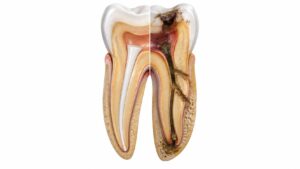
You wake up in a Miami apartment with a tight jaw, sensitive teeth, or a dull headache behind the eyes. Perhaps a partner has mentioned grinding at night, or a filling feels chipped after a stressful week. The question is understandable: are night guards safe, especially when one may be worn for hours every night?
For most adults, a properly fitted and regularly cleaned night guard is considered safe. The meaningful risks usually come from an uneven fit, unsuitable design, poor hygiene, or wearing an appliance without dental supervision when another condition is present. A custom evaluation with a dentist in Miami, FL can determine whether a guard is appropriate, whether an existing appliance needs adjustment, and whether symptoms point to TMJ dysfunction, sleep apnea, or another concern.
Table of Contents
- What a Night Guard Does and Why Miami Patients Use Them
- Comparing Custom Boil-and-Bite and Stock Night Guards
- Materials and Regulatory Standards Behind Safe Guards
- Potential Risks Bite Changes TMJ Strain and Hygiene Issues
- How to Use Clean and Replace a Night Guard Safely
- When a Dentist Visit Matters More Than an OTC Guard
- Booking a Custom Night Guard Consultation in Miami
What a Night Guard Does and Why Miami Patients Use Them
Bruxism means grinding or clenching the teeth, often during sleep. Stress, irregular schedules, intense workouts, and long workdays can all contribute to jaw tension. Miami professionals managing traffic, hospitality shifts, demanding client schedules, or late nights may not notice the habit until a tooth becomes sensitive or the jaw feels tired in the morning.
A night guard places a protective layer between the upper and lower teeth. Depending on the design, it may be a thin hard appliance, a softer material, or a dual-layer guard with different surfaces. The appliance helps prevent direct tooth-on-tooth contact and spreads some clenching pressure across the biting surfaces. That can reduce wear on enamel and help protect fillings, crowns, and other dental work.
What patients often notice first
Early signs can be subtle:
- Morning jaw tightness: The muscles around the cheeks or temples feel tired before breakfast.
- Flattened or shortened front teeth: Repeated contact can gradually change the edges of the teeth.
- Cracked molars or damaged fillings: A dentist may find wear that the patient hasn't felt.
- Headaches behind the eyes: Facial muscle tension can contribute to morning discomfort.
- Partner observations: Grinding sounds may be obvious to someone sharing the bed even when the patient remains unaware.
A guard manages the mechanical damage caused by grinding. It doesn't cure bruxism or necessarily stop the habit, as explained by the Cleveland Clinic's overview of mouthguards. A patient may still clench while wearing it, but the teeth have a barrier between them.
Practical rule: A night guard should feel secure without requiring constant biting to keep it in place.
Safety depends on more than the presence of plastic in the mouth. Fit, thickness, bite balance, material quality, cleaning, and professional follow-up all matter. Patients searching for a dentist near me should evaluate the guard as a medical appliance, not as an accessory purchased from a pharmacy shelf.
Comparing Custom Boil-and-Bite and Stock Night Guards
The three common choices differ sharply in how they sit on the teeth. A custom guard begins with a dental impression or digital scan. A laboratory then fabricates the appliance from a planned design, often using hard acrylic or a dual-laminate material, and trims it around the individual gumline. The dentist checks how the upper and lower teeth meet and can make adjustments if one area contacts too heavily.
A boil-and-bite guard is softened in hot water at home and molded by the patient. It can offer more adaptation than a stock guard, but the result depends on the molding technique and the shape of the person's teeth. It may feel bulky, loosen during sleep, or wear quickly in someone who clenches forcefully.
A stock guard comes ready-made in a general shape. It's usually the least expensive option, but it may require the wearer to clench to keep it seated. That behavior can add jaw fatigue and make the appliance a poor long-term choice for someone with significant grinding.
Night Guard Types at a Glance
| Feature | Custom Guard | Boil-and-Bite Guard | Stock Guard |
|---|---|---|---|
| Fit precision | Designed from a patient's scan or impression | Molded at home with limited precision | General shape, not individualized |
| Bite control | Dentist can assess and adjust contact | Limited adjustment after molding | Minimal or no adjustment |
| Comfort | Usually more stable and contoured | Can feel thick or loose | May shift or require clenching |
| Material options | Hard acrylic, soft materials, or dual-laminate designs | Commonly thermoplastic material | Ready-made thermoplastic material |
| Durability | Selected according to grinding pattern | Often limited for moderate or heavy grinding | May wear or deform sooner |
| Best use | Ongoing protection with professional oversight | Short-term or temporary use after guidance | Temporary use when professional care isn't immediately available |
The strongest safety factor is fit quality, not a brand name or a low price. A guard that rocks, pinches the gums, or creates one-sided contact can place pressure where it doesn't belong. The American Dental Association discussion of occlusal guards also underscores the importance of cleaning these appliances because microorganisms can colonize them.
A temporary over-the-counter guard may be reasonable while a patient is arranging an exam, but persistent pain, new bite changes, or visible damage calls for a professional evaluation. That matters especially for Miami patients who wear a guard nightly through long, humid seasons and may not notice gradual loosening.
Materials and Regulatory Standards Behind Safe Guards
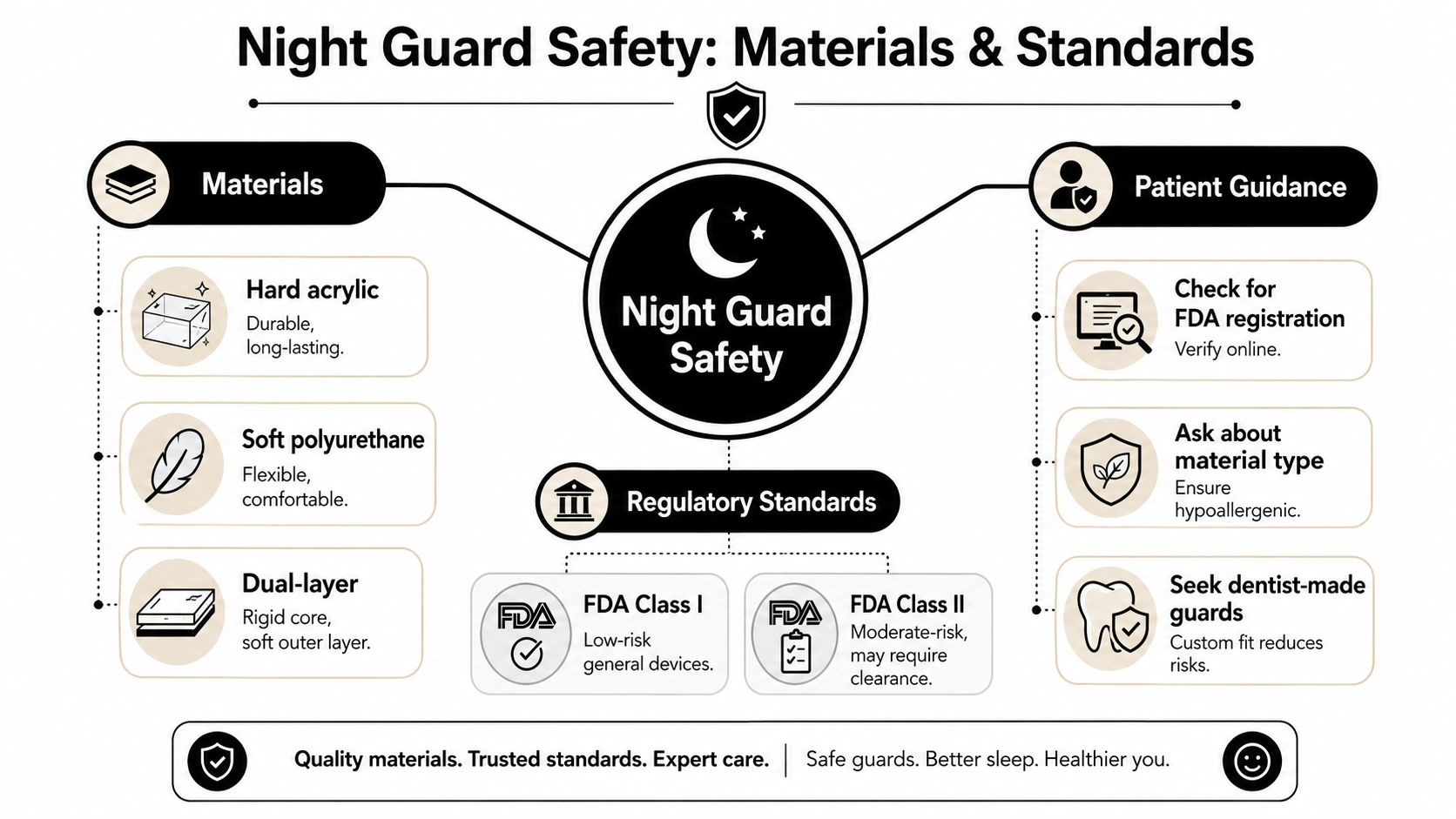
Patients don't need to decode every laboratory specification, but they should know what material is being placed in the mouth. Common dental guard materials include properly cured acrylic and ethylene-vinyl acetate, or EVA. Dual-layer appliances combine different properties, such as a softer inner surface with a more rigid outer structure.
Regulatory records support the general safety of modern night-guard materials when they're manufactured correctly. A U.S. FDA device submission for a night-guard product reports testing of predicate devices indicating safe use, while a later FDA clearance file described EVA-based mouthguard material, Erkodur, Splint Biocryl, and Erkoloc-Pro as biocompatible, ISO-certified, and BPA-free.
That doesn't mean every appliance sold online offers the same protection. A regulatory clearance concerns the device and its intended use. It doesn't replace an examination of the patient's teeth, bite, jaw joints, restorations, or airway concerns.
What to ask before choosing a guard
Patients can ask:
- What material is being used? The provider should be able to identify the material rather than offer only a vague “medical-grade description.
- How is the appliance cured and finished? Manufacturing quality affects comfort, durability, and surface condition.
- Will the bite be checked? Material safety doesn't correct an unbalanced design.
- Can the guard be adjusted? A clinician should be able to evaluate pressure points and changes in contact.
Marketing language such as “FDA-approved shouldn't be the sole reason to buy a guard. Patients should also consider fit, intended wear pattern, cleaning instructions, and access to follow-up care. For a plain-language review of material choices, see what night guards are made of.
Potential Risks Bite Changes TMJ Strain and Hygiene Issues
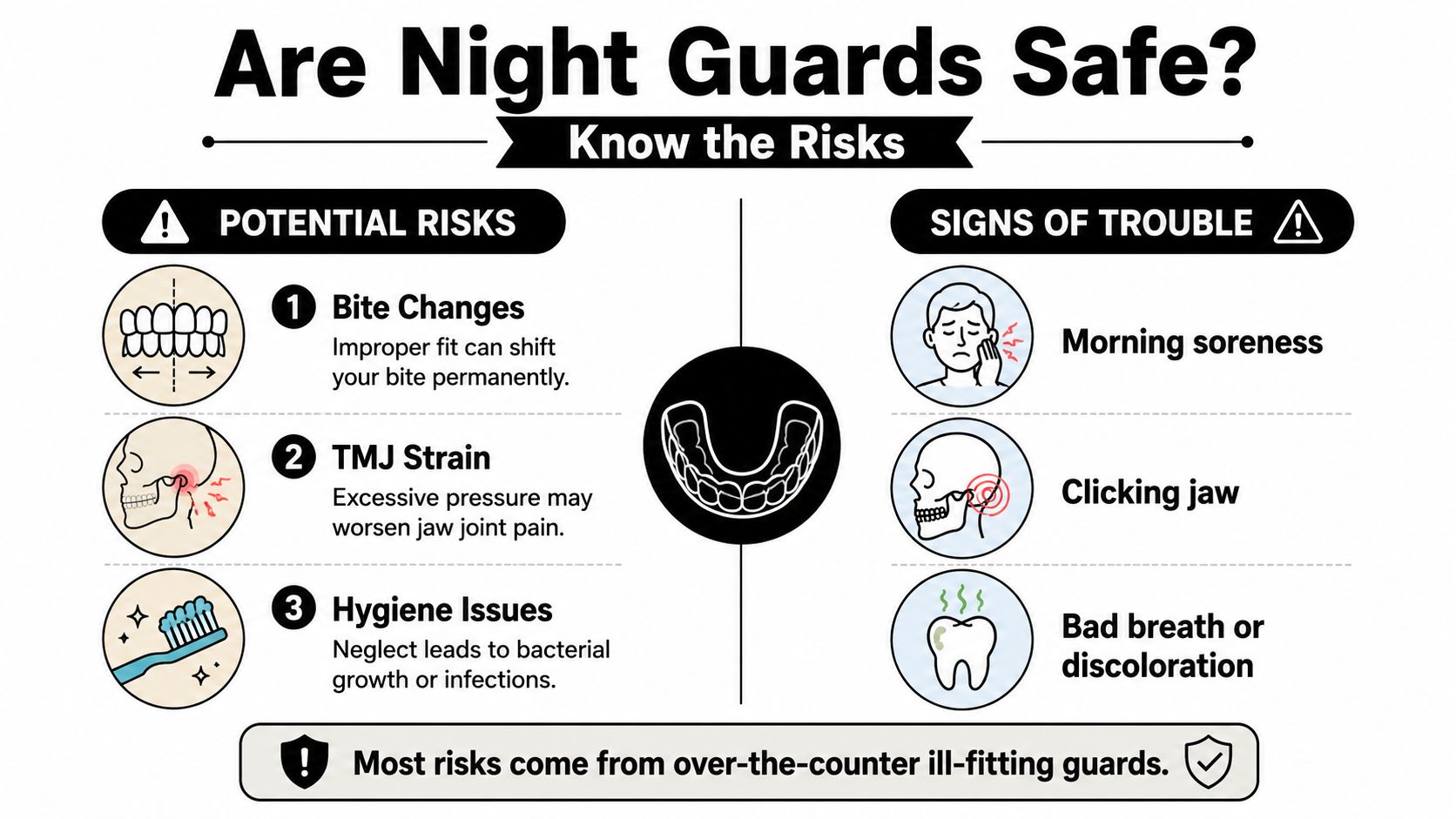
A night guard isn't automatically safe because it covers the teeth. A poor design can introduce problems, particularly when the appliance is worn continuously without supervision or becomes damaged.
Bite changes from uneven contact
If a guard contacts some teeth more heavily than others, the jaw may repeatedly close into an altered position. Over time, patients may notice that the bite feels different when the appliance comes out, or that the teeth no longer meet in the familiar way. Conservative custom splint treatment has a low risk of negative effects, but long-term or poorly supervised use can cause severe, sometimes irreversible occlusal changes, according to the clinical discussion of night-guard microplastic and wear concerns.
Mandibular advancement appliances and partial-contact designs require particular caution when worn beyond 4 to 6 weeks without supervision, as the same source explains. Full-coverage custom appliances and periodic bite checks are safer standards for ongoing use.
TMJ strain from the wrong design
A guard that's too thick, too thin, loose, or uneven can make the chewing muscles work harder. Patients may develop morning soreness, facial fatigue, jaw clicking, limited opening, or discomfort near the ear. A patient-focused review of night-guard side effects describes how poor fit may contribute to tooth movement, bite changes, jaw strain, or TMJ-related discomfort.
Hygiene problems
A guard sits against the teeth and gums for hours. If it stays wet in a closed case, accumulates saliva and debris, or receives only a quick rinse, it can harbor bacteria, plaque, and fungi. Patients may notice bad breath, gum irritation, discoloration, or increased sensitivity, and poor maintenance can contribute to infection or cavity risk. A Los Angeles Times explanation of night guards highlights cleaning and ventilated storage as practical safeguards.
A 1992 clinical study involving 61 patients treated with occlusal splints reported that only a few found the therapy uncomfortable and observed no serious adverse event or complication, as documented in the PubMed record. More recent evidence remains incomplete. A 2026 overview found that only 4 of 21 systematic reviews reported adverse-effect data, with most reported problems being short-lived, although clinically important harms remain possible and rare.
How to Use Clean and Replace a Night Guard Safely
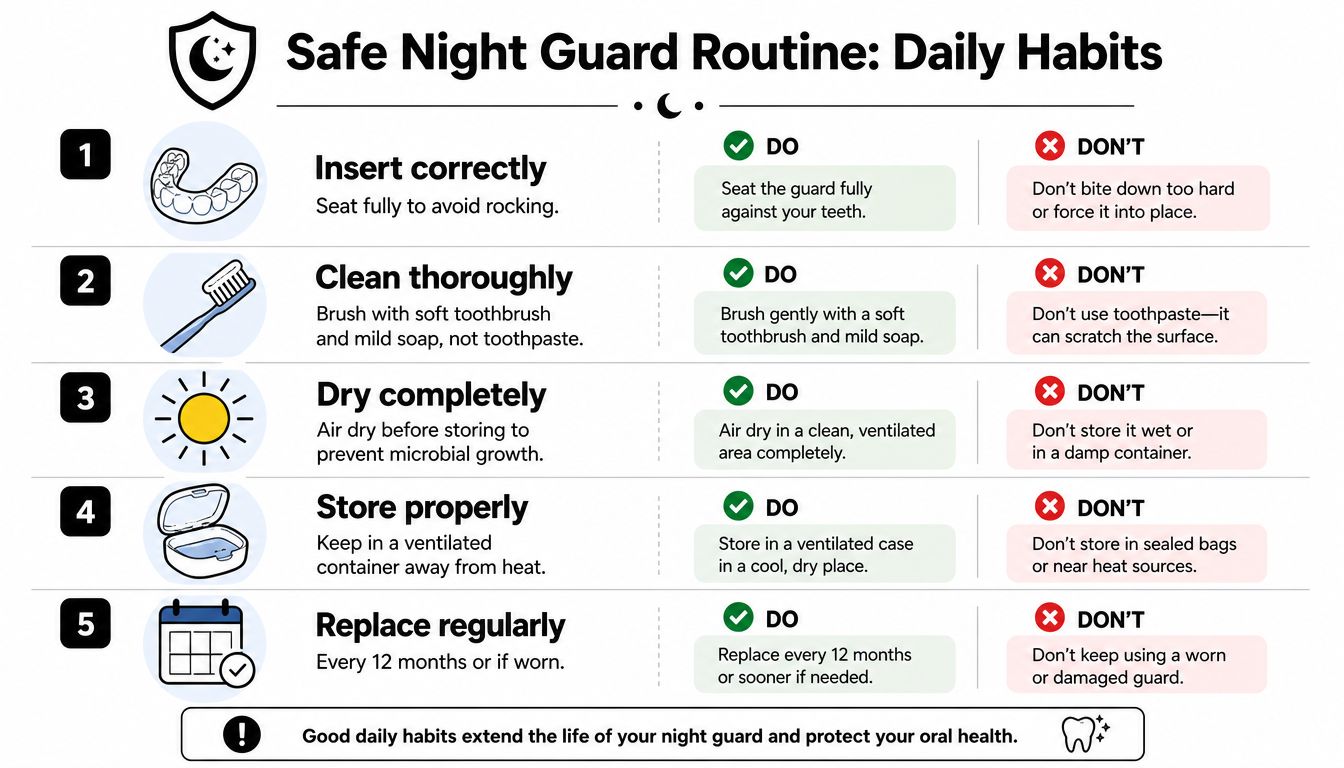
Daily care determines whether a guard remains a protective appliance or becomes a source of irritation. The routine is simple, but each step has a purpose.
The morning cleaning routine
After removing the guard, rinse it with cool water. Inspect the surface and edges for cracks, holes, rough areas, warping, or changes in fit. A soft toothbrush and mild, non-abrasive soap can remove residue without scratching the appliance.
Toothpaste can be too abrasive for some guard materials, while hot water may distort the shape. Bleach and harsh household cleaners can damage the material or leave substances that shouldn't remain in the mouth. A dentist-recommended soak may be appropriate when the appliance needs deeper cleaning.
Drying and storage
A guard should air-dry fully before it goes into a ventilated case. A sealed damp container encourages microbial growth. Miami's heat and humidity make bathroom storage less ideal, and a guard shouldn't be left in a parked car, where high heat can deform it.
The right replacement timing depends on the material, wear pattern, and clinical checks. Soft guards may need replacement roughly every six months, dual-laminate guards may last about one to two years, and hard acrylic guards may last three to five years when monitored by a dentist. These are practical ranges, not guarantees, and heavy grinding can shorten any appliance's useful life.
Signs the guard has reached the end
Replace or reassess a guard when it develops:
- Perforations or holes: Damage can expose teeth to direct contact and create rough edges.
- Persistent odor: Odor may indicate buildup that routine cleaning no longer controls.
- Looseness: A guard that no longer stays stable may create uneven pressure.
- Visible bite marks or deep grooves: Heavy wear can change the appliance's intended shape.
The night-guard care and use instructions can help patients follow a consistent home routine, but a loose or damaged guard still requires a dental assessment.
When a Dentist Visit Matters More Than an OTC Guard
An over-the-counter guard can't diagnose why the jaw hurts or determine whether the airway is being affected during sleep. A Miami dental visit becomes the safer choice when symptoms suggest more than uncomplicated tooth grinding.
Patients should arrange an evaluation for morning jaw locking, clicking with limited opening, repeated headaches, cracked or severely worn teeth, gum recession that exposes root surfaces, or pain that continues after removing the appliance. These signs may indicate joint or muscle involvement, significant bruxism, or another condition requiring a broader plan.
A guard also deserves professional review when the patient has:
- Suspected obstructive sleep apnea: A grinding guard isn't an airway appliance, and jaw positioning may matter.
- Loose teeth: An appliance can place unwanted force on teeth that already lack stability.
- Braces or dentures: The design and retention requirements differ, so professional advice is important.
- Crowns, veneers, implants, or recent fillings: New restorations can change the bite and require precise clearance.
What an evaluation adds
A dentist can examine tooth wear, restorations, gum health, jaw joints, and muscle tenderness. Dental x-rays may be considered when the clinical findings warrant them. The provider can also assess whether a hard acrylic guard, dual-laminate appliance, or another approach suits the bite.
The U.S. News guide to night guards and related conditions notes that people with braces, dentures, or loose teeth should seek professional advice and that TMJ or sleep-apnea concerns require clinician supervision. A professional visit is usually a focused, non-invasive step. It can prevent months of wearing an appliance that protects enamel while aggravating the underlying problem.
Booking a Custom Night Guard Consultation in Miami
A custom consultation begins with the patient's symptoms, not with a preselected product. Patients can bring an insurance card, a list of medications, and notes about morning headaches, jaw tightness, tooth sensitivity, chipped fillings, clicking, or sleep disruption. Photographs of a damaged guard can also help the dental team understand what has changed between visits.
The dentist examines the teeth and gums, evaluates the bite, and checks the jaw joints and muscles. If sleep apnea is suspected, the conversation may include coordination with an appropriate medical provider rather than treating grinding as an isolated dental issue. The clinician may use a digital scan or traditional impression to capture the teeth accurately.
What happens after the scan
The laboratory design is selected according to the bite, restorations, grinding pattern, and comfort needs. A hard acrylic appliance may suit a patient needing a durable, precisely adjusted surface, while a dual-laminate design may be considered when a softer inner layer is useful. The finished guard is checked in the mouth, adjusted for stable contact, and reviewed for insertion, removal, cleaning, and storage.
A custom guard from Ultra Smile DentalSpa can be incorporated into a broader Miami dental plan that includes cleaning and exams, restorative dentistry, crowns, cosmetic dentistry, dental implants, or other care when those needs affect the bite. Patients seeking a cosmetic dentist near me, dental implants near me, a tooth extraction, or an emergency dentist can mention nighttime grinding during the appointment so the full oral-health picture is considered.
The consultation is a practical way to protect enamel and identify jaw or sleep concerns before they become more disruptive. Patients in Downtown Miami, Midtown Miami, and Hallandale Beach can call or book online with a neighborhood office for a personalized evaluation. Professional supervision offers the safest and most predictable route when nightly protection is needed.
Ultra Smile DentalSpa evaluates jaw tension, tooth wear, bite balance, and appliance fit before recommending a custom night guard. Schedule a consultation through Ultra Smile DentalSpa to discuss symptoms and create a supervised plan for protecting the smile.