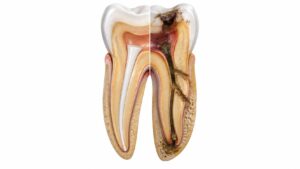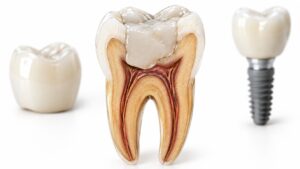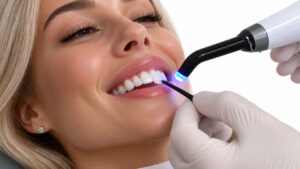
A Brickell professional finishes an oat-milk latte before a client meeting, checks a video-call preview, and notices that coffee and cabernet have left the front teeth looking darker than they used to. Another Miami resident sees a small chip each time a photo is taken. Someone else has a missing tooth, crowded teeth, or dental anxiety that has delayed treatment for far too long.
Cosmetic dentistry procedures can address these concerns, but the right treatment isn't automatically the most dramatic one. A Miami cosmetic dentist should first determine whether the priority is color, shape, alignment, tooth strength, or tooth replacement, then explain what the patient will see, feel, pay, and maintain over time.
Table of Contents
- Why More Miami Adults Are Exploring Cosmetic Dentistry
- Understanding Cosmetic Dentistry and the Six Core Procedures
- What Each Procedure Involves From Start to Finish
- Costs Insurance and Realistic Budgeting in 2026
- What to Expect at a Spa Like Miami Practice
- Longevity Maintenance and Honest Trade Offs
- Choosing the Right Procedure and Booking Your Visit
Why More Miami Adults Are Exploring Cosmetic Dentistry
Miami places unusual visibility on the smile. Professionals move between client meetings in Brickell, social events in Midtown, dinners in Downtown Miami, and video calls where the camera stays close to the face. Coffee, cafecito, wine, cigars, citrus, and natural aging can all influence how teeth look, while chips and uneven edges may become more noticeable in photographs.
A patient may begin by searching for a cosmetic dentist near me after seeing discoloration in a work headshot. Another may search for a dentist in Miami, FL after avoiding open-mouth laughter for years. The concern often sounds small, but the effect can reach dating, presentations, family photos, and everyday conversations.
Cosmetic dentistry has also grown well beyond a celebrity-only service. Independent market reporting estimates the global cosmetic dentistry market at about USD 28.48 billion in 2025, with a projection of about USD 59.52 billion by 2034 and a 8.53% CAGR from 2025 to 2034. Other 2025 estimates range from approximately USD 32.36 billion to USD 33.39 billion, reflecting broad demand for whitening, veneers, crowns, and aligner therapy. The same market report places Europe at 41.43% of market share in 2025, while another estimate places North America at 38.7%, showing strong adoption in major regions. These figures come from the 2025 cosmetic dentistry market report.
Natural-looking results matter more than dramatic changes
Many adults aren't asking for an exaggerated “Hollywood smile. They want teeth that look brighter, balanced, and natural in conversation. That may mean whitening alone, repairing one chipped incisor with bonding, straightening crowded teeth with Invisalign, or combining treatments in a carefully staged smile makeover.
The most useful consultation starts with a candid question: What should change, and what should stay the same? A trusted Miami dental practice should evaluate the starting teeth, gums, bite, existing restorations, lifestyle, budget, and expectations before recommending cosmetic dentistry procedures.
Practical rule: A treatment can be technically successful and still feel wrong if the result doesn't suit the patient's face, habits, or expectations.
Understanding Cosmetic Dentistry and the Six Core Procedures
Cosmetic dentistry is elective dental care focused on the appearance of the teeth, gums, and smile. Restorative dentistry focuses primarily on repairing disease, damage, weakened teeth, or missing teeth. The two areas often overlap. A crown may protect a cracked tooth while matching the surrounding teeth, and an implant may replace a missing tooth while restoring appearance and function.
The six core cosmetic dentistry procedures fit on a spectrum from relatively conservative to more involved:
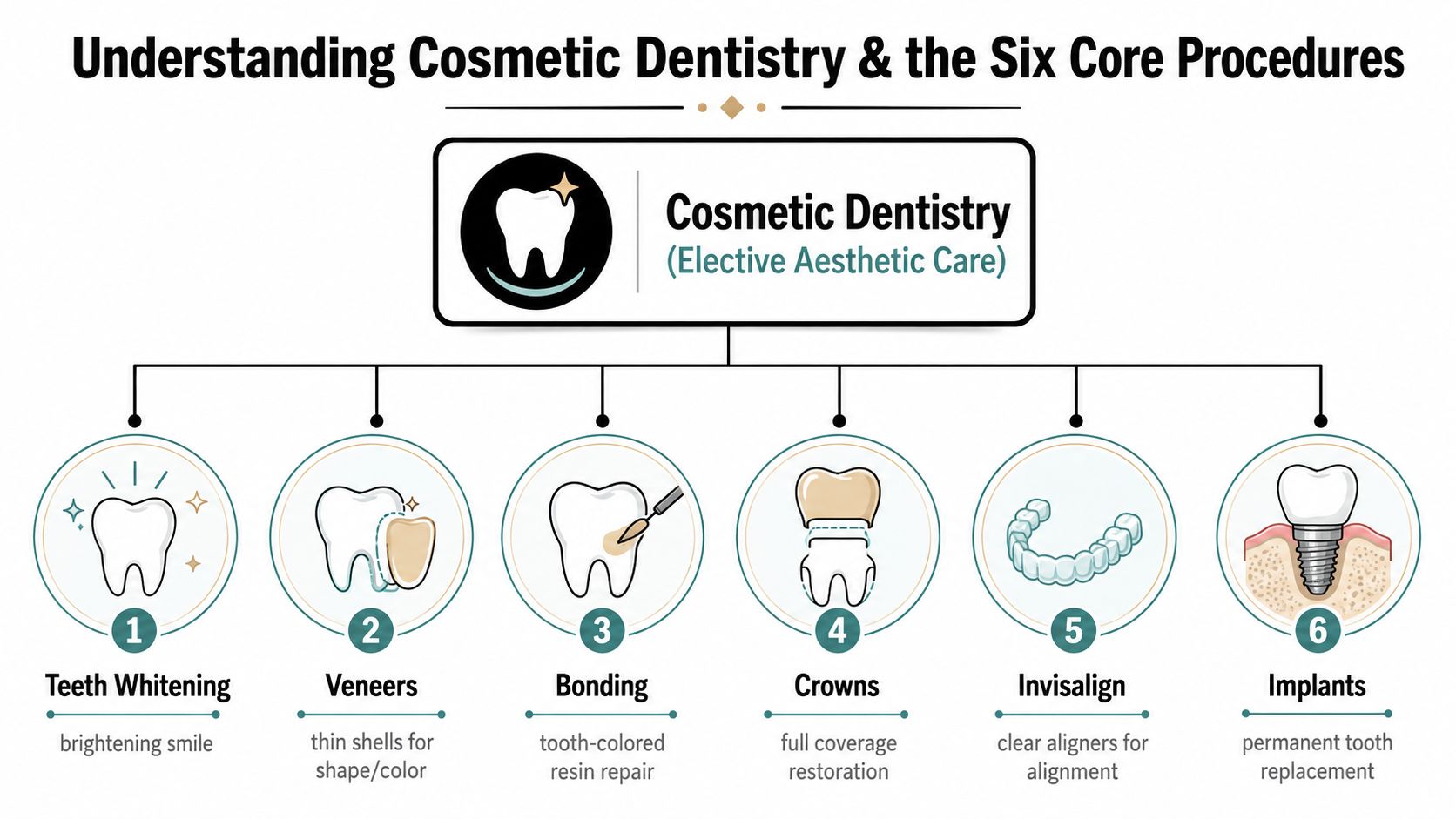
| Procedure | Main purpose | Commitment |
|---|---|---|
| Professional teeth whitening | Brightens natural teeth affected by stains | Low |
| Composite bonding | Repairs chips, small gaps, and shape concerns | Low to moderate |
| Porcelain veneers | Changes front-tooth color, shape, and proportions | Moderate |
| Invisalign clear aligners | Improves alignment and selected bite concerns | Moderate |
| All-ceramic crowns | Covers and strengthens a damaged tooth | Moderate to high |
| Aesthetic dental implants | Replaces a missing tooth with a fixed restoration | High |
Finding the correct starting point
Whitening is usually considered when the concern is shade and the teeth are healthy. Bonding can be appropriate for a small chip or localized gap when preserving natural enamel is the priority. Veneers cover the visible front surface and can address several appearance concerns at once, but they require a more significant commitment than whitening or bonding.
Invisalign moves teeth rather than just covering them. Crowns are generally reserved for teeth that need full coverage because of substantial damage, weakness, or extensive existing dental work. Implants involve oral surgery and replacement of a missing tooth, so they belong at the restorative end of the spectrum.
Many Miami smile makeovers combine two or three procedures. The plan might involve Invisalign for alignment, whitening for natural teeth, and bonding or veneers for selected teeth. The sequence matters because whitening natural teeth won't change the color of existing fillings, crowns, or veneers, as explained by the American Dental Association's guidance on whitening.
What Each Procedure Involves From Start to Finish
Patients usually want more than a procedure name. They want to know what the dentist is correcting, whether the visit involves drilling or numbness, how many appointments are likely, and what the mouth will feel like afterward.
Professional teeth whitening
What it fixes: Surface and deeper discoloration on natural teeth.
How it works: In-office whitening uses a professionally controlled peroxide system for faster brightening. Dentist-supplied take-home trays use a customized fit and a prescribed gel schedule. Sensitivity can occur because peroxide temporarily moves through enamel and dentin toward the nerve, while gum irritation may occur if gel contacts soft tissue.
Who may benefit: Adults with healthy teeth and gums whose primary concern is shade. Whitening won't change the color of fillings, crowns, veneers, or other tooth-colored restorations. The American Dental Association explains available whitening options and common side effects.
Visits and recovery: In-office whitening may be completed in one appointment, while take-home treatment requires repeated use at home. Teeth may feel temporarily sensitive, especially with cold drinks, but most patients return to normal activities immediately. Higher peroxide concentration may produce faster initial color change without guaranteeing better long-term results. One clinical trial reported perceptible change in more than 80% of participants after one session with 35% hydrogen peroxide, and nearly 100% after two sessions. Another regimen using 6% hydrogen peroxide strips retained color in more than 95% of participants at 12 weeks. The findings are reported in this clinical whitening research indexed by PubMed.
Composite bonding
Bonding repairs a minor chip, closes a small gap, or reshapes an uneven edge with tooth-colored composite resin. The dentist prepares the surface, applies the resin in layers, hardens it with a curing light, and polishes the result during the same appointment in many cases.
The tooth generally doesn't feel much different after treatment, although the area may feel slightly unfamiliar until the patient adjusts to the new contour. Bonding is conservative because it can often preserve more natural enamel than veneers or crowns. It isn't the ideal answer for severe structural damage, extensive bite forces, or a patient seeking a major color change across many teeth.
Porcelain veneers
Veneers are custom-made shells placed over the visible front surfaces of selected teeth. The process usually includes an examination, photographs, digital planning, shade discussion, tooth preparation, temporary veneers when needed, and final bonding.
The essential trade-off is enamel removal. Even conservative veneer preparation changes the tooth permanently, so candidacy and design must be assessed carefully. Patients may feel vibration, pressure, or numbness during preparation, followed by temporary sensitivity or awareness of the provisional teeth. Veneers can look highly natural when translucency, contour, texture, and shade are planned correctly.
A systematic review and meta-analysis found pooled veneer bond strength of 15.9 MPa, with lithium disilicate averaging 25.4 MPa compared with 12.1 MPa for translucent zirconia. Enamel substrates averaged 21.1 MPa, compared with 11.3 MPa for composite cores, according to the review of veneer bonding outcomes. These findings support preserving enamel when possible and selecting materials according to the case.
Invisalign clear aligners
Invisalign uses a series of clear removable aligners to guide teeth toward a planned position. Digital scanning replaces traditional impression material in many practices. Some patients need small tooth-colored attachments, and refinements may be required when teeth don't track exactly as planned.
The aligners can feel tight when a new set is introduced, but they don't involve the brackets and wires associated with traditional braces. Patients must remove them for meals and keep them clean. The treatment works best for people who can follow the wear instructions consistently and understand that retention after active movement is essential.
All-ceramic crowns
A crown covers the visible portion of a tooth rather than only its front surface. It may be more appropriate than a veneer when a tooth is cracked, heavily filled, weakened, severely discolored, or structurally compromised.
The dentist removes damaged or selected tooth structure, takes a digital scan or impression, and places a temporary crown when the final restoration isn't made during the same visit. The tooth may feel numb during preparation and sensitive afterward. A crown can restore chewing and protect the remaining tooth, but it requires more reduction than a veneer and isn't a conservative solution for a healthy tooth with a minor cosmetic concern.
Aesthetic dental implants
An implant replaces a missing tooth with a surgically placed post, an abutment, and a custom crown. Planning may include extraction, three-dimensional imaging, assessment of available bone, and bone grafting when the site needs support.
Patients should expect several healing phases rather than a single cosmetic appointment. A temporary tooth may be used while the implant integrates with the jaw, and the final crown is fitted after the tissues and implant are ready. Swelling, soreness, and dietary restrictions can occur after surgery, while the final restoration is designed to blend with the neighboring teeth.
| Procedure | Best for | Visits | Recovery |
|---|---|---|---|
| Whitening | Natural tooth discoloration | One or more | Usually immediate return to routine |
| Bonding | Small chips, gaps, and reshaping | Often one | Minimal, possible brief sensitivity |
| Veneers | Front-tooth color and shape changes | Several stages | Temporary sensitivity possible |
| Invisalign | Alignment concerns | Multiple monitoring visits | Pressure with aligner changes |
| Crowns | Weakened or damaged teeth | One or more | Sensitivity may follow preparation |
| Implants | Missing teeth | Multiple healing stages | Surgical recovery and healing |
Patients researching veneers in Miami, FL should ask whether the proposed design preserves enamel, how temporaries will be evaluated, and how the final shade will coordinate with the rest of the smile.
Costs Insurance and Realistic Budgeting in 2026
A precise price for cosmetic dentistry requires an examination, photographs, imaging, and a discussion of the number of teeth involved. Costs vary with materials, laboratory work, preparation, gum treatment, bite correction, and whether the procedure addresses a medical or functional problem.
No verified local price data is available for the requested Miami ranges, so responsible budgeting should avoid fabricated dollar figures. A dental office can provide a written estimate after evaluating the case rather than quoting a universal price online.
| Procedure | Low range in Miami | High range in Miami | Typical visits | Insurance coverage |
|---|---|---|---|---|
| Whitening | Requires personalized quote | Requires personalized quote | One or more | Usually cosmetic |
| Bonding | Requires personalized quote | Requires personalized quote | Often one | Usually cosmetic |
| Veneers | Requires personalized quote | Requires personalized quote | Several stages | Usually cosmetic |
| Invisalign | Requires personalized quote | Requires personalized quote | Multiple visits | May vary by plan |
| Crowns | Requires personalized quote | Requires personalized quote | One or more | May apply when medically necessary |
| Implants | Requires personalized quote | Requires personalized quote | Multiple stages | May vary by plan and indication |
What insurance may and may not cover
Cosmetic-only whitening, veneers, and elective bonding are generally not covered by dental insurance. Coverage may overlap with function when a crown restores a tooth after extensive damage or a dental implant replaces a missing tooth, but the policy, diagnosis, exclusions, and annual limits control the outcome.
Patients should request a predetermination before treatment. They should also ask whether the estimate includes diagnostic imaging, temporary restorations, laboratory fees, sedation, retainers after Invisalign, bone grafting, and future maintenance.
Building a staged budget
A staged plan can make treatment easier to manage. One patient may begin with cleaning and exams, gum treatment, and whitening before deciding whether veneers are still needed. Another may prioritize a missing tooth with extraction planning and an implant, then address shade and shape after the foundation is stable.
Payment options can include an office payment plan, a third-party lender such as CareCredit, or eligible HSA and FSA funds. Eligibility depends on the account rules and the nature of treatment, so patients should confirm details with the plan administrator and review the written financial agreement. A practical cost-planning resource is this guide to cosmetic dentistry cost.
What to Expect at a Spa Like Miami Practice
A comfort-first dental visit begins before treatment. After scheduling, the practice should explain arrival details, forms, health history, insurance information, and what the consultation includes. Patients can bring an insurance card, medication list, prior dental records, photos of smiles they like, and written questions about appearance, comfort, timing, and budget.

The consultation should make the smile understandable
A cosmetic-focused exam may include digital scans instead of goopy impressions, intraoral photography, shade assessment, facial photographs, and bite analysis. These tools help patients see the same concerns the dentist sees, such as uneven gumlines, worn edges, crowding, discoloration, or a mismatch between natural teeth and restorations.
The conversation should cover the desired result, dental history, medications, anxiety level, budget, and timeline. A patient who wants a subtle change should say so clearly. A patient who clenches, grinds, has gum bleeding, or has avoided dental care because of fear should mention that before treatment planning.
The first appointment's length depends on the services needed and the complexity of the examination. The office should explain the expected duration during scheduling rather than leaving the patient uncertain.
Comfort measures can include warm towels, noise-canceling headphones, paraffin hand wax, streaming entertainment, aromatherapy, and treatment rooms designed to feel calmer than a conventional clinic. Sedation options may include nitrous oxide or oral conscious sedation when clinically appropriate and prescribed after review of the patient's health history.
A spa-like environment doesn't replace clinical standards. It should support careful diagnosis, informed consent, safe treatment, and a clear follow-up plan.
Patients who want to preview the atmosphere can watch the practice video before scheduling.
An anxiety-friendly practice treats comfort requests as routine planning, not an inconvenience. The patient should know who will explain each step, how to signal for a pause, what sensations to expect, and how post-visit questions will be handled.
Longevity Maintenance and Honest Trade Offs
The question “How long will it last? deserves a nuanced answer. Longevity depends on material, enamel preservation, bonding conditions, bite forces, hygiene, diet, gum health, laboratory quality, and whether the patient protects the restoration from grinding.
Long-term evidence supports strong outcomes in carefully selected veneer cases. One clinical study reported feldspathic porcelain veneers bonded to prepared enamel with an estimated cumulative survival rate of 96% at 10 years and 91% at 20 years, as documented in the long-term veneer study indexed by PubMed. A separate review found 89.3% survival after 9 to 10 years, while 79.4% survived with complications, including material defects, secondary caries, and gingival problems, according to this 2024 ceramic veneer review.
Those figures don't mean every veneer remains problem-free. A 2025 systematic review identified marginal adaptation, gingival inflammation, and marginal discoloration among common complications. Patients reported dissatisfaction with function, food impaction, and cleaning difficulty, as described in the systematic review of ceramic veneer complications.
The maintenance burden changes by procedure
Bonding usually requires more frequent attention than porcelain because composite resin can stain, chip, or wear. Ceramic veneers generally resist surface staining better, but they aren't indestructible and may require repair or replacement. A practice-based evaluation reported ceramic veneer survival of 93.5% over 10 years and 83.0% over 20 years, supporting the distinction between ceramic durability and the shorter expected service of direct composite restorations. The findings appear in the 10-year practice-based veneer evaluation.
Whitening affects natural teeth, not veneers or crowns. If a patient whitens after restorations are placed, the natural teeth may become lighter while the restorations remain unchanged. Invisalign results also depend on retention. Without regular retainer wear, teeth can shift after active alignment.
A beautiful result still needs a maintenance plan. The plan should be discussed before the patient accepts treatment, not after the first repair.
A practical checklist includes:
- Protect against grinding: Use a professionally fitted nightguard when bruxism threatens teeth or restorations.
- Keep gums stable: Attend cleaning and exam visits, and treat inflammation before placing elective restorations.
- Manage staining habits: Follow whitening guidance and moderate coffee, wine, tobacco, and strongly pigmented foods.
- Clean carefully: Brush, floss, and use the tools recommended for veneer margins, crowns, bridges, or implants.
- Wear retainers: Follow the Invisalign retention protocol after active tooth movement.
- Plan reviews: Ask how repairs, replacement, and future shade changes will be handled.
Patients with unmanaged gum disease, significant bruxism, or unrealistic expectations may feel disappointed even when the technical work is sound. A pre-treatment conversation about those risks protects the investment and the relationship.
Choosing the Right Procedure and Booking Your Visit
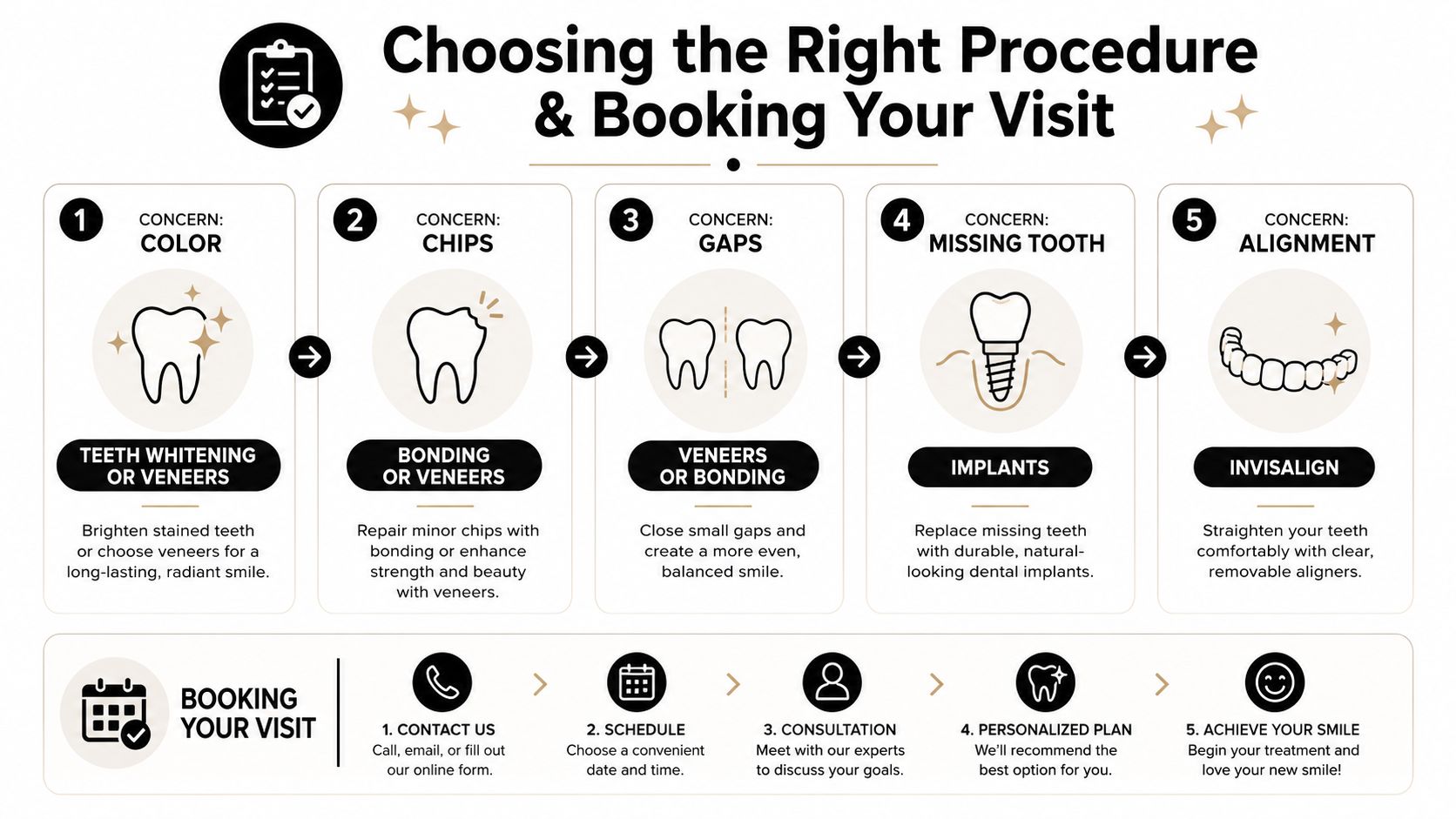
The clearest decision path starts with the concern, not the procedure.
- Color: Consider professional whitening when natural teeth are healthy and the issue is discoloration. Veneers may be considered when stains are resistant or shape also needs correction.
- Chips: Bonding may suit a small localized defect. Veneers or a crown may be more appropriate when damage is extensive.
- Gaps: Bonding can address a small space, while veneers or Invisalign may better suit broader spacing or alignment concerns.
- Missing teeth: Dental implants can replace the tooth after the dentist evaluates the extraction site, bone, gums, and bite.
- Alignment: Invisalign may be a suitable orthodontic alternative for selected crowding, spacing, and bite concerns.
A consultation should evaluate facial photographs, tooth proportions, bite forces, gumline symmetry, existing restorations, enamel condition, and oral hygiene. Digital smile planning can help patients preview possibilities, but a preview isn't a guarantee. The final plan still depends on biology, function, material limits, and the patient's willingness to maintain the result.
Miami patients can bring inspiration photos, a list of medications and prior dental work, and honest questions about budget, anxiety, treatment length, and lifestyle. Those details help the dentist recommend a conservative starting point instead of an unnecessarily large treatment plan.
For adults searching for a dentist near me, an Emergency dentist, or dental implants near me in Miami, cosmetic planning may begin with general dental care, cleaning and exams, dental X-rays, tooth extraction, or restorative treatment. Healthy foundations make elective cosmetic care safer and more predictable.
Ultra Smile DentalSpa offers cosmetic dentistry procedures including porcelain veneers, professional teeth whitening, bonding, Invisalign, crowns, and dental implants in a calming Miami setting. Schedule a comfort-first consultation at Ultra Smile DentalSpa to discuss the smile concern, treatment options, maintenance responsibilities, and budget before any procedure begins.