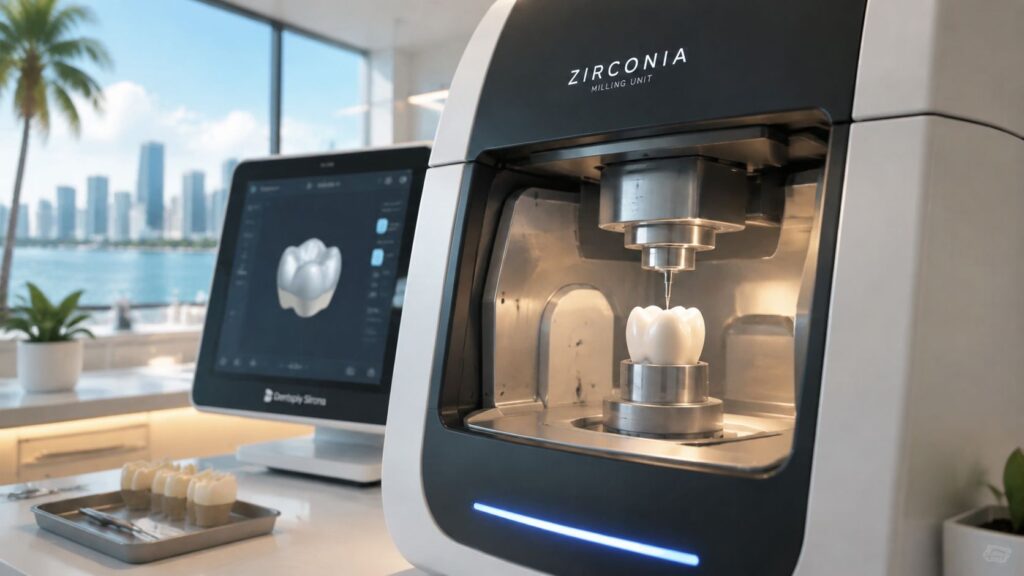
A chipped tooth before a major meeting, a cracked molar that suddenly hurts, or an old crown that no longer feels secure can make a dental visit feel urgent. For busy patients searching for a dentist in Miami, FL, the appeal of finishing treatment in one appointment is obvious. Same day crown technology can combine scanning, design, milling, and placement into one efficient visit, but it isn't automatically the right choice for every tooth.
At Ultra Smile DentalSpa, patients can discuss same-day crowns alongside restorative dentistry, cosmetic dentistry, dental implants, tooth extraction, emergency dental services, cleaning and exams, dental x-rays, and new patient exams. The important question isn't only whether a crown can be made quickly. It's whether the material, design, bite, gum condition, and appearance make a same-day restoration a dependable choice.
Table of Contents
- Why Same Day Crowns Are Changing Miami Smiles in 2026
- How the Same Day Crown Process Works Step by Step
- Same Day Crowns vs Traditional Lab Crowns
- Materials Used in Same Day Crown Technology
- When Same Day Crowns Are Not the Right Choice
- Recovery and Long-Term Care for Same Day Crowns
- Cost of Same Day Crowns in Miami and What to Ask
- Same Day Crown FAQs and Booking Your Miami Visit
Why Same Day Crowns Are Changing Miami Smiles in 2026
A Miami professional notices a chip in a front tooth while getting ready for a Brickell board meeting. There isn't time for a temporary crown, a laboratory waiting period, and another appointment next week. A chairside crown may offer a practical alternative, with the tooth prepared, digitally scanned, designed, milled, and restored during one visit.
The technology behind this process developed from early experimentation in the 1970s into commercial chairside use during the 1980s and 1990s. A commonly cited milestone occurred in 1985, when the first commercial CEREC system was demonstrated at the University of Zurich. Another review notes that CAD/CAM entered dentistry in 1989 for in-office fabrication of ceramic restorations in one appointment. The historical transition is described in this review of chairside CAD/CAM dentistry.
What patients notice in the chair
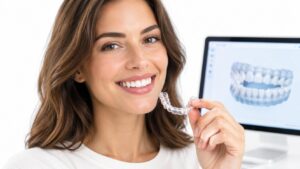
Modern systems use an intraoral scanner instead of a tray filled with impression material. The dentist can view the tooth and bite on a screen, make design adjustments, and send the restoration to an in-office milling unit. The workflow is described in this clinical overview of digital same-day crown treatment.
For a suitable single-tooth case, the patient may avoid a temporary crown and a second injection appointment. The finished restoration can restore chewing and appearance before the patient returns to the evening routine. That convenience explains why same-day crown technology has moved beyond an unusual service and into routine restorative care at practices such as Ultra Smile DentalSpa.
A technology with a clinical track record
Speed alone doesn't establish quality. Earlier CEREC-generated restorations had reported survival of about 97% at five years and 90% at ten years, according to the historical review linked above. A separate prospective study of 308 restorations reported 94.7% survival at five years and 85.7% at ten years, with fracture identified as the primary failure mode in that report, as summarized by this clinical discussion of same-day CEREC crowns.
Practical rule: A same-day crown is a treatment option, not a shortcut around diagnosis. The dentist still has to decide whether the tooth can support it.
How the Same Day Crown Process Works Step by Step
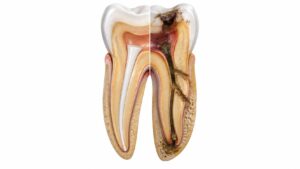
The appointment follows a clear sequence. The dentist first examines the tooth, checks the gums and bite, and takes any necessary dental x-rays. If decay, a crack, or an old filling has weakened the tooth, that problem must be addressed before the crown is designed.
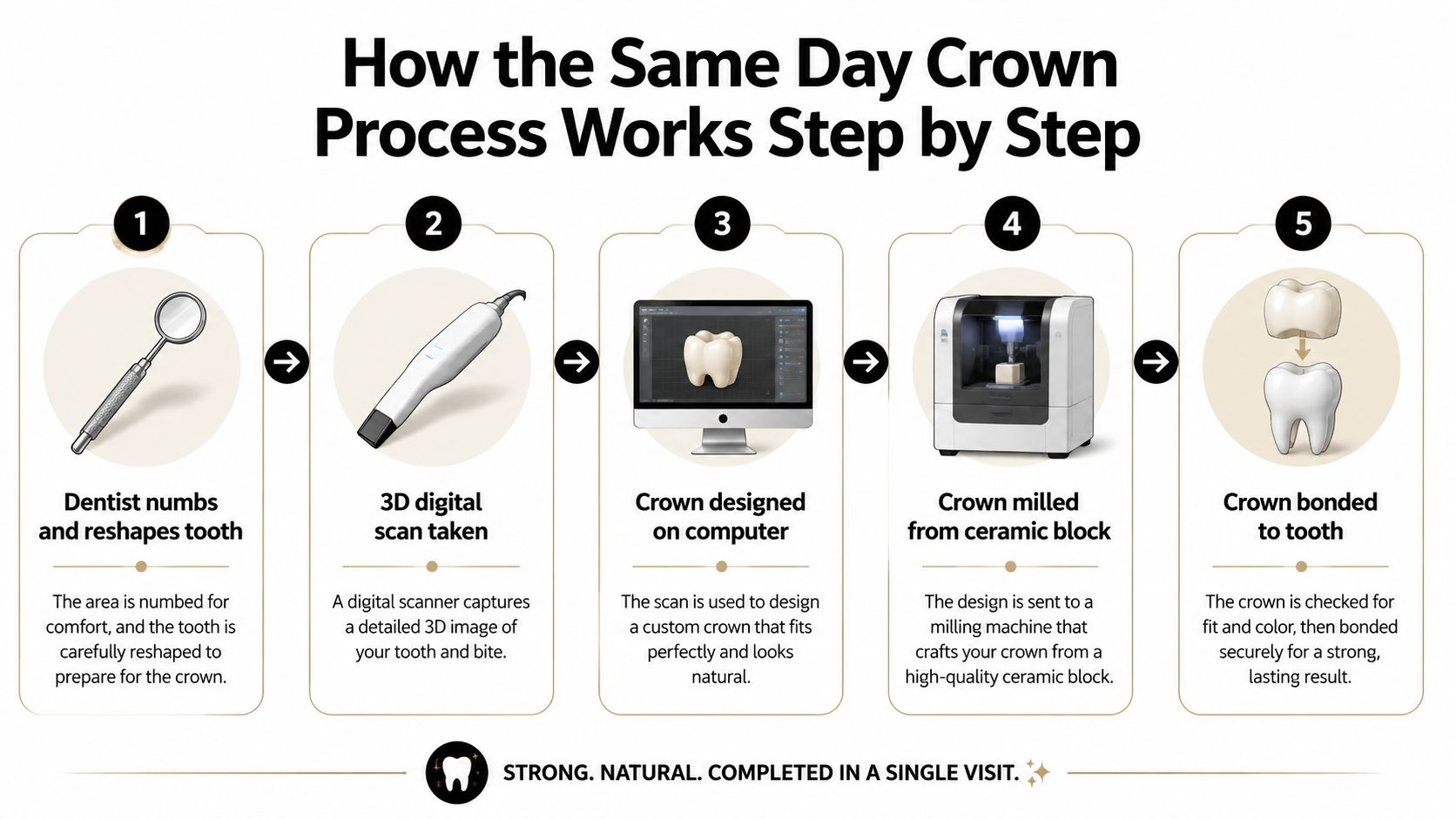
Five parts of the visit
The tooth is numbed and reshaped. The dentist removes decay and compromised filling material, then creates room for the crown. The goal is to preserve healthy tooth structure while giving the restoration a stable foundation.
A digital scan captures the tooth and bite. A small wand-style camera moves around the prepared tooth and nearby teeth. Patients don't have to tolerate a goopy impression tray, and the scan records the shape needed for the crown design.
The dentist designs the restoration. CAD software displays the tooth on a chairside monitor. The dentist adjusts the crown's contours, contact points, grooves, and bite so it works with the surrounding teeth.
The milling unit shapes the crown. The design guides a machine that carves the restoration from a ceramic or zirconia block. It works somewhat like a 3D printer crossed with a jewelry engraver, although the machine mills material away rather than building it up layer by layer. Descriptions of chairside materials and finishing steps appear in this overview of same-day ceramic crowns.
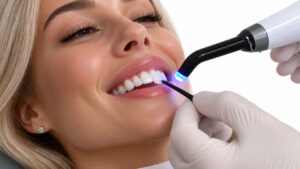
The crown is checked, adjusted, and bonded. The dentist evaluates the fit, shade, contacts, and bite. The restoration is then polished and bonded to the prepared tooth.
The total visit commonly takes 90 minutes to two hours, depending on the tooth, preparation, material, and adjustments. A patient with a straightforward case may leave with a finished crown instead of a temporary restoration.
A short visual explanation can help anxious patients understand the sequence before treatment:
Same Day Crowns vs Traditional Lab Crowns
Same-day and laboratory crowns can both restore a damaged tooth. The meaningful difference is how the restoration is designed, fabricated, customized, and delivered.
Claims about exact fit and lifespan should be handled carefully because outcomes depend on preparation, isolation, bite, material, cementation, and maintenance. Independent summaries report CAD/CAM crown marginal gaps commonly around 68 micrometers, compared with about 85 micrometers for conventional crowns, and both figures remain below the commonly used clinical acceptability threshold of 120 micrometers. The comparison is discussed in this review of CAD/CAM and laboratory-fabricated crowns.
| Factor | Same Day Crown | Traditional Lab Crown |
|---|---|---|
| Visits | Designed and placed during one appointment when the case is suitable | Usually requires preparation, a temporary restoration, laboratory fabrication, and a later seating visit |
| Impression | Digital intraoral scan | Physical impression or laboratory-directed digital workflow |
| Fabrication | Milled in the dental office from a ceramic or zirconia block | Fabricated by a dental laboratory technician |
| Convenience | Fewer appointments and no temporary crown in a straightforward case | More time between preparation and final placement |
| Aesthetic customization | Dentist and software shape and shade the restoration chairside | A ceramist can perform highly detailed hand-customized shading |
| Complex treatment | Often best suited to a single crown with good isolation and a stable bite | Often more predictable for complex bridges, multiple units, and demanding cosmetic work |
| Cost | Depends on material, preparation, tooth location, and the practice's technology | Depends on laboratory fees, material, preparation, and complexity |
A 5-year study of chairside CAD/CAM ceramic laminate veneers reported a 99.0% mean survival rate and a 96.4% success rate. In that cohort, Empress CAD veneers showed 97.8% survival, while e.max CAD veneers reached 100% survival, as reported in this PubMed-indexed study. Veneers aren't identical to crowns, but the findings support the broader point that chairside ceramic restorations can perform reliably in appropriate cases.
Same-day isn't synonymous with superior. It generally wins on convenience, while laboratory fabrication can offer more flexibility when the tooth, bite, or aesthetic demands are complicated.
Materials Used in Same Day Crown Technology
The material often matters more than the label “same-day. Chairside systems can use different ceramic blocks, and each material balances strength, translucency, polish, and suitability for a particular tooth.
Lithium disilicate
Lithium disilicate, including e.max CAD, offers a natural translucency that can blend well with visible teeth. It can suit a front tooth or a premolar when the patient prioritizes lifelike appearance and the bite is controlled. A chairside molar study found precrystallized lithium disilicate materials with fracture resistance around 1,557 to 1,786 newtons, according to the PubMed-indexed material study.
Zirconia
Zirconia is known for strength and can be considered for posterior teeth that receive substantial chewing pressure. Its appearance has improved, but the dentist still has to assess whether its optical properties suit a highly visible front-tooth case. Newer blocks may require specific firing or sintering steps, so the selected system matters.
Feldspathic ceramic
Feldspathic ceramic can provide excellent aesthetic layering and surface character. It may suit demanding cosmetic work where visual nuance matters more than maximum fracture resistance, but it isn't the automatic choice for a heavily loaded molar or a patient who grinds.
| Material | Strength | Aesthetics | Best For |
|---|---|---|---|
| Lithium disilicate | Strong ceramic option with documented chairside fracture resistance | Translucent and tooth-like | Visible teeth and selected posterior restorations |
| Zirconia | High-strength option for heavy chewing areas, depending on the block and workflow | Can look natural, but shade and translucency require careful selection | Molars and patients with higher functional demands |
| Feldspathic ceramic | More limited for heavy loading | Highly customizable and visually refined | Cosmetic cases where appearance is the priority |
In August 2026, researchers reported a method that reduced the debinding step for 3D-printed zirconia crowns to under 30 minutes, with the potential to reduce total production time from as much as 100 hours to a single visit, according to ScienceDaily's report on the emerging technique. That is an emerging development, not a promise that every Miami office currently offers 3D-printed zirconia.
The practical framework is simple: tooth location, bite force, available tooth structure, and aesthetic priority should guide the material choice. A consultation should identify which factor matters most for that specific restoration.
When Same Day Crowns Are Not the Right Choice
Same-day treatment can be excellent for a straightforward single crown, but physical limitations still matter. A deep margin below the gumline may be difficult to scan accurately, especially if moisture or bleeding prevents a clear field. In that situation, a laboratory workflow may give the dentist and technician more control.
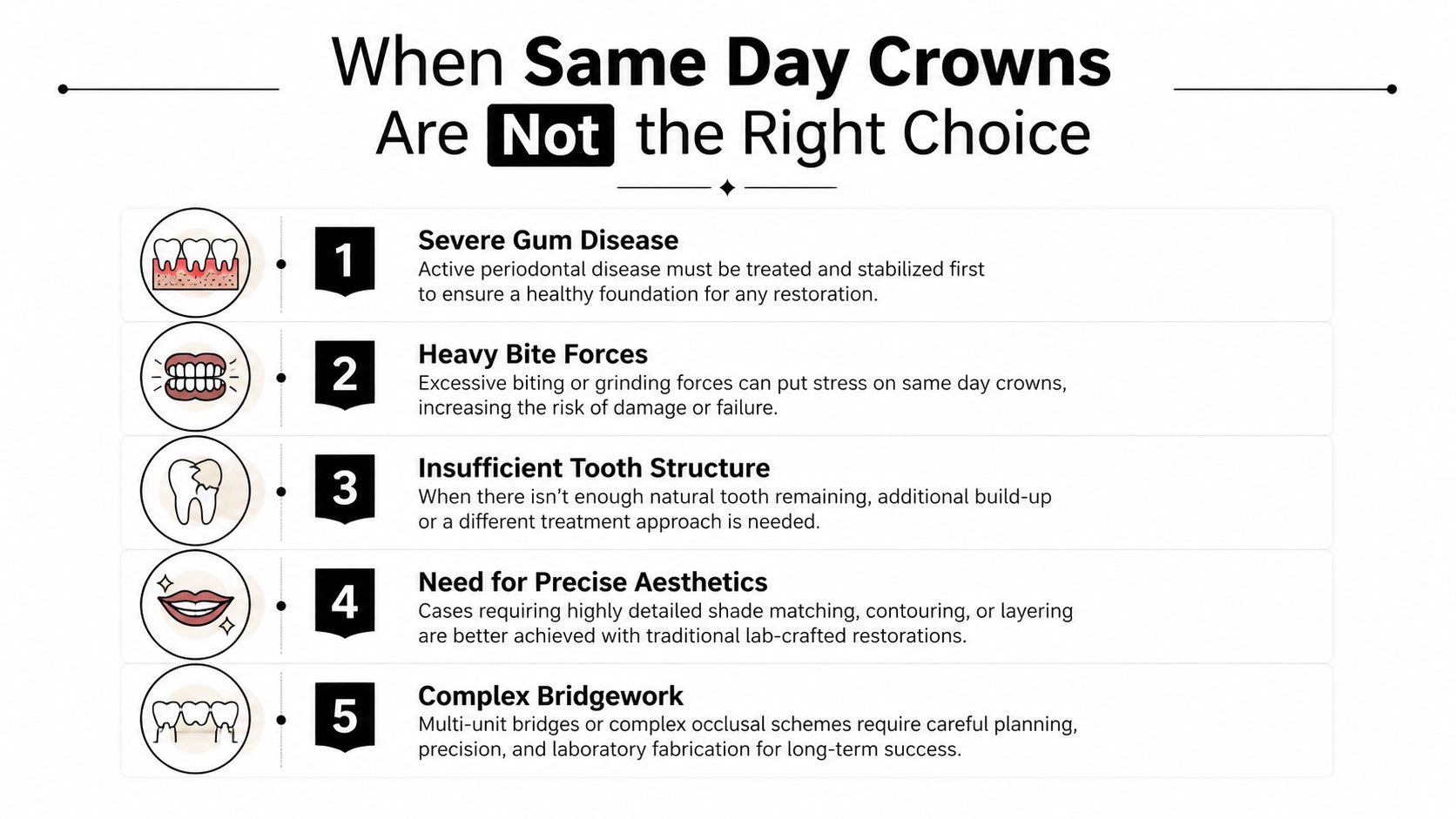
Situations that may favor laboratory fabrication
- Extensive build-up: If little healthy tooth structure remains, the dentist may need a more involved foundation before choosing the final crown.
- Long-span bridgework: A bridge spanning multiple teeth or replacing missing teeth often benefits from laboratory planning and fabrication.
- Heavy grinding or clenching: Severe bruxism can place forces on ceramic that may require a different material or reinforcement strategy.
- Limited mouth opening: A scanner wand and chairside workflow need adequate access. Restricted opening can make accurate scanning and placement more difficult.
- Highest-level cosmetic matching: A laboratory ceramist can hand-layer porcelain and make detailed shade adjustments for demanding anterior cases.
Complex implant-supported cases, multiple-unit treatment, uncontrolled moisture, and very deep margins may also favor a laboratory crown for predictability, as described in this guidance on choosing between same-day and laboratory crowns.
A dentist who recommends a laboratory crown when same-day treatment is possible in theory may be protecting the result, not rejecting the technology.
The consultation should include a frank discussion of the tooth's structure, gum health, bite, scan access, material, and backup plan. Patients searching for a cosmetic dentist near me, an emergency dentist, or restorative care in Miami shouldn't feel pressured to choose speed before the case has been evaluated.
Recovery and Long-Term Care for Same Day Crowns
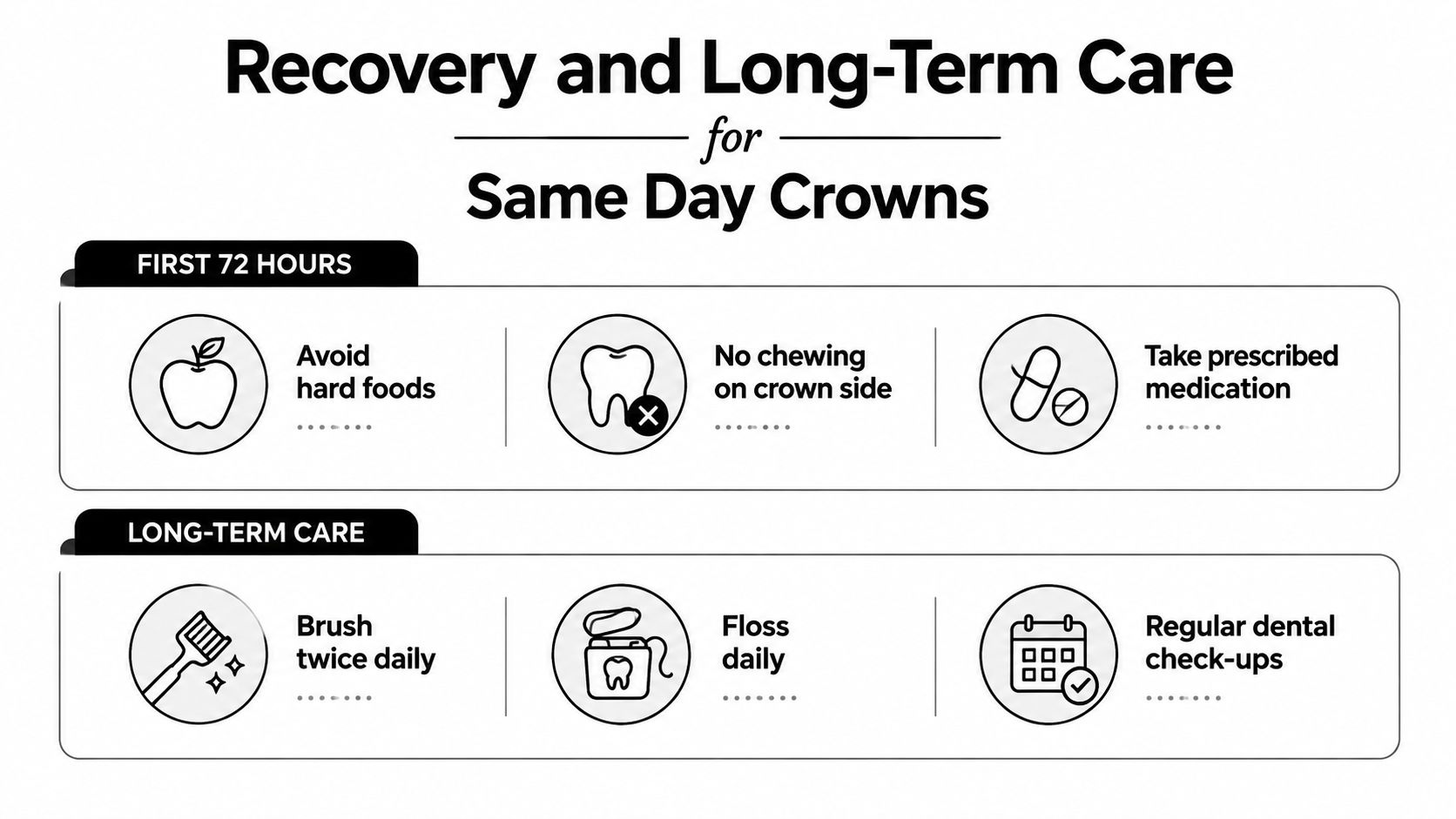
The first part of crown care is short-term protection. Numbness can make it easy to bite a cheek or tongue, so patients should wait until normal sensation returns before eating normally. Mild sensitivity around the treated tooth can occur after preparation and bonding, but persistent, severe, or worsening pain deserves a call to the dental office.
During the early recovery period, harder foods and chewing directly on the restored side may be uncomfortable. Patients should follow the dentist's medication instructions and avoid using the crown to open packages, bite objects, or chew unusually hard items.
A Miami-friendly maintenance routine
Cuban coffee, citrus-heavy drinks, and acidic beverages can challenge the surrounding enamel and the gumline if patients sip them frequently. A beach day and chlorine exposure aren't direct reasons to expect crown failure, but daily habits still make plaque control and hydration important. Stressed professionals who clench or grind at night may need a night guard to reduce force on the restoration.
- Brush the margin carefully: Clean where the crown meets the gum without scrubbing aggressively.
- Clean between teeth daily: A water flosser or unwaxed floss can help remove plaque around the contact and gumline.
- Keep professional visits: Cleaning and exams help the dentist monitor the crown, gums, and neighboring teeth.
- Protect against grinding: A properly fitted night guard can reduce damaging nighttime pressure.
A realistic lifespan depends on material, bite, hygiene, gum health, and habits. Many patients can expect a same-day crown to serve for 10 to 15 years with good care, although no restoration lasts forever. A crack, chip, looseness, swelling, persistent sensitivity, or a bite that suddenly feels uneven should prompt a follow-up.
For additional home-care guidance, patients can review how to care for dental crowns.
Cost of Same Day Crowns in Miami and What to Ask
The fee for a same-day crown reflects more than the ceramic block. Cost drivers can include the office's investment in scanners and milling equipment, the selected material, the tooth's location, the amount of preparation required, and whether the tooth needs a build-up or core before the crown is placed.
Insurance often classifies a same-day crown similarly to a laboratory crown because both are restorative crown procedures. Coverage still depends on the patient's plan, waiting periods, exclusions, deductibles, and annual maximum. A patient should request a written estimate rather than assume that the technology determines coverage.
Patients can use this guide to same-day crown costs as a starting point, then ask the Miami practice for a case-specific estimate. Advertising that says “from a particular price may exclude imaging, preparation, a build-up, bite adjustments, or follow-up visits.
Questions worth bringing to the consultation
What does the quoted fee include? The estimate should clarify whether it covers the consultation, dental x-rays or other imaging, preparation, a build-up, crown placement, and follow-up care.
Is the crown made in the office? Patients can ask whether the practice owns the milling unit, uses an outside laboratory, or combines both workflows.
What happens if the crown needs to be remade? The office should explain its warranty period, adjustment policy, and conditions that could affect coverage.
What is the laboratory backup? Even an office that offers same-day treatment may use a laboratory for cases that become too complex or require a different material.
Which material is being recommended, and why? The answer should connect the material to the tooth's position, bite force, appearance, and remaining structure.
A clear conversation protects the patient from surprise fees and helps reveal whether the proposed workflow is clinically sensible. The lowest advertised starting fee isn't necessarily the lowest total cost if essential steps are added later.
Same Day Crown FAQs and Booking Your Miami Visit
How long does the appointment take?
A straightforward same-day crown appointment typically takes 90 to 120 minutes, although preparation, material choice, gum conditions, and bite adjustments can change the schedule. A dentist may recommend more time when the tooth needs extensive repair or when the final shade requires careful evaluation.
Will the numbing wear off normally?
Yes, local anesthetic normally fades after the appointment. Until sensation returns, patients should avoid chewing and take care not to bite the cheek, lip, or tongue.
Will the crown feel different from a natural tooth?
The crown may feel unfamiliar at first because its shape and contact with neighboring teeth are new. It shouldn't feel persistently high, painful, or unstable. If the tooth strikes first when biting, the patient should contact the office for a bite adjustment rather than trying to wait through ongoing discomfort.
Can an existing crown be replaced on the same day?
Sometimes. The dentist must first assess why the existing crown needs replacement, how much tooth structure remains, whether the gums are healthy, and whether the scan can capture the margins. A replacement crown may be suitable for chairside fabrication, but a laboratory restoration can be more predictable when the case involves complex preparation or demanding shade matching.
Can teeth whitening change a crown's color?
Whitening products lighten natural tooth structure, but they don't change the established color of a ceramic crown. Patients considering teeth whitening and a new crown should discuss treatment order with the dentist so the restoration can be matched to the intended smile shade.
How long can a same-day crown last?
A realistic expectation for many patients with good hygiene is 10 to 15 years, though the actual service life depends on the material, bite, gum health, tooth structure, and daily habits. Regular dental cleanings, exams, and prompt attention to chips, looseness, swelling, or ongoing sensitivity support early intervention.
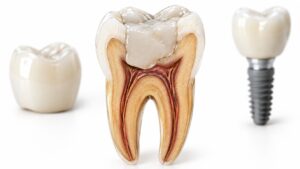
Patients in Brickell, Coral Gables, Miami Beach, Downtown Miami, Midtown Miami, and nearby communities can schedule a consultation to determine whether same-day crown technology fits the tooth and the schedule. Ultra Smile DentalSpa combines digital scanning and in-office fabrication with restorative, cosmetic, emergency, and preventive dental care, so the treatment plan can address the full condition of the mouth rather than only the visible chip.
Schedule a same-day crown consultation with Ultra Smile DentalSpa to discuss the tooth's structure, material options, bite, appearance, and expected care. The Miami team can help determine whether a single-visit crown is appropriate or whether a laboratory restoration, dental implant, tooth extraction, or another restorative service would provide the more dependable result.