A lot of people start searching what are night guards made of after the same kind of night. They wake up with a tight jaw, a dull headache near the temples, or teeth that suddenly feel more sensitive than usual. Sometimes a partner hears grinding first. Sometimes a chipped edge on a front tooth is what finally gets attention.
For patients looking for a dentist near me or a dentist in Miami, FL, the material question matters more than most websites make it seem. A night guard isn't just “plastic. The material affects comfort, safety, durability, fit, and whether the guard is appropriate for light clenching or heavy grinding. It also matters whether the guard is professionally made or bought online, especially for patients worried about long-term exposure to lower-quality materials.
At a practice that provides dental care, new patient exams, dental x-rays, emergency visits, and restorative treatment in Miami, the goal is to protect teeth before grinding leads to more serious treatment such as crowns, tooth extraction, or even replacement options for damaged teeth. Patients who already search for cosmetic dentist near me, Dental implants near me, or emergency dentist often don't realize that unmanaged bruxism can damage both natural teeth and existing dental work.
Table of Contents
- Protect Your Smile While You Sleep with a Dentist in Miami
- A Guide to Common Night Guard Materials
- Soft vs Hard Guards What Your Dentist Recommends
- Dual-Laminate Guards The Best of Both Worlds
- Why a Custom Night Guard From Your Dentist is Safer
- Schedule Your Night Guard Consultation in Miami Today
Protect Your Smile While You Sleep with a Dentist in Miami
Many patients in Miami describe the same pattern. They feel fine during the day, then wake up with facial tension, pressure around the jaw joints, or a sense that their bite feels “off in the morning. Others come in because someone sleeping nearby heard grinding, or because a tooth that never bothered them before has started to feel sensitive.
That's usually when the search begins for a dentist near me, an emergency dentist, or a dentist in Miami, FL who can figure out whether nighttime clenching is becoming a real problem. Grinding can wear enamel, stress restorations, and aggravate soreness in the jaw. It can also affect cosmetic work, which matters to patients who have already invested in veneers, whitening, or other smile improvements.
A night guard can help, but only when the material matches the way a person grinds or clenches. Someone with mild nighttime clenching may do well with a softer appliance. Someone who bears down heavily often needs a firmer material that won't deform under pressure. Patients exploring night guards for teeth grinding in Miami often don't realize that the right answer depends on force, symptoms, bite pattern, and existing dental work.
Why the material question matters
A night guard sits in the mouth for hours at a time. Patients should know what it's made from and whether it's intended for light or heavy use. The difference between medical-grade EVA and rigid acrylic such as PMMA isn't academic. It changes how the guard feels, how long it lasts, and how well it protects teeth.
A guard that feels comfortable at first isn't always the one that gives the safest long-term result.
For patients in Downtown Miami, Midtown Miami, and Hallandale Beach, this decision also fits into bigger oral health planning. A detailed exam can identify whether symptoms come from simple clenching, more forceful bruxism, TMJ-related strain, or damage that now overlaps with restorative dentistry, cosmetic dentistry, or urgent care needs.
A Guide to Common Night Guard Materials
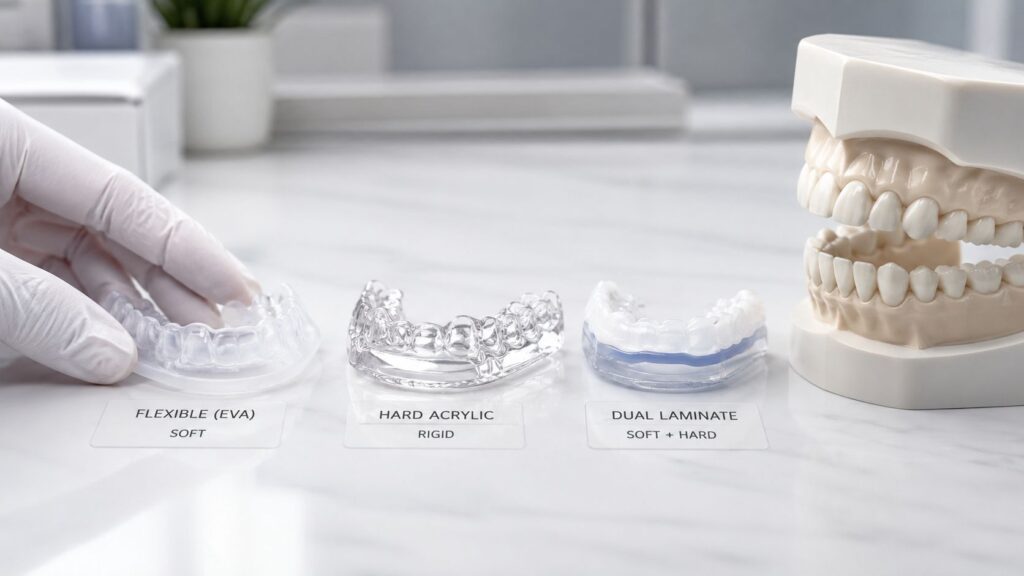
Night guards generally fall into three categories. Soft guards, hard guards, and dual-laminate guards. Each material type solves a different problem, and choosing correctly is part of good clinical care, not personal preference alone.
The three material categories patients should know
Soft night guards are usually made from ethylene-vinyl acetate, or EVA. EVA is widely used because it's flexible, lightweight, and able to cushion teeth for patients with mild clenching or mild bruxism. Modern medical-grade EVA is also recognized as BPA-free, BPS-free, latex-free, and phthalate-free, which makes it a strong option for patients concerned about chemical exposure, as outlined in this night guard material safety review.
Hard night guards are made from rigid acrylic polymers, most commonly polymethyl methacrylate, or PMMA. This type of material doesn't flex much, which is exactly why it's used when the grinding force is stronger and the appliance needs to hold its shape under pressure.
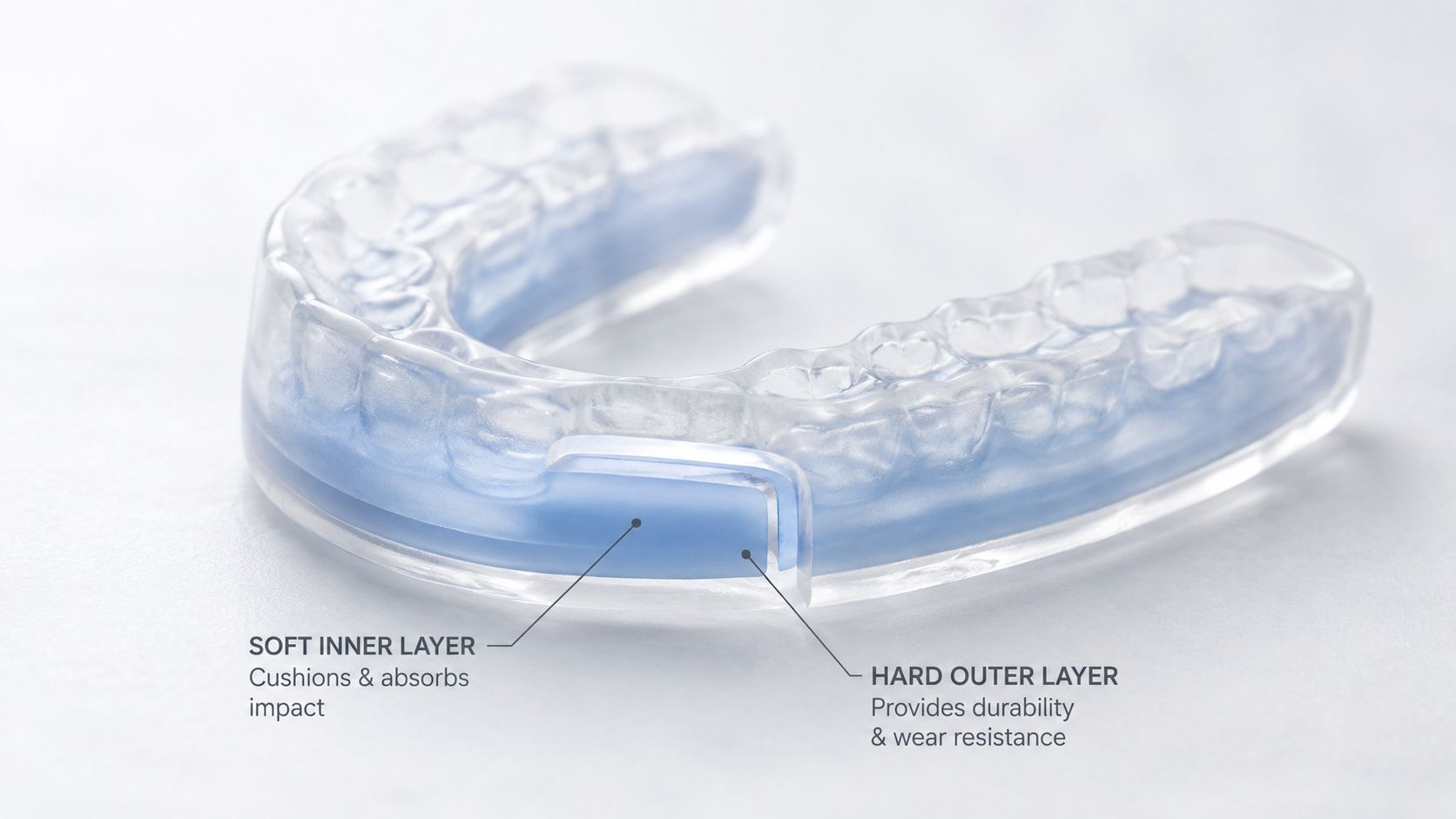
Dual-laminate guards combine both ideas. They place a softer inner layer against the teeth and a harder outer shell on the outside. For some patients, that mix creates a more workable balance between comfort and durability.
Night Guard Material Comparison
| Material Type | Primary Material | Best For | Feel | Durability |
|---|---|---|---|---|
| Soft | EVA | Mild clenching or mild bruxism | Cushioned and flexible | Lower than hard acrylic |
| Hard | PMMA acrylic | Severe grinding and high-force clenching | Firm and rigid | High |
| Dual-laminate | Soft inner layer with hard acrylic outer layer | Patients needing both comfort and stronger protection | Soft inside, firm outside | Moderate to high |
Patients often assume softer means safer. That isn't always true. A soft material can feel easier at first, but a heavy grinder may chew through it faster or distort it over time. A hard guard may feel more noticeable at first, but it can be the more protective choice when the goal is preserving enamel and preventing fractures.
Practical rule: The right material is the one that matches the force pattern, not the one that sounds nicest in a product description.
That distinction matters in general dentistry and in larger treatment planning. If a patient already has crowns, fillings, veneers, or is considering dental implants near me, protecting the bite from nighttime stress becomes even more important.
Soft vs Hard Guards What Your Dentist Recommends
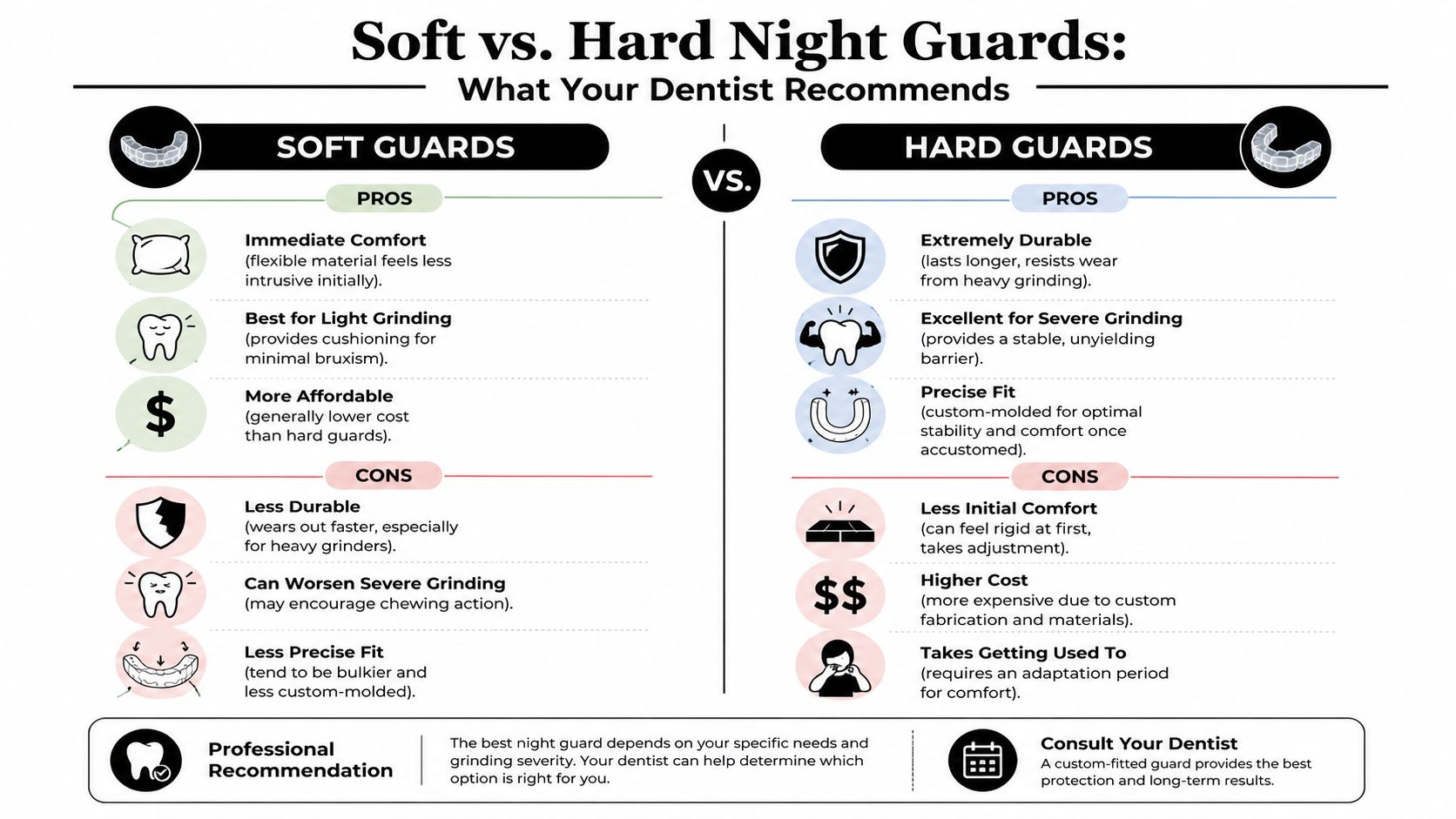
The most common clinical decision comes down to soft EVA versus hard acrylic PMMA. Both are established dental materials. The better option depends on how aggressively the patient clenches or grinds, what symptoms are showing up, and whether the teeth already show damage.
When a soft guard makes sense
Soft guards are usually made from EVA, a flexible thermoplastic used widely in custom appliances. High-quality EVA is considered safe for oral use because it contains no phthalates or BPA, and custom soft guards are valued for their shock-absorbing feel and ability to adapt closely to the teeth. Clinical data also places soft EVA materials in a Shore A hardness range of 70 to 95, which helps explain the cushioned texture patients notice right away, according to this overview of night guard materials and best use cases.
For the right patient, a soft guard can be a good match when:
- Symptoms are mild: Jaw soreness is present, but tooth wear appears limited.
- Comfort is the main barrier: Some patients won't wear a rigid appliance consistently at first.
- Clenching is more common than aggressive grinding: Cushioning can help these patients tolerate nighttime wear better.
A soft guard is not the universal answer. That's where many online guides oversimplify the topic.
When a hard guard is the safer choice
Hard night guards are fabricated from rigid acrylic polymers, especially PMMA, because that material provides the structural stability needed for severe grinding. Standard heavy-grinding models are typically approximately 1.5mm thick to resist enamel wear and tooth fractures, as described in this clinical overview of dental night guard materials and manufacturing.
That firmness matters when the bite force is high. Under strong grinding pressure, softer materials can wear through, compress, or invite a chewing response. A hard guard creates a more stable barrier.
Patients usually lean toward hard guards when there is:
- Visible tooth wear on the chewing edges.
- Repeated breakage of softer appliances.
- Pain around the jaw joints linked to heavy nighttime activity.
- Existing crowns, veneers, or restorative work that need more reliable protection.
Heavy grinders usually need a material that resists the habit, not one that yields to it.
There's also a safety nuance patients rarely hear. Soft polymers can shed microplastic particles faster under heavy grinding, particularly when the appliance is low quality or worn. That risk is one reason severe grinders often do better with a custom, medical-grade option selected for force tolerance, as discussed in this review of night guard microplastics risk.
For patients comparing options, the recommendation is less about comfort on night one and more about what protects the teeth over time. Ultra Smile DentalSpa offers both soft and hard night guards as part of custom treatment planning based on bite pattern and grinding severity.
Dual-Laminate Guards The Best of Both Worlds
Some patients fall in the middle. They grind hard enough that a soft guard may not hold up well, but they dislike the feel of a fully rigid appliance. That's where a dual-laminate guard can be useful.
How the layered design works
A dual-laminate guard combines a soft inner surface that sits against the teeth with a hard outer shell that provides strength. The soft interior improves day-one comfort and retention. The harder exterior helps the appliance tolerate more force than a purely soft guard.
This design is often a practical compromise for patients who:
- Need more durability than EVA alone can offer
- Struggle to adapt to a fully hard guard
- Have moderate to heavier grinding with sensitivity to bulk or rigidity
Modern hard components in these appliances are typically based on the same family of acrylic materials used in hard guards, while the inner side keeps a softer contact layer against enamel and restorations.
Who usually benefits most
A dual-laminate guard often suits the patient whose symptoms don't fit into a simple “light or “severe category. They may report morning jaw fatigue, early wear on the teeth, or damage to previous dental work, but still find fully hard appliances harder to tolerate during the adjustment period.
That flexibility in treatment matters for a full-service office in Miami that also provides cleaning and exams, dental x-rays, restorative dentistry, smile improvements, and follow-up care. The guard material has to fit the actual person wearing it, not just a category on a chart.
The best appliance is the one the patient can wear consistently and that the bite can tolerate safely.
For patients who want to see the concept visually, this short video gives a useful overview of how night guards are made and fitted.
In some cases, other thermoformable materials may be used for specific clinical goals, but most patients are deciding among soft, hard, or dual-laminate designs. The right match depends on grinding force, jaw symptoms, tooth wear, and whether there are crowns, veneers, or implant restorations that need protection.
Why a Custom Night Guard From Your Dentist is Safer
The biggest safety mistake patients make is assuming any night guard sold in a store or online is close enough to a custom appliance. It isn't. Material quality, fit, and manufacturing standards all affect the result.
The safety issues patients miss with OTC guards
Custom-made night guards fabricated in dental laboratories are clinically superior to over-the-counter options because they provide a precise fit that helps prevent unnecessary wear and tear. OTC guards may use lower-cost materials such as PVC, which are less durable and less safe than the medical-grade EVA and PMMA used in custom appliances, leading to higher failure rates and potential health risks, according to this discussion of custom night guards versus lower-cost alternatives.
Some imported or over-the-counter boil-and-bite guards also create a chemical safety issue that many patients never hear about. While many domestic guards are marketed as BPA-free, some imported products have been confirmed to contain BPA and may also involve phthalate concerns. That's a major difference from medical-grade custom options and one reason patients comparing custom night guards and store-bought guards should look beyond price alone.
Another point that gets blurred online is the difference between safe, modern acrylics and older or non-compliant formulations. Patients may hear “hard plastic and assume all hard guards are equal, but they aren't. This review of night guard material safety concerns in imported products explains why that distinction matters.
Why fit changes the outcome
The second problem with OTC guards is fit. A stock tray can't account for the exact shape of the teeth, the bite relationship, or how the jaw closes at night. That mismatch can lead to bulkiness, shifting, sore gums, poor retention, and uneven contact.
A custom guard changes that in practical ways:
- It fits the actual anatomy: The appliance is formed from a model or scan of the patient's teeth.
- It wears more evenly: A better fit reduces unnecessary movement and friction.
- It supports treatment planning: The dentist can match thickness and material to the clinical problem.
- It helps protect previous dental work: That matters for crowns, veneers, fillings, and implant restorations.
Patients should also inspect their guard regularly. Clinical guidance recommends checking for breakage or perforation on a weekly basis and replacing the appliance immediately if damage is found, according to the same custom night guard reference linked earlier.
For some patients, a low-cost guard feels like an easy short-term answer. But when the appliance fits poorly, wears quickly, or uses questionable materials, it can create new problems instead of preventing them. That can eventually feed into more complex treatment needs, including restorative dentistry, emergency care, or replacement of damaged dental work.
Schedule Your Night Guard Consultation in Miami Today
A patient who comes in for grinding symptoms usually starts with a straightforward visit. The dentist checks for wear on the enamel, bite changes, tenderness in the jaw muscles, and damage to fillings, crowns, or cosmetic work. If needed, new patient exams, dental x-rays, and a closer bite evaluation help determine whether the problem is mild clenching, stronger bruxism, or part of a larger treatment picture.
What the visit looks like
The next step is choosing the right material and design. Some patients need a soft EVA guard because comfort and mild cushioning are the priority. Others need hard acrylic because the teeth are already showing signs of heavy force. Patients who land between those two categories may do better with a dual-laminate design.
Once the appliance type is selected, digital records or impressions are used for fabrication, and the final fitting makes sure the guard seats properly and feels stable. At a Miami office designed for patient comfort, details like a calm environment, aromatherapy, entertainment during treatment, and a smoother visit flow can make the process easier for people who usually avoid the dentist.
When to book sooner rather than later
Some signs shouldn't wait:
- Morning jaw pain: Especially if it's happening regularly.
- Chipped or flattened teeth: Wear tends to progress, not reverse.
- Broken fillings, crowns, or veneers: Grinding often contributes.
- Headaches with bite tension: The pattern may be related to nighttime clenching.
- Tooth sensitivity: Worn enamel can expose more vulnerable tooth structure.
Patients searching for a dentist in Miami, FL, cosmetic dentist near me, Dental implants near me, tooth extraction, or emergency dentist often discover that grinding is part of the reason they need care in the first place. Addressing it early can help protect natural teeth, cosmetic work, and restorative treatment already in place.
A consultation with Dr. Neda Bahmadi is the clearest way to determine which material is safe, comfortable, and appropriate for long-term wear in Miami, Downtown Miami, Midtown Miami, or Hallandale Beach.
If nighttime grinding, jaw tension, or tooth wear has become part of daily life, schedule a consultation with Ultra Smile DentalSpa. A custom evaluation can identify the right night guard material, protect existing dental work, and help prevent the kind of damage that turns into bigger treatment later.