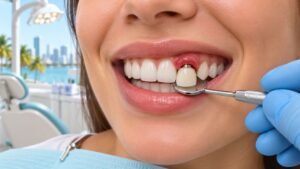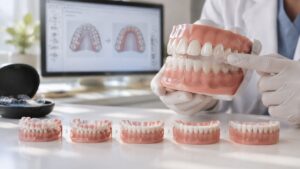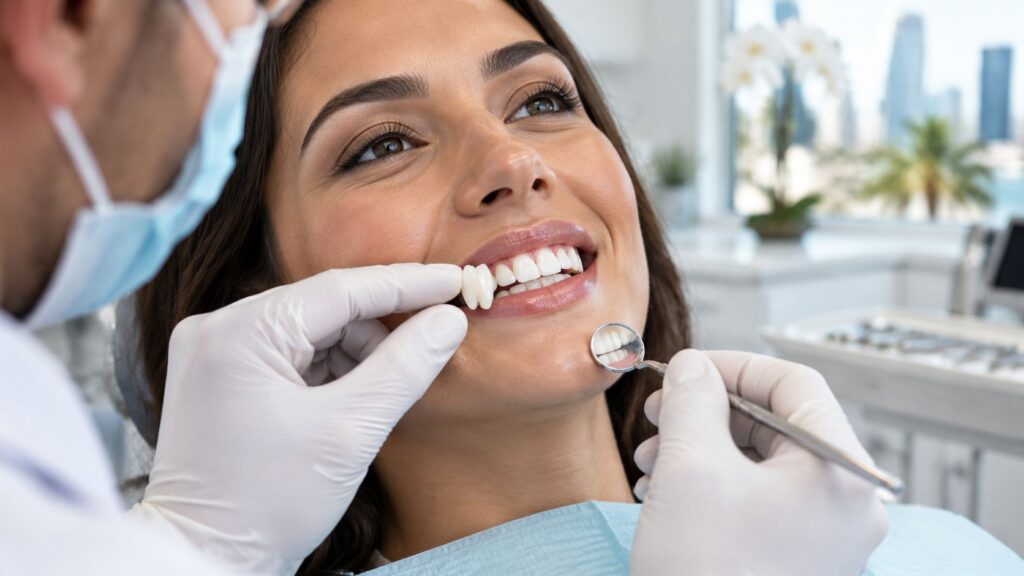
Yes, a dentist can remove veneers, and the appointment itself usually takes a single visit. The enamel that was trimmed away to make room for the porcelain, roughly 0.3 to 1.0 millimeters in a conventional case, does not grow back, so the tooth underneath won't return to how it looked before treatment.
That gap between "the veneer can come off" and "the tooth goes back to normal" is where most disappointment starts. The advice patients hear most often, that veneers are a reversible choice you can undo later, is only half true. Removal is a real, routine dental procedure. Reversal is not a procedure at all, because no dentist can rebuild enamel that was cut away.
What follows is the honest version. It covers what comes off, what stays behind, how a dentist decides what to place next, and the questions worth asking before anyone touches the porcelain.
Table of Contents
- Yes, Veneers Can Come Off, but Your Tooth May Not Go Back
- Why Enamel Loss Makes Veneer Removal Permanent
- How Long Veneers Last and Why Some Come Off Early
- How a Dentist Removes a Veneer Step by Step
- What Happens to Your Tooth After Veneer Removal
- Book a Veneer Removal Consultation in Miami
Yes, Veneers Can Come Off, but Your Tooth May Not Go Back
A dentist separates a bonded shell from a tooth with controlled instrumentation under magnification. That part is routine and usually comfortable under local anesthesia. What the tooth looks like afterward has nothing to do with how carefully the shell was lifted. It depends entirely on what was done to the tooth before the veneer ever went on.
The American Dental Association is direct about this, describing veneer treatment as irreversible because placement usually involves removing enamel from the facial and proximal surfaces, and enamel doesn't regenerate (ADA MouthHealthy guide to veneers). Once that layer is gone, the tooth stays prepared for life.
Three broad categories of veneer behave very differently on the way out.
Veneer types and what removal leaves behind
| Veneer type | Tooth preparation | Can it be removed? | What usually comes next |
|---|---|---|---|
| Conventional porcelain | About 0.3 to 1.0 mm of enamel reduced | Yes, by a dentist; the enamel loss is permanent | Replacement veneer, bonding or a crown |
| No-prep or minimal-prep porcelain | Little or no enamel reduced | Yes, often with less structural impact; depends on design and bonding | Protective restoration if dentin is exposed, otherwise re-bonding or a new veneer |
| Composite resin veneers | Usually little or no enamel reduced | Yes, usually removed and polished off | Repair, re-bonding or replacement |
Removal and reversal are two different words
Patients hear "reversible" and picture their original smile coming back. What returns, in a conventional porcelain case, is a prepared tooth that needs coverage. It's often smaller, rougher and more temperature-sensitive than the neighbors.
The distinction that matters: a dentist can take the ceramic off. Nothing in dentistry can put the enamel back.
That's why the useful question isn't "can veneers be removed" but "what protects this tooth once they're off." Debonding is the easy half. Choosing the right restoration is the half that decides how the next decade feels.
Read your records first
The single most useful thing a patient can do before booking is find out whether their veneers were conventional or minimal-prep. Dental records, radiographs and old photographs usually answer it, and so does a call to the office that placed them. That one detail sets the entire pathway, because a tooth that kept its enamel has options a prepared tooth doesn't.
Why Enamel Loss Makes Veneer Removal Permanent
Enamel is the hard mineralized shell covering the crown of a tooth. It's the hardest tissue in the body and the only one that never repairs itself. Think of a wall that gets sanded before a fresh coat of paint. The paint can be peeled away years later, but the sanded surface stays exactly as it was left. A prepared tooth behaves the same way.
Preparation isn't arbitrary. It does three jobs at once.
- It creates room. A veneer is a shell of finite thickness, so the tooth gives up a little material to keep the finished smile from looking bulky.
- It sets the contour. Slight reshaping at the edges lets porcelain sit flush at the gum line instead of catching the lip.
- It gives the bond a clean surface. Adhesive dentistry works best on freshly prepared enamel rather than years of wear and old surface texture.
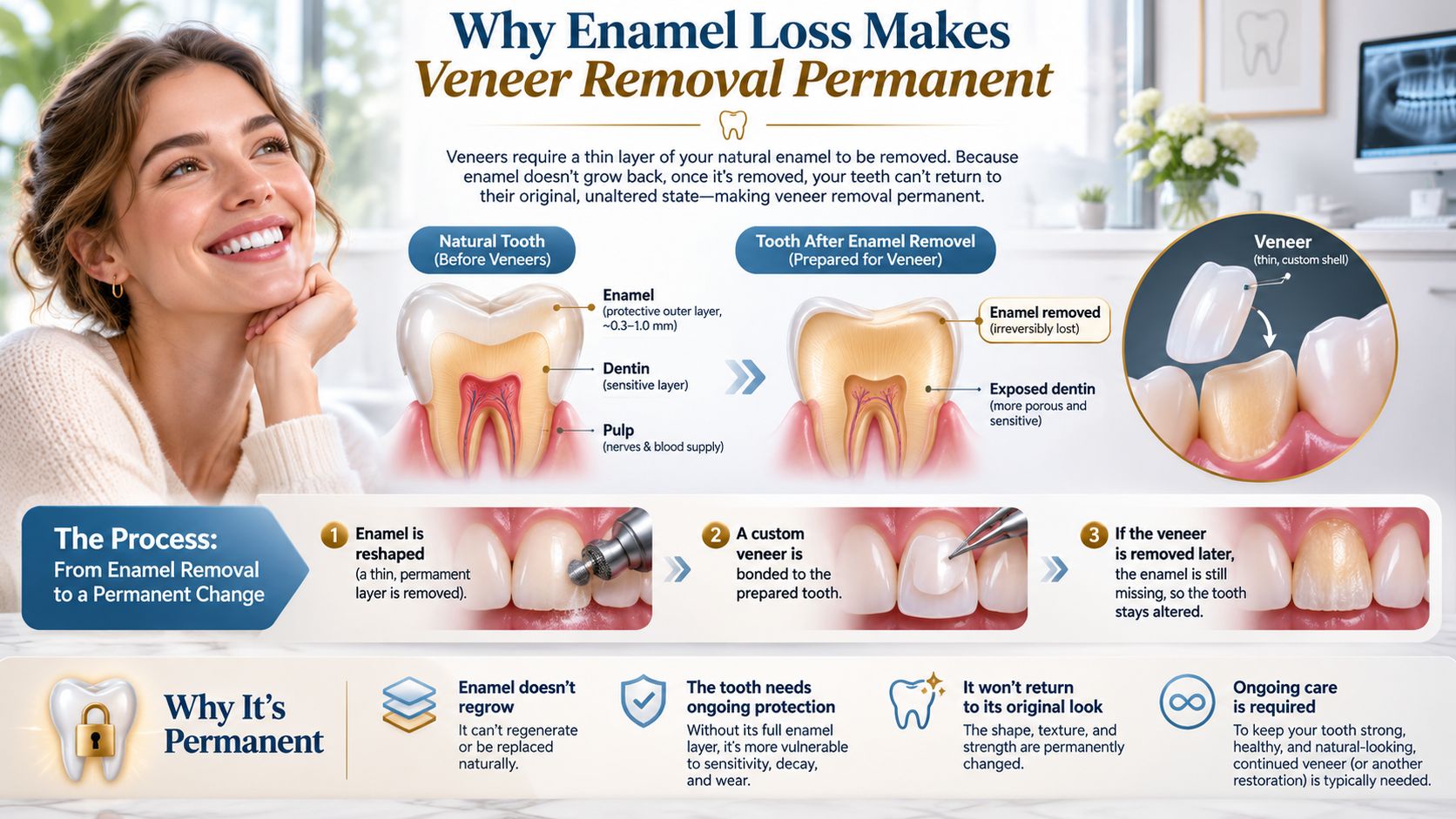
A 2026 review of the clinical literature calls conventional preparation an irreversible loss of tooth structure, and puts typical reduction at roughly 0.3 to 1.0 millimeters to create space for the ceramic and support predictable bonding (2026 review of veneer preparation and enamel loss). The same review notes that no-preparation approaches preserve more enamel but suit selected mild cosmetic cases rather than every smile.
At Ultra Smile DentalSpa, the approach is a minimal amount of enamel removed to make space for veneers, which keeps as much healthy tooth as possible. Minimal still means permanent. A reduction too small to see with the naked eye is still gone for good.
What changes when dentin is exposed
Dentin sits directly beneath enamel. It's softer, more porous and threaded with microscopic tubules that connect toward the nerve. When preparation reaches it, or when a dentist finds it exposed after removal, two things shift at once.
Sensitivity climbs first. Hot coffee, cold water and firm pressure land differently on dentin than on enamel. Bond strength gets less predictable too, because resin grips dentin less reliably than it grips enamel. The 2026 review links dentin exposure to postoperative sensitivity and weaker restoration performance, which is exactly why the next restoration has to be chosen with care rather than improvised.
Two questions worth asking before anyone touches the porcelain
Ask how much enamel was removed at placement, and ask whether the preparation reached dentin. Those two answers tell you whether a new veneer, a round of composite bonding or a crown is the practical path. Cases vary widely, and a plain breakdown of how much enamel is removed for veneers helps put the range in context before a consultation.
How Long Veneers Last and Why Some Come Off Early
Durability is the reason removal is usually a planned restorative decision rather than an emergency reversal. A systematic review of porcelain laminate veneer studies estimated a 95.5% cumulative survival rate at 10 years (systematic review of porcelain laminate veneer survival). Most veneers that come off come off because something changed, not because the material gave out on schedule.
Here's the short version of what patients ask most about what stays and what goes.
When the same review separated individual complications, estimated 10-year survival came out at 96.3% where fracture counted as the failure reason, 99.2% for debonding, 99.3% for secondary caries and 99.0% for the need for endodontic treatment. Read those numbers as a map of what goes wrong. Chipping and fracture lead the list, with decay underneath and loosening behind it.
Outcomes aren't uniform across every practice and every mouth. A separate systematic review of long-term studies following patients for 10 to 12 years found survival ranging from 53% to 94.4%, a spread driven by case selection, preparation, material, oral hygiene, bite forces and study design.
The bonding surface matters more than the shade
Where the veneer was bonded turns out to predict a lot. A 2024 review found roughly 99% survival for veneers bonded primarily to enamel, against about 94% when bonded to composite resin and 91% when severe dentin exposure was present. That's the same principle showing up again from a different angle: enamel is the surface adhesive dentistry wants.
Most veneers that come off aren't failures of porcelain. They're restorations that aged out, or ones whose bite was never corrected in the first place.
Why a veneer comes off early
- Fracture or chipping. Often a bite problem wearing away at the incisal edge rather than a weak ceramic.
- Debonding. A loose margin lets bacteria and stain travel underneath.
- Discoloration. Porcelain itself holds color well, but the cement line and the tooth beneath can darken over time.
- Recurrent decay. A leaking margin is invisible from the front while trouble builds at the edge.
- Changed cosmetic goals. Shape, length and shade preferences move as patients age.
None of these figures mean every veneer lasts exactly ten years. Many stay functional well past a decade, and when one does come off for a failure, replacement usually follows rather than a bare tooth. Longevity also depends on the habits patients keep, and a plain explanation of how long veneers last covers the maintenance side.
How a Dentist Removes a Veneer Step by Step
Removal is a sequence, not a single motion. Every step exists to protect whatever enamel is left and to avoid turning a cosmetic problem into a structural one.
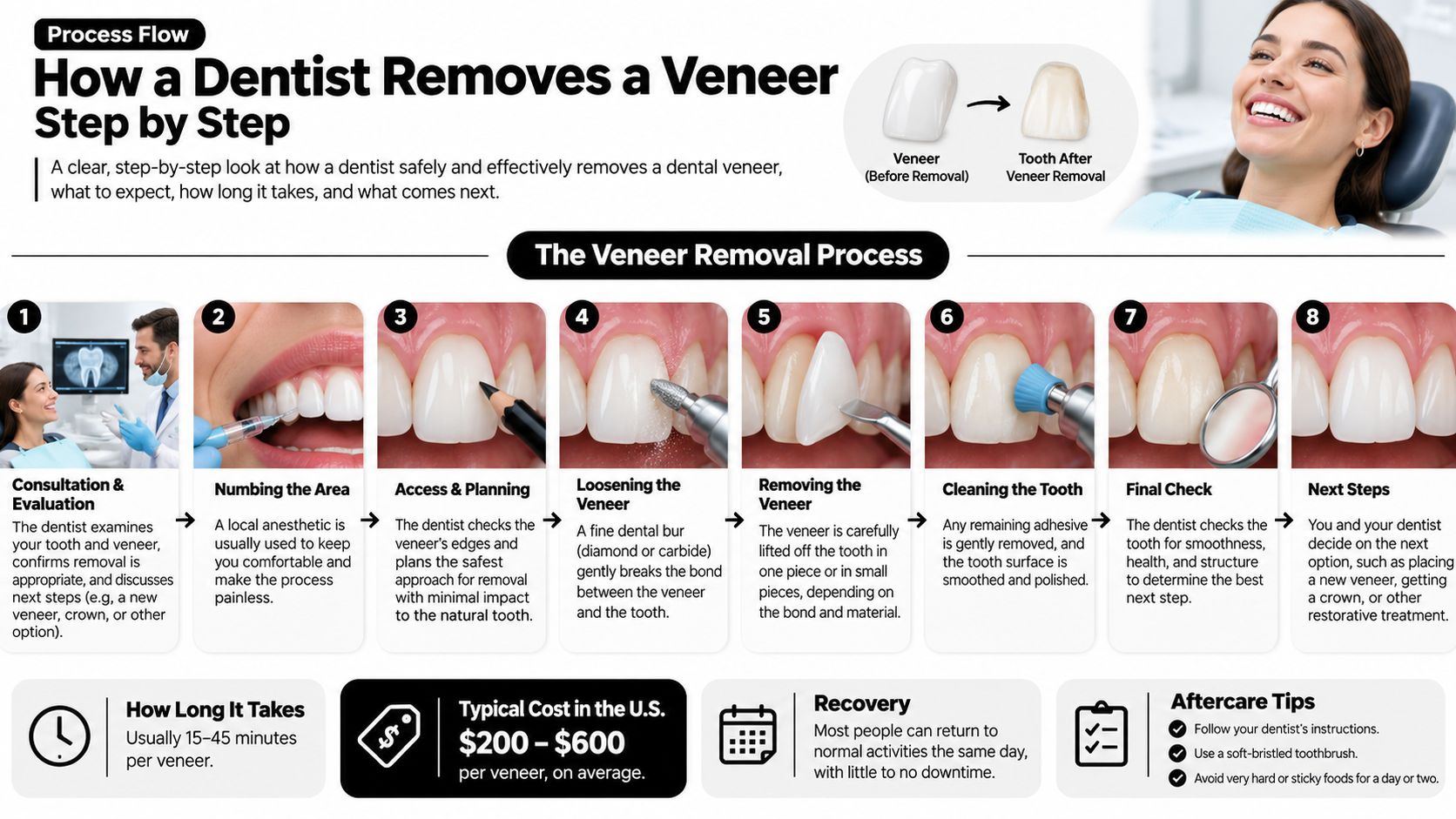
- Review the records. X-rays, photographs and past notes show how the tooth was prepared and how deep the original reduction went. Skipping this step is how a straightforward replacement turns into a surprise mid-appointment.
- Examine the tooth first. The dentist checks for decay, cracks, gum irritation and bite problems before touching the veneer. A veneer that looks fine can be sitting over active decay.
- Choose the method. Controlled sectioning or debonding with hand instruments is the standard route. Laser-assisted removal enters the conversation where the case suits it.
- Section slowly, piece by piece. Wedging or prying at an edge can crack the tooth the veneer is bonded to. Slow separation protects both the tooth and the neighbors.
- Clean off the bonding. Old resin looks almost identical to enamel at normal viewing distance, so this is done under magnification. Rushed cleanup is how a reversible case becomes an irreversible one.
- Assess what remains. The dentist checks how much enamel survives, whether dentin is exposed, and how the tooth responds to air and touch.
- Plan the next restoration before you leave. A prepared tooth should never go home unprotected, and temporaries cover that gap while a final restoration is made.
Where laser-assisted removal fits
A 2026 randomized clinical trial reported successful removal of ceramic veneers with both conventional and laser-assisted approaches, with the laser protocol showing a significant time advantage and sometimes lifting the restoration in one piece (clinical guide to veneer removal and laser-assisted debonding). An intact veneer can sometimes be recemented when the tooth interface stays suitable.
The trial measured removal efficiency, not enamel regeneration, guaranteed recementation or freedom from further treatment. Laser doesn't restore lost structure, and it doesn't make a conventional veneer biologically reversible.
Never attempt this at home: a veneer bonded to enamel resists fingernails, floss and every household tool. Prying one loose chips enamel, cracks the ceramic and often damages the tooth underneath.
What a successful removal looks like
A clean, stable tooth with no active decay, no cracks and no gum inflammation, plus a written plan for what covers it next. That's the finish line. A veneer that comes off beautifully but leaves an unprotected tooth isn't a success, it's a delay.
What Happens to Your Tooth After Veneer Removal
What the dentist finds under the shell sets the entire plan. There's no single outcome, which is why a good consultation spends its time on diagnosis rather than shade selection.
What the dentist finds under the veneer and the next step
| Finding at removal | What it means | Typical next step |
|---|---|---|
| Intact enamel | Tooth surface is sound and suitable for bonding | New veneer or composite bonding |
| Exposed dentin | Higher sensitivity and a weaker bond surface | Protective restoration and desensitizing care |
| Decay under the veneer | Bacteria reached the tooth structure | Treat the decay, then restore the tooth |
| Large crack or fracture | Significant tooth structure is missing | Crown or other full-coverage restoration |
| Bonding or cement residue | Leftover material on the surface | Clean and polish before the new restoration |
| Gum inflammation | Irritation near the veneer edge | Treat the gums before restoring the tooth |
The replacement options, compared
A new porcelain veneer is custom-made from an impression of the teeth, which is how Ultra Smile DentalSpa produces restorations that match their neighbors, and it suits a tooth with sound enamel and a stable bite. Composite bonding is the conservative choice for small areas, though resin stains and roughens faster than ceramic. A crown fits when too much structure is missing for a shell to hold.
Leaving the tooth bare is the one option that rarely works. Exposed dentin brings sensitivity and decay risk, and a prepared tooth looks smaller than the teeth beside it.
The risk nobody mentions early enough
If the first veneer failed because of grinding, inadequate bonding or decay, a replacement can fail the same way. Treating the cause and reassessing the bite come before selecting a new restoration. Patients who clench at night often need a night guard alongside the new work.
The removal technique itself is still an emerging clinical issue rather than a cosmetic inconvenience, and the evidence on laser approaches remains limited (patient guide to whether veneers can be removed). Newer tools may preserve more, but they don't make removal universally atraumatic. The appropriate endpoint is often a conservative re-restoration rather than a return to untouched teeth (guide to veneers and what removal really means).
Aftercare and the signals that matter
Mild sensitivity to heat, cold or pressure usually eases as the tooth settles. Lasting sensitivity deserves a check. Sharp or persistent pain, swelling or a loose tooth warrants a call within the week, because pain can point to decay, gum inflammation, bite problems or pulpal disease rather than the veneer itself.
Routine check-ups are how veneers and the teeth under them get monitored over the years, and they catch a leaking margin before it becomes a cavity. Bring original records, old photographs, a written list of symptoms and any history of clenching or grinding to the first visit.
Book a Veneer Removal Consultation in Miami
The next decision matters more than the removal itself. A consultation at Ultra Smile DentalSpa begins with a detailed review of your dental needs and cosmetic goals, then works through your original records and X-rays to establish how your teeth were prepared. From there, the team can outline what should replace the veneers and what that involves in time, comfort and cost.
The practice serves Downtown Miami, Midtown Miami and Hallandale Beach, so a patient searching for a cosmetic dentist near me in any of those neighborhoods has somewhere local to start. Visits are built around comfort, with a calm treatment environment and clear explanations at each stage rather than a hurried pitch.
What the appointment covers
An exam with dental x-rays, photographs and a bite assessment comes first. Then a conversation about realistic options, which may include custom veneer replacement, composite bonding or crowns, alongside general and restorative dentistry such as cleanings, dental implants for a tooth beyond saving, tooth extraction, and emergency dentist care if something is actively painful.
Patients often arrive with a specific worry: a dark line at the gum, a chip that keeps returning, or a smile that never felt like theirs. Naming the cause changes the plan. It's also worth asking how the practice handles calls that arrive while the team is chairside, since a dental office in Miami, FL that runs a busy schedule can't always pick up mid-procedure, and Heyline's guide to dental call coverage explains how an answering service keeps new patient enquiries from dropping into voicemail.
What to bring
- Old records and photographs. They show the original tooth shape and how much enamel was reduced.
- A symptom list. Note sensitivity, bleeding gums, looseness or discomfort when biting.
- A grinding history. Clenching changes the plan more often than patients expect.
- Your questions. Write them down, including whether removal will be drilled or laser-assisted.
Nothing needs to be decided on the spot. What matters is knowing whether the veneers can come off safely and what will protect the teeth afterward, before a small cosmetic concern becomes a painful one.
Ultra Smile DentalSpa combines advanced clinical dentistry with a spa-like visit in Downtown Miami, Midtown Miami and Hallandale Beach, and its team, led by Dr. Neda Bahmadi, DMD, handles veneer consultations, custom replacement, composite bonding and same-day crowns under one roof. If a veneer feels loose, looks dated or sits over a tooth that's become sensitive, an exam and a written plan will tell you exactly what comes next. Visit Ultra Smile DentalSpa to request a consultation and get a clear answer about your veneers.