Only 61.3% of patients were free from minor or major complications after five years in a systematic review of implants supporting fixed partial dentures. That's the detail often missing from the dental implants vs partials conversation: a replacement can remain in place and still need repairs. For Miami adults dealing with missing teeth, uncomfortable chewing, or a loose appliance, the useful question isn't which option lasts longer. It's which treatment fits the mouth, the daily routine, and the willingness to maintain it.
Table of Contents
- Dental Implants vs Partials at a Glance in Miami
- How Missing Teeth Change Bite and Bone
- Longevity and the Maintenance Each Option Needs
- Which Option Fits Common Missing-Tooth Cases
- Surgery Steps and What to Expect Afterward
- 2026 Costs and Typical Treatment Timelines
- Daily Care, Cleaning, and Recall Visits
- Choose Your Option and Book a Consultation
Dental Implants vs Partials at a Glance in Miami
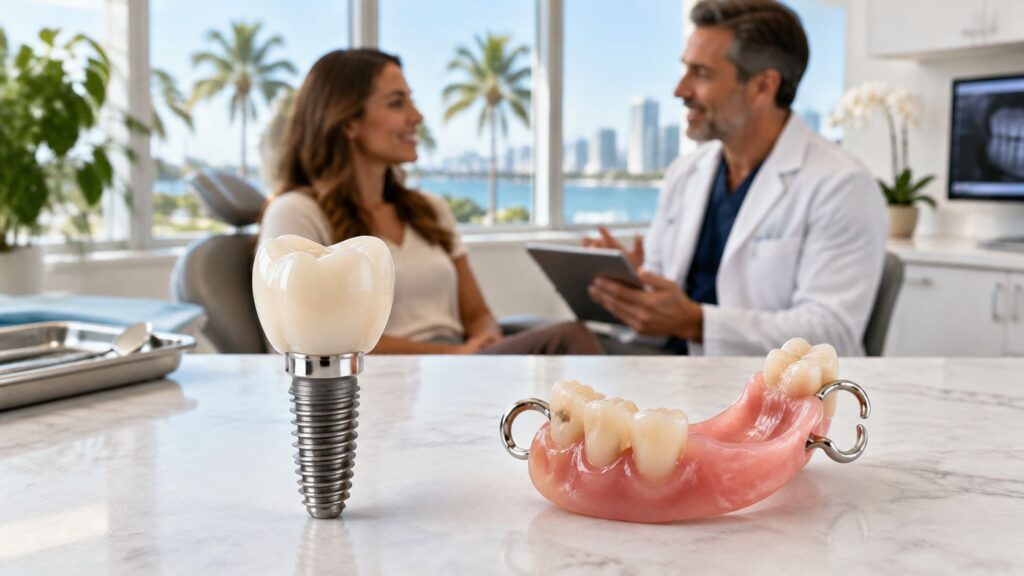
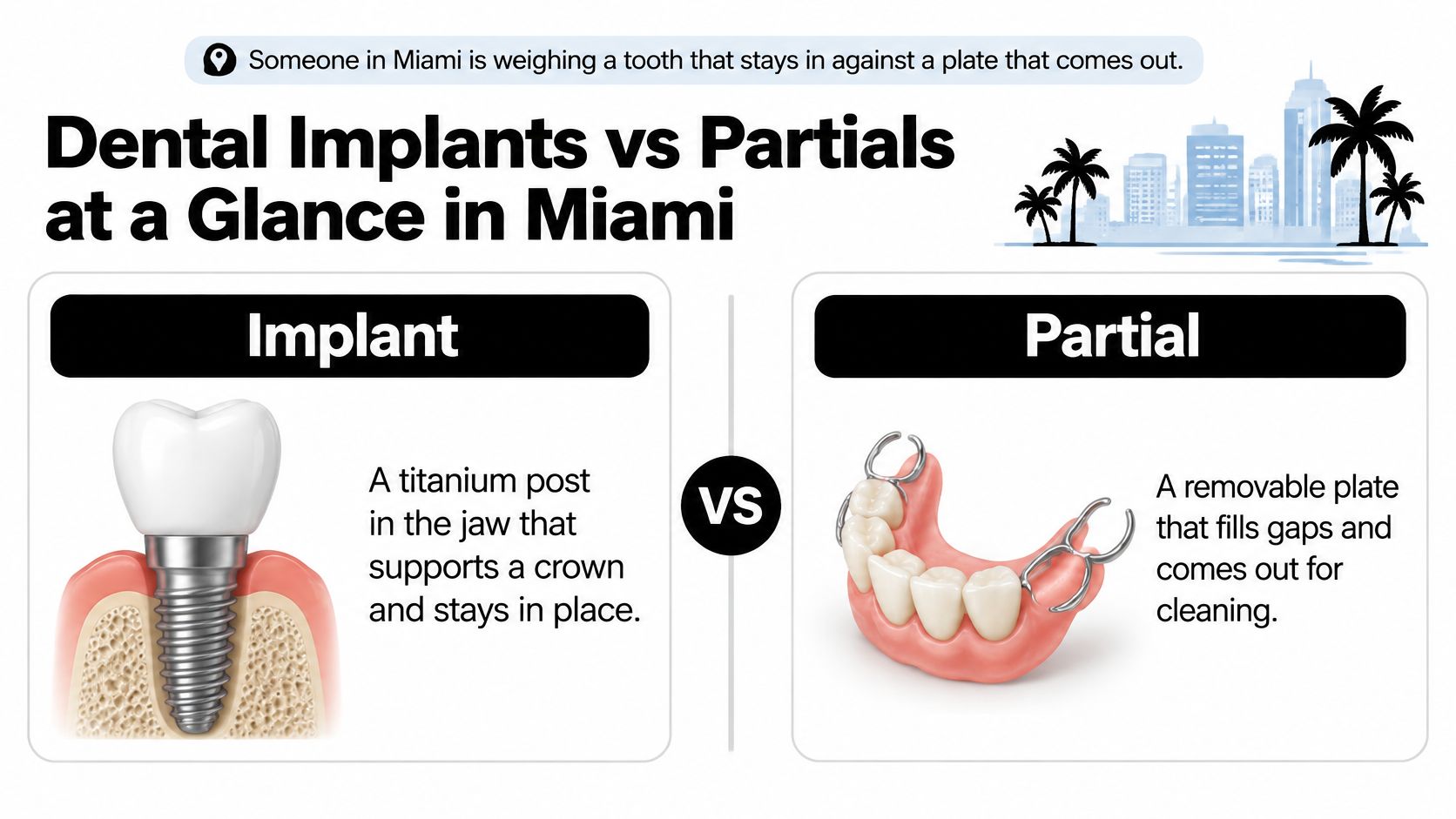
An implant's titanium post is placed in the jawbone, then heals for several months before a custom crown is attached. A partial replaces missing teeth with an appliance that rests on the gums and may use clasps around remaining teeth. The right comparison includes how each is held, cleaned, and maintained.
| Factor | Dental implants | Removable partials |
|---|---|---|
| How it is held | Titanium post in the jawbone, followed by a custom crown | Gum-colored base and clasps on remaining teeth |
| Chewing and speech | Fixed in place; cleaning around it takes care | Removed for cleaning; fit and pressure need attention |
| Jawbone | Transfers chewing force to the bone at the implant site | The ridge beneath the removable base can change over time |
| Surgery | Post placement, possible graft, and several months of healing | Usually no implant surgery |
| About five years | About 95.4% implant survival when supporting a fixed partial, not a repair-free guarantee | About 95.3% supporting-tooth survival and 95.1% denture survival |
| Typical fee | Set by a local exam; no single fee applies to every case | Set by a local exam; partial costs depend on the case |
| Daily care | Brush and clean around the implant and restoration | Remove and clean as directed; monitor clasps and sore spots |
| Often a fit for | People seeking a fixed tooth with suitable bone and gum health | People replacing several teeth or seeking a removable option |
The survival figures describe different study groups, not a head-to-head comparison or a promise for an individual. Around 95% survival does not mean no repairs, and a partial can be a lasting treatment rather than a temporary step.
A fixed tooth or a removable appliance
An implant replaces a tooth root with a titanium post. After several months of healing, a custom crown is attached. A partial denture fills gaps with replacement teeth on a base, supported by the gums and, in many designs, clasps on remaining teeth.
A fixed implant crown stays in place, while a partial can be taken out for cleaning. Implants involve surgery and healing; partials avoid implant surgery but need checks for fit, movement, and pressure on supporting teeth. Some treatment plans use a partial now and consider implants later, or use implants to help support a partial. Replacing each missing tooth with an individual implant is not the only option.
Ultra Smile DentalSpa serves Downtown Miami, Midtown Miami, and Hallandale Beach, and offers implants and bone grafts, partials and dentures, and crowns and bridges. An exam and digital X-rays can help determine which options suit the patient's mouth.
Decision point: Consider whether a fixed tooth is a priority, or whether a well-fitting removable replacement could meet your needs.
For a patient searching for a dentist near me, the next step is to request an assessment through the practice's own consultation process. Dental practices may use tools to automate appointment booking with Expressify AI, but patients should follow the booking process provided by their chosen practice.
How Missing Teeth Change Bite and Bone
A Miami patient missing back teeth may begin chewing almost entirely on the opposite side. Another may avoid smiling because a front gap shows, or notice that air escapes differently during speech. These symptoms can occur together, but the underlying bite needs an examination rather than an assumption.
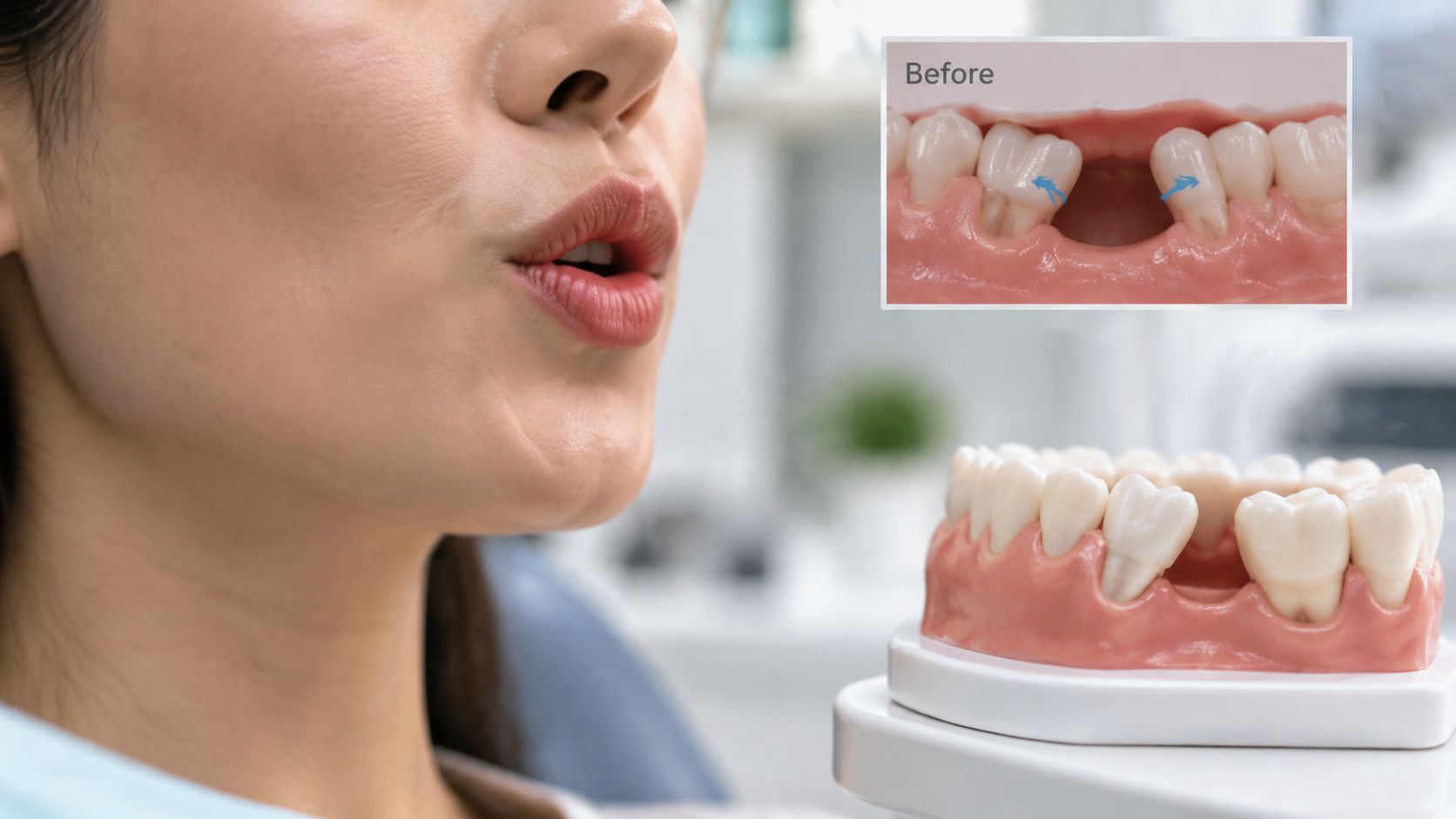
Without contact from the missing tooth, neighboring teeth can tip into the space and the opposing tooth may move toward it. The bone around an empty socket also remodels after tooth loss. The amount and pattern of change differ between mouths.
Matching the replacement to the problem
An implant transfers chewing force through its post into the jaw. That can help maintain bone around the loaded site, but it doesn't prevent every form of bone loss or replace treatment for gum disease.
A partial restores visible teeth and chewing surfaces without placing a post into each gap. Its framework can help maintain the arrangement of remaining teeth, although the dentist must control how the appliance loads those teeth. The ridge beneath the removable base can continue changing.
This model illustrates how the supporting structures differ.
The middle path that often gets overlooked
An implant-assisted partial remains removable, but strategically placed implants help steady it. A clinical publication in Dentistry Journal discusses improved stability and patient-centered outcomes with implant assistance, while emphasizing hygiene and ongoing attachment maintenance.
Consider a patient whose partial rocks at the back during meals. Adding implant support may address that movement without converting every missing tooth into a separate implant crown. The dentist still needs to confirm suitable bone, attachment space, and a design the patient can clean.
A conventional partial can also be a planned first stage. Later implant treatment remains conditional on anatomy and health, so future conversion shouldn't be promised before planning.
A removable replacement isn't automatically lesser care. A treatment that the patient can clean and maintain may be the more practical choice.
Facial pain needs its own diagnosis. Pain and Sleep Therapy Center's comparison is an educational resource for distinguishing jaw-joint and nerve-pain questions, not evidence that a missing tooth explains every facial symptom. Digital X-rays, a gum examination, and a bite assessment help a dentist in Miami, FL separate those concerns.
Longevity and the Maintenance Each Option Needs
An implant can remain in place and still need attention. The post in the jawbone and the visible restoration are separate parts, so their survival and repair needs are measured separately.
| Option | 5-year result | 10-year result | Typical follow-up |
|---|---|---|---|
| Implant supporting a fixed partial | 95.4% implant survival | No estimate provided | Check for biological and mechanical complications |
| Crown or bridge on those implants | No estimate provided | No estimate provided | Check for fractures, loose screws, and lost retention |
| Conventional tooth-supported partial | Teeth 95.3%; denture 95.1% | Performance declines with longer wear | Clasp adjustment, reline, later replacement |
| Implant-assisted partial, uniform attachments | About 98.8% implant survival | No uniform ten-year estimate established by the cited attachment-system findings | Attachment wear and peri-implant mucositis |
| Cantilever implant bridge | About 1% failure across reviewed follow-up, not a five-year estimate | No separate ten-year estimate established | Technical problems 14%; retention loss 13%; biological problems about 20% |
The fixed-partial figures distinguish the implant from the restoration attached to it. The reviewed findings also describe biological complications and mechanical problems, including fractured covering material, loose screws, and lost retention.
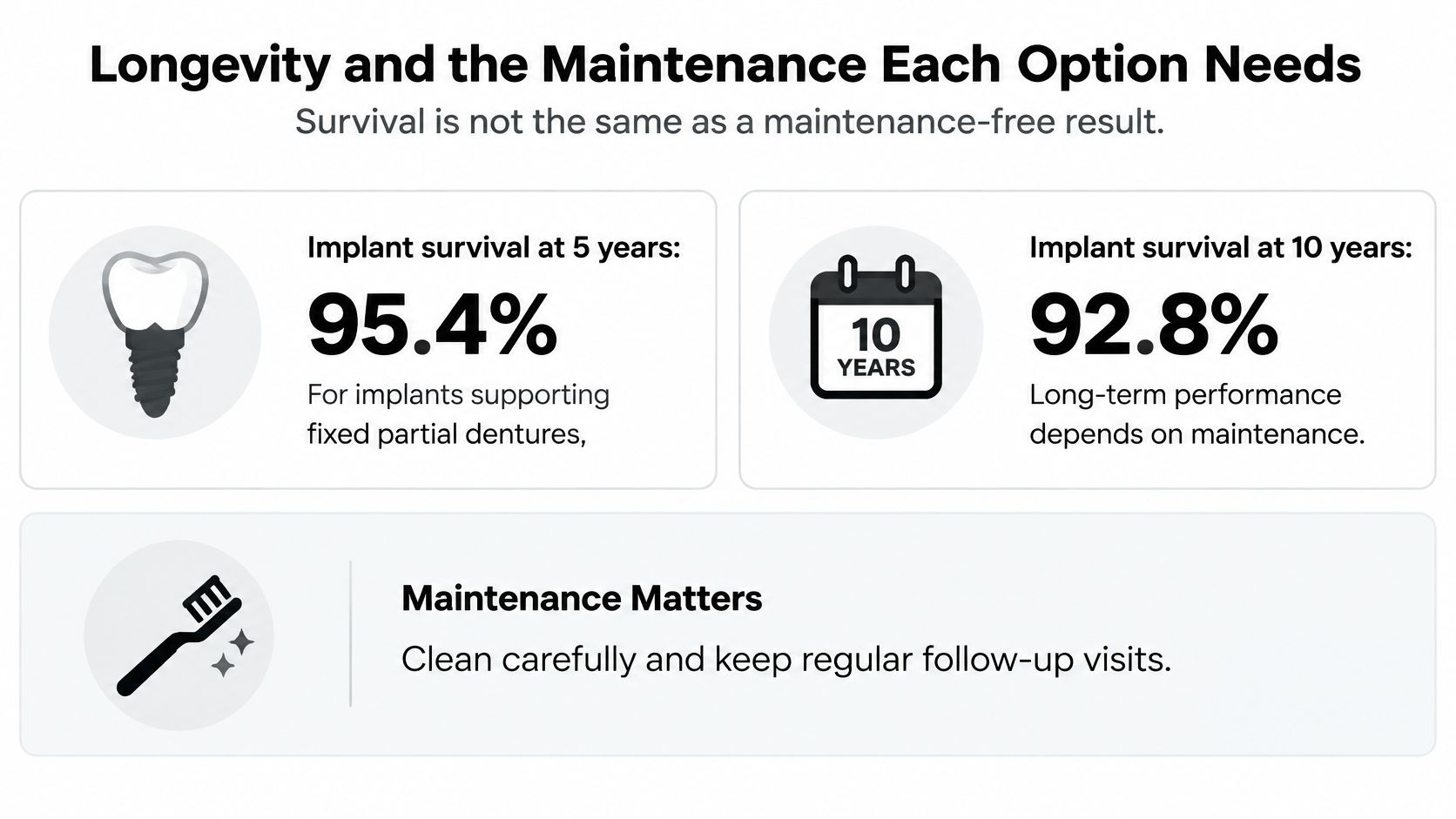
Why a surviving implant may still need care
A systematic review of implant-assisted partial dentures found implant survival ranging from 95.1% to 100%, while stricter implant success measures ranged from 70.9% to 90.6% across included studies. An implant may remain in place even if inflammation, bone changes, or mechanical problems need treatment.
Attachment design also affects follow-up. A review of tooth-implant-supported removable partial dentures reported approximately 98.8% implant survival after five years for uniform attachment systems, alongside complications requiring care. These results don't predict what will happen with every fixed crown or removable design.
For a conventional partial, the supporting teeth need regular monitoring, too. A reline reshapes the underside of the base so it fits the gums better. It doesn't treat decay or gum disease.
Bridge design changes the maintenance burden
A systematic review of implant-supported cantilever fixed partial dentures reported approximately 1% implant or prosthesis failure, but 14% prosthesis- or abutment-related complications, 13% retention loss, and biological complications in about 20% of cases. The evidence certainty was low, and extensions longer than 7 mm had more technical problems.
Those findings apply to a particular bridge design, not to implants generally. Before treatment, ask who will address loose screws, worn attachments, repairs, and follow-up imaging.
The accompanying video offers another visual reference for the implant discussion.
Which Option Fits Common Missing-Tooth Cases
A systematic review of conventional tooth-supported removable partial dentures reported approximately 95.3% survival for supporting teeth and 95.1% for dentures after five years, with performance declining over longer use. That supports treating a partial as a legitimate restorative option, not an inferior substitute.
The useful recommendation changes with the patient's starting point.
Different gaps call for different plans
A missing molar with healthy gums and adequate bone. A single implant and crown is often worth considering when the patient wants a fixed replacement without a clasp. The dentist must still check clearance, bite forces, and access for cleaning.
Several separated gaps with sound supporting teeth. A partial may restore those spaces through a shared framework. Metal frameworks can provide rigidity, while flexible nylon designs may reduce visible metal, but flexibility isn't automatically better for support or long-term adjustment.
A partial that shifts during meals. An implant-assisted partial may be the most targeted change. A review of tooth- and implant-supported removable partial dentures found estimated implant survival of 99.3% at three years and 98.8% at five years for uniform attachment designs, although attachments and supporting tissues still required maintenance.
When preparation matters more than the restoration
For a thin ridge, the practical choice may be grafting before implant placement or continuing with a removable appliance. A partial shouldn't be described as preserving unlimited future implant options, because bone can change while treatment is postponed.
Active gum disease or poorly controlled medical conditions require attention before elective implant treatment. Heavy smoking also changes the risk discussion. A temporary or definitive partial may be reasonable during preparation, but it still needs healthy support.
- Limited hand strength: A removable appliance may make caregiver-assisted cleaning easier, provided removal and reinsertion are manageable.
- Dental anxiety: Staged care can separate urgent needs from elective surgery.
- A crowded work schedule: Someone commuting through Downtown or Midtown Miami may prefer a plan with clearly identified treatment and adjustment visits.
The examination should record which teeth are missing, ridge shape, remaining-tooth health, bite, cleaning ability, and realistic attendance for follow-up. No material or survival percentage replaces that assessment.
Surgery Steps and What to Expect Afterward
Implant treatment and partial-denture treatment begin with records, but the appointments serve different purposes. Implant planning evaluates a surgical foundation; partial planning evaluates how an appliance will fit, function, and share support.
The implant sequence
- Examination and imaging. Digital X-rays and a gum and bite examination help assess the site. Additional imaging may be needed to understand bone dimensions and nearby structures.
- Preparation and post placement. Unsalvageable teeth may require extraction, and inadequate bone may require grafting. After numbing, the clinician places the titanium post.
- Healing. The bone develops a stable connection with the post over several months. A temporary removable replacement may fill a visible gap when it won't interfere with healing.
- The custom crown. Once the site is ready, the dentist attaches the replacement tooth and checks the bite.
Early recovery may involve soreness, softer foods, and careful cleaning around the surgical site. Smoking should be avoided, and worsening swelling, persistent bleeding, or increasing pain warrants prompt contact with the treating clinician. The dental implant healing timeline explains the distinction between early recovery and readiness for the final restoration.
The partial-denture sequence
- Records and impressions capture the mouth and the relationship between the jaws.
- The laboratory makes the framework, base, and replacement teeth, with fitting checks when needed.
- Delivery includes a bite check, clasp assessment, and instruction on insertion and removal.
- Adjustment visits address pressure points rather than expecting the patient to tolerate sores.
A Cochrane review of denture impression techniques found no reliable overall evidence establishing a universally superior approach; evidence specific to partial dentures was very limited. Careful design, laboratory work, and follow-up matter more than a claim that a particular impression material guarantees comfort.
Ultra Smile DentalSpa offers root canals, deep cleanings, tooth extraction services, and bone grafts when those treatments belong in the restorative plan. Saving a useful supporting tooth may change the entire design, so extraction shouldn't be automatic.
2026 Costs and Typical Treatment Timelines
The 2024 Synchrony Average Procedural Cost Study, conducted by ASQ360° Market Research and summarized in this denture-cost overview, reported U.S. averages of $1,738 for resin-based partials, $1,761 for flexible-nylon partials, and $2,229 for metal-framework partials. These are national averages from that study, not current Miami quotes or guaranteed package prices.
Partial fees and treatment clocks
| Path | Published U.S. average | What the fee covers | Usual calendar |
|---|---|---|---|
| Resin-based partial | $1,738 | Appliance category with acrylic teeth and a gum-colored base; included visits require confirmation | Impressions, laboratory work, delivery, and adjustments |
| Flexible nylon partial | $1,761 | Flexible-base appliance; preparation and follow-up inclusions require confirmation | Laboratory fabrication and fit checks |
| Metal-framework partial | $2,229 | Cast framework and replacement teeth; supporting-tooth treatment may be separate | Framework checks, fabrication, and delivery |
| Implant then custom crown | No single supported national average | Itemized post, connecting components, crown, and any grafting | Several months of healing before final restoration; crown fabrication may be completed in one visit when appropriate |
Separating the appliance fee from total care
A written estimate should distinguish the replacement from preliminary treatment. Tooth extraction, periodontal care, a root canal, or grafting can change the total even when the final appliance is unchanged.
Later costs deserve a place in the discussion too. A removable appliance may need a reline or clasp repair, while an implant-assisted design may need replacement retention components.
Insurance benefits shouldn't be assumed. Patients can bring the insurance card and request benefit verification for the proposed procedures, including exclusions, limits, and patient responsibility. For Medicare-related questions, Prime Journal's Medicare coverage check guide provides a starting checklist, but it isn't confirmation that a particular dental procedure is covered.
Budget rule: A useful estimate names the complete treatment sequence, not just the most attractive starting fee.
Healing time isn't crown-making time
Conventional partials move through laboratory fabrication and fitting without waiting for an implant to join with bone. Their calendar still changes when teeth need treatment first.
Ultra Smile DentalSpa creates crowns and bridges with CEREC technology in one visit, without temporary solutions or multiple crown-fabrication appointments. That capability doesn't eliminate implant healing. A free consultation can be requested through the form on the treatment pages to clarify the proposed sequence and local fee.
Daily Care, Cleaning, and Recall Visits
A restoration should be chosen with its cleaning routine in mind. A patient who can brush a visible crown easily may still struggle to reach underneath an implant bridge. Someone who prefers a removable partial must be able to handle it safely or have reliable assistance.
Cleaning a fixed implant restoration
A soft toothbrush cleans the crown and gumline. Floss threaders, appropriately sized interdental brushes, or a water flosser can help reach spaces that a standard brush misses, with the tool selected for the restoration's design.
The clinician should demonstrate the route rather than recommend better flossing. Excessive force or the wrong brush size can irritate tissue, while inaccessible spaces may require changes to the hygiene plan.
At recall appointments, the dental team checks the tissues, bite, and restoration. X-rays are taken when clinically indicated to assess bone and other structures, not automatically at every cleaning.
Cleaning and monitoring a partial
The appliance should be removed for cleaning, with a soft denture brush and a suitable nonabrasive cleanser. Cleaning over a towel or a basin containing water reduces the chance of breakage if it slips.
- Protect the material: Hot water can distort an appliance, and some soaking products aren't suitable for metal components.
- Clean the supporting teeth: Plaque around clasps and contact areas needs attention even when the appliance looks clean.
- Report changes early: Persistent sores, cracks, food trapping, or a loose clasp call for assessment rather than home bending or adhesive repair.
The guide to caring for partials and dentures provides additional appliance-care information. Overnight removal and storage should follow the instructions for the specific material.
Maintenance works best when the patient knows who handles an urgent repair before a clasp breaks or a crown becomes loose.
Recall timing should reflect gum health, medical history, dexterity, and the condition of supporting teeth. Smoking, diabetes, and missed preventive visits can make monitoring more important, regardless of whether the replacement comes out.
Choose Your Option and Book a Consultation
The decision starts with bone and gum health, the pattern of missing teeth, and the problem the patient most wants solved. A visible gap, difficulty chewing, and a rocking plate may require different approaches even when the number of missing teeth is similar.
A consultation should leave the patient with more than a treatment name. The useful outcome is a written explanation of the proposed restoration, necessary preparation, healing requirements, cleaning access, and maintenance responsibilities.
Preparing for a Miami consultation
Patients can bring a medication list, dental insurance information, and any existing appliance. Notes about where food catches, when the partial lifts, or which area becomes sore help focus the examination.
- For comfort concerns: Record whether discomfort occurs during chewing, insertion, or prolonged wear.
- For appearance concerns: Identify which gap or clasp shows during speech and smiling.
- For scheduling concerns: Explain work commitments and any difficulty returning for adjustments.
Someone searching for dental implants near me should expect a discussion of removable alternatives as well as surgery. Likewise, a search for a cosmetic dentist near me shouldn't lead straight to whitening or veneers when missing teeth and unstable support need restorative treatment first.
Severe pain, swelling, or a broken tooth calls for prompt assessment by an emergency dentist, rather than waiting for an elective replacement consultation. Pain relief and control of active disease come before a cosmetic finish.
A fixed implant suits appropriate anatomy and a preference for a non-removable tooth, a conventional partial suits a lower-surgery approach, and an implant-assisted partial can address troublesome movement. The concrete next step is to request a consultation and bring the medication list, insurance card, and existing partial.
Ultra Smile DentalSpa offers implants and bone grafts, crowns and bridges, and partials and dentures for patients comparing replacement options in Miami. Visit Ultra Smile DentalSpa to request a free consultation through a treatment-page form and discuss a plan that fits the patient's mouth, comfort, and daily care needs.