Yes, Invisalign can close many mild-to-moderate gaps, most predictably when the space comes from tooth position and measures about 5 mm or less. Larger gaps, or spaces caused by a missing tooth or gum problems, often need additional treatment.
But a gap's visible width doesn't tell the whole story. The important question is whether the teeth can move into a healthy, stable position, and whether the cause of the spacing has been addressed. For adults looking for a dentist in Miami, FL, a cosmetic dentist near me, or an Invisalign consultation, an in-person evaluation is the way to find out what fits.
Table of Contents
- Can Invisalign Close a Gap? The Short Answer
- How Long Invisalign Takes to Close a Small Gap
- Why the Cause of a Gap Decides the Result
- Where Aligners Fall Short and Why Plans Change
- Keeping a Closed Gap From Reopening
- When Veneers or Bonding Make More Sense
- Book a Gap Consultation in Miami, FL
Can Invisalign Close a Gap? The Short Answer
What decides the outcome more than the space you see? Yes, Invisalign can close many gaps, including a front-tooth diastema, when the spacing comes from tooth position and the roots can be guided into a stable bite. Orthodontic literature describes spacing up to approximately 5 millimeters as potentially treatable with aligners (orthodontic review of clear aligners). Beyond that range, movement usually has to be bodily rather than simple tipping, so the plan may need attachments, refinement trays, braces, elastics, or restorative support.
| Gap situation | Typical width | Aligner outlook | Likely extra step |
|---|---|---|---|
| Space from tooth position (tipping) | Under about 2 mm | Usually predictable | Minor attachments if needed |
| Moderate spacing between front teeth | About 2–5 mm | Often treatable, planning matters | Attachments and possible refinement trays |
| Spacing larger than about 5 mm | Over 5 mm | Harder, needs bodily movement | Braces, elastics, or a combined approach |
| Scattered small gaps across the arch | Several small spaces | Possible, root control is key | Attachments and full-arch planning |
| Gap from a missing tooth | Set by the space left by the missing tooth | Aligners alone usually aren't enough | Restorative care such as an implant or bridge |
| Gap linked to a high frenum or gum disease | Set by the measured space, once the frenum or gum cause is assessed | Cause must be treated first | Frenectomy or periodontal treatment |
The table is a screen, not a verdict. A narrow gap can still be stubborn when roots are angled, the bite puts pressure on the space, or gum support is weak. A wider space can still be planned when the cause is understood and the final position has enough healthy support to stay closed.
Before choosing trays: Ask whether the treatment plan addresses the cause of the gap, not only the visible opening.
A Miami dental exam, photographs, digital scans, and dental X-rays show whether aligners alone fit the job. Bring prior orthodontic records if you have them, and be ready to say when the space appeared, whether it has changed, and whether any teeth are missing or have been restored.
How Long Invisalign Takes to Close a Small Gap
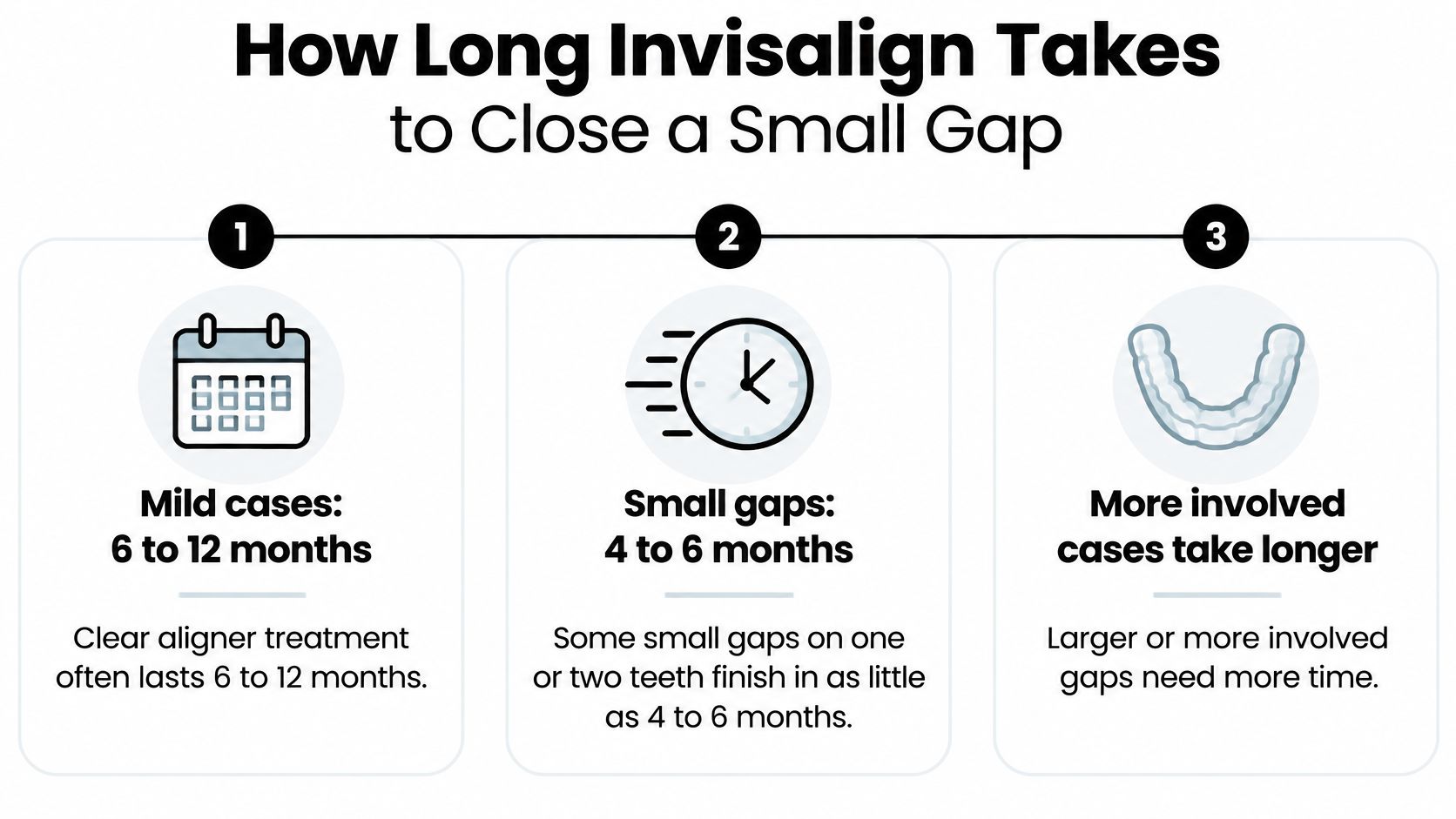
A small gap is often measured in months, while spacing across several teeth can take around a year or more. The difference is rarely the visible opening alone. Root position, how many teeth must move, and whether the bite has to be coordinated decide how much correction is programmed and how closely the teeth follow it.
| Case type | Typical active treatment | Main factor that changes it |
|---|---|---|
| Small gap on one or two teeth | Often a few months | Few aligners and short movement |
| Mild case with a few teeth involved | A few months, sometimes longer | Number of teeth and wear consistency |
| Moderate spacing across several teeth | Around a year or more | Amount of movement and root control |
| Gap needing refinement trays | Extra weeks or months after the first series | How closely teeth follow the plan |
| Retention phase after active treatment | Ongoing after the gap closes | Retainer schedule and gum health |
Those ranges are typical, not guaranteed. Two gaps with the same width can behave differently if one tooth only needs to tip and the other needs its root moved through bone.
Tray changes are commonly prescribed every one to two weeks, but the schedule is set by the provider. Wear time matters just as much. Leaving aligners out for long stretches can slow progress and make the next tray fit poorly.
Refinement trays are a normal possibility when some teeth do not track as planned. They extend treatment because they depend on the response seen at checks, so I would treat any quote as an estimate until scans show the roots, bite and gum support.
Closing the space is only part of the timeline. Retainers hold the result afterward, and a good estimate should include monitoring, likely refinements and the retention plan rather than ending the day the gap looks shut.
Why the Cause of a Gap Decides the Result
A gap is a symptom, like a crack in a wall. Filling the crack doesn't necessarily fix the frame behind it. Aligners apply programmed, sequential forces to tip or translate teeth, but a plan must consider the roots, bite, and gum support, not just the visible crowns. A systematic review of clear-aligner biomechanics included 29 studies and rated the evidence as moderate in reliability, supporting careful case selection rather than assuming every gap will close exactly as simulated (review of clear-aligner biomechanics).

Three different gaps, three different plans
A 1.5 mm space caused by a slightly tipped canine may respond predictably when the teeth need a relatively simple position change. The provider still checks the roots and bite, but the visible space may reflect a movement that aligners can manage without extensive correction.
A 4 mm gap with a thick, high frenum calls for a closer look at the tissue between the front teeth. Aligners might help move the teeth, and attachments can support control, but the frenum may also need treatment to address a contributing cause. Closing the space without evaluating that tissue can leave an important part of the problem unresolved.
A gap beside a missing lateral incisor is a different kind of case. Trays may help position the surrounding teeth, but aligners alone don't replace the missing tooth. Restorative care, such as an implant or bridge, may be part of the plan.
Scattered gaps can require more root control than a single small space. Attachments, elastics, or interproximal reduction may be considered, depending on tooth shape and the intended movement. The plan also needs to account for the full arch: moving teeth together in one area can shift or create space elsewhere. For readers curious about how airway-focused orthodontic care considers more than straight teeth, Pain and Sleep Therapy Center airway care offers another perspective on orthodontic evaluation.
At a consultation, ask two direct questions: What is causing this gap? And does the proposed plan address that cause? Clear answers help distinguish a straightforward aligner case from one that needs periodontal, surgical, restorative, or combined treatment.
Where Aligners Fall Short and Why Plans Change
A digital plan is a prediction, not a guarantee that every tooth will follow the exact path shown on screen. A retrospective comparison published in 2005 found Invisalign and fixed braces similarly effective for space closure, marginal-ridge alignment, and root paralleling, while aligners fell short on some other corrections and on ideal bite contacts (Align Technology's release on the published comparison). Predicted tooth movement is not always fully achieved, which is why a course of treatment can end with refinement trays rather than the last tray on the original timeline.
Extraction cases are harder still. A 2025 meta-analysis of 14 studies with 510 participants found clear aligners significantly less effective than predicted at retracting front teeth after premolar extraction (meta-analysis indexed by PubMed). That finding is relevant to planning larger movements; it says little about a single small gap.
Missing teeth, gum disease, a high frenum, and movement beyond a small space are the cases most likely to change a plan. Each one needs a diagnosis before a cosmetic promise. Root position belongs in that diagnosis, since teeth tipped together can look closed on screen while the roots still lean, and that affects how well the result holds. Wear time matters too: trays left out longer than recommended give teeth room to drift back toward the old spacing.
For a step-by-step look at how trays, attachments, and refinements fit together, see what Invisalign treatment involves. Before committing to a plan, I would ask three questions:
- Will this plan likely need refinements?
- What's the backup if the teeth don't track?
- How will the finished result be held in place?
Keeping a Closed Gap From Reopening
Closing a gap is only half the job. Keeping it closed is the other half.
The forces that contributed to spacing can continue after active treatment ends. A long-term review of orthodontically closed spaces between the upper front teeth found significant relapse in 60% of patients, with recurring gaps averaging 0.78 mm (long-term review of diastema relapse). Larger initial gaps and increased overjet were linked to greater reopening.
Other post-retention research on closed front-tooth gaps tells a similar story: measurable reopening shows up in a share of patients, often tied to the front teeth tilting forward again after treatment. The cause and root position matter. Teeth that were tipped into place rather than moved bodily, or gaps driven by ongoing tongue pressure, carry more risk of drifting back. A closed space needs ongoing support, especially when the bite keeps pushing the teeth apart.
Retainers are part of treatment
Two main options exist. A removable retainer is worn on the schedule your provider sets, often indefinitely. A bonded retainer is a thin wire fixed behind the front teeth, and many orthodontists favor it for holding a closed midline gap because it stays in place around the clock.
The right retainer depends on tooth position, gum health, bite, and the original cause of the spacing. A gap tied to a habit like tongue thrust may need that habit addressed alongside retention, or the pressure reopens the space. Gum and bone support matter too, which is why regular cleanings and exams belong in the plan. Bone loss under a closed gap can let teeth shift even with a retainer in place.
Two warning signs deserve attention. A gap that widens again after treatment can signal a gum or bone support problem rather than ordinary settling. Persistent tongue pressure or other habits can keep working against the result.
I recommend settling the retainer plan before the first tray goes in. Know which type your provider suggests, how long you'll wear it, and what happens if a bonded wire breaks or a removable one gets lost.
When Veneers or Bonding Make More Sense
| Option | Best for | Main trade-off | How soon results appear |
|---|---|---|---|
| Invisalign clear aligners | Gaps from tooth position and mild-to-moderate spacing | Requires consistent daily wear and possible retainers | Months; timeline set after evaluation |
| Composite bonding | Small gaps and tooth-shape issues | Can stain or chip and may need repair | Often completed in one visit |
| Porcelain veneers | Wider gaps where teeth look small or uneven | Enamel removal means the change isn't fully reversible | Usually a few visits; timing varies |
| Orthodontic braces | Larger or complex spacing | Visible hardware during treatment | Set by the treatment plan |
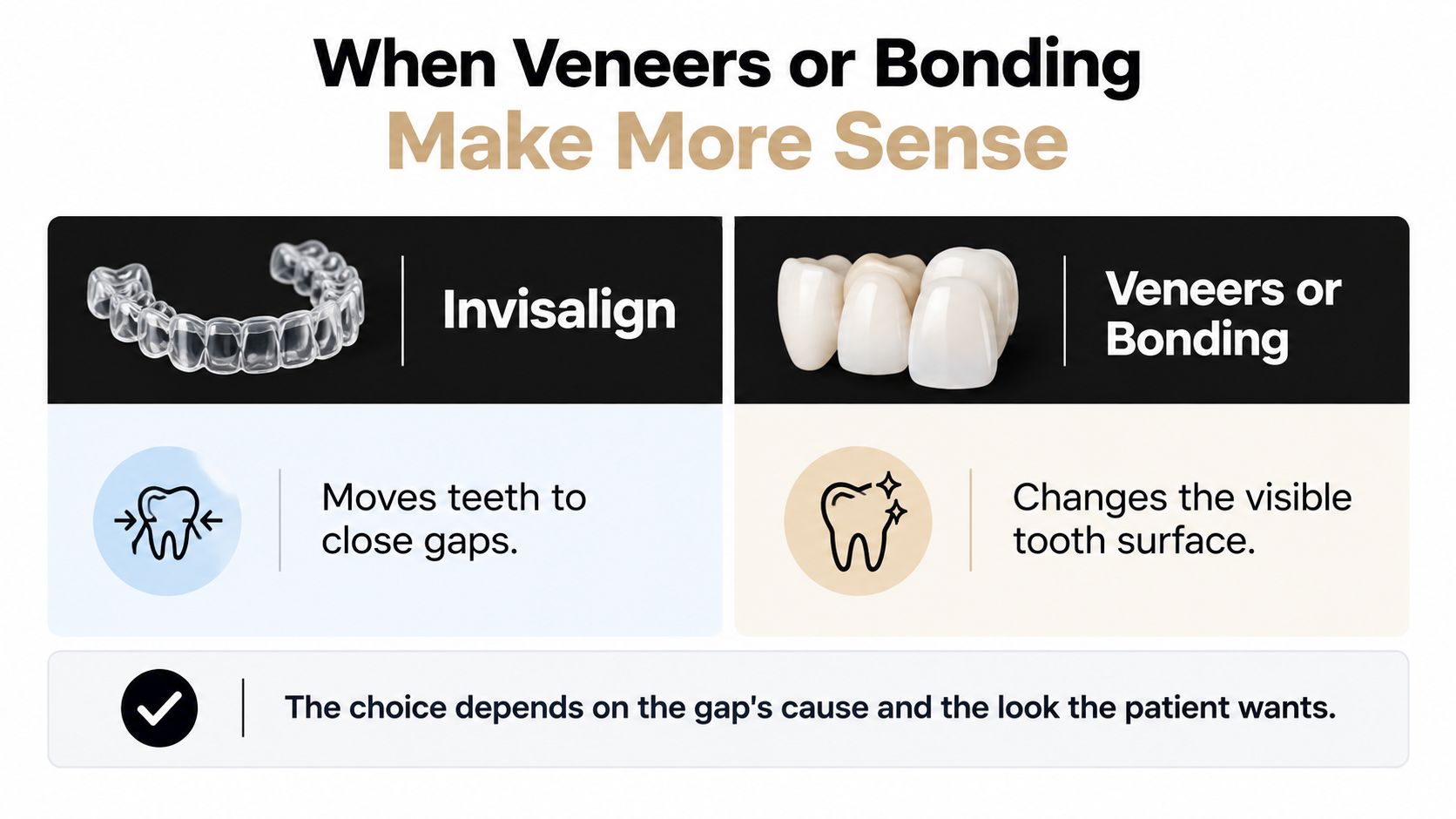
Aligners move teeth. Bonding and veneers change the visible tooth surface. That difference guides the choice. If a small gap comes from tooth shape, composite bonding can add tooth-colored material to change the outline without moving the teeth. Composite is also used in restorative dentistry, but it can stain or chip and may need repair over time. More on dental bonding for front teeth can help patients understand how the approach differs from orthodontics.
Porcelain veneers are thin shells bonded to the front of teeth. They may suit a wider gap when the teeth also look small or uneven, but they usually require removing some enamel. That makes the change not fully reversible, so the decision should account for tooth health and the desired result, not just the size of the opening.
Aligners make more sense when tooth position is the main issue and the plan needs to change the bite or root position. Braces may be considered when movement is too complex for aligners alone. Some patients combine methods, such as aligning teeth first and then using bonding to refine tooth shape.
- Small gap from tooth shape: bonding may be a suitable option.
- Gap with cosmetic changes needed in other teeth: veneers may be considered.
- Gap caused by tooth position: aligners may address the underlying alignment.
- Gap with a missing tooth or complex movement: restorative treatment, braces, or a combined plan may be needed.
Ultra Smile DentalSpa offers Invisalign, veneers, composite work, and implants, allowing those options to be discussed side by side during a consultation.
Book a Gap Consultation in Miami, FL
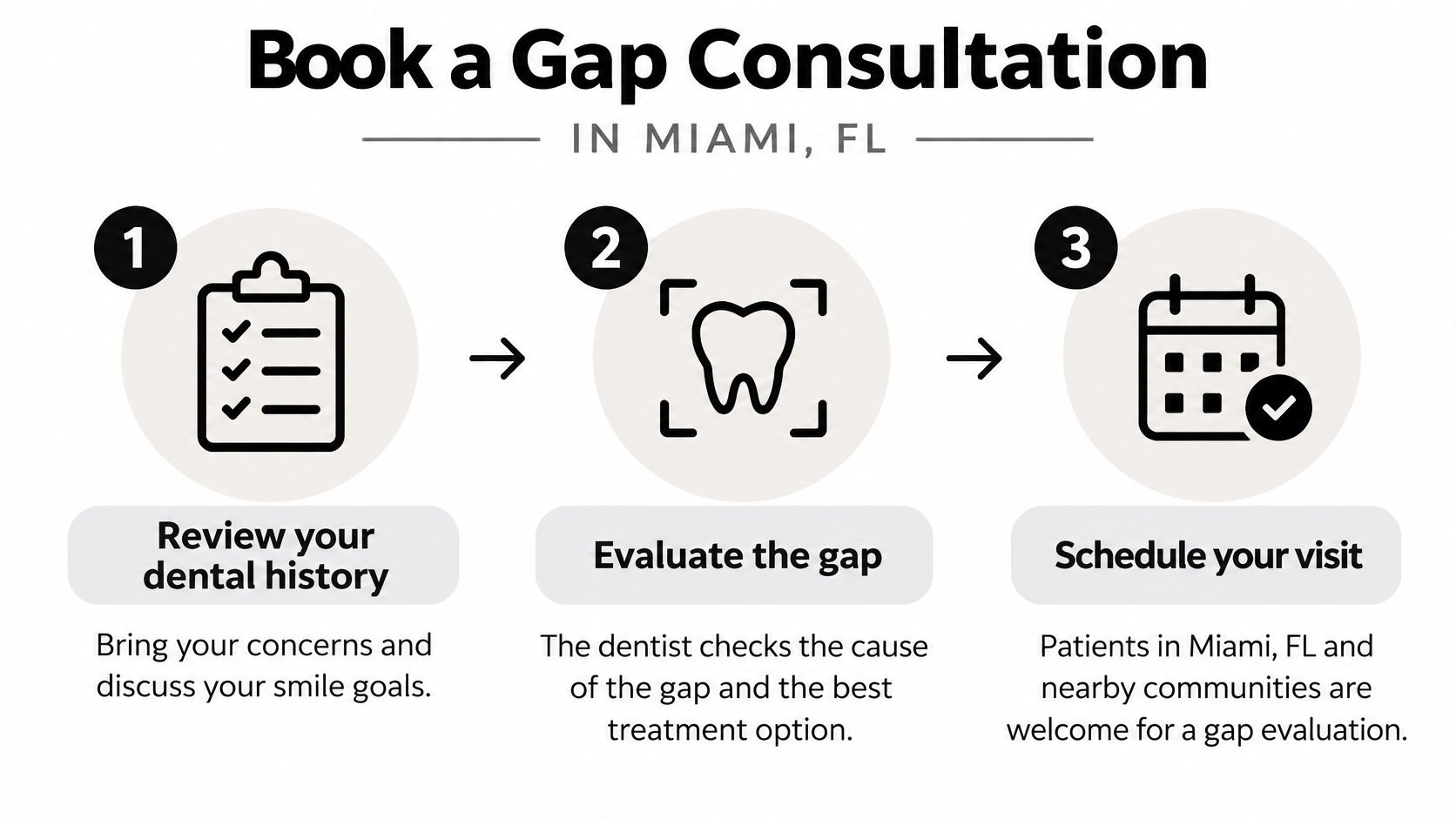
Patients in Miami, FL, including Downtown Miami, Midtown Miami, and Hallandale Beach, can request an evaluation to discuss a gap and possible treatment. The appointment can cover your goals, the gap's history, and what an exam and records show.
- Review your history and goals. Discuss previous orthodontic treatment, what you'd like to change, and how long the gap has been present.
- Examine your teeth, gums, bite, and frenum. These findings help identify whether spacing relates to tooth position, a missing tooth, or gum disease.
- Take diagnostic records. Photos, digital scans, and dental X-rays help assess tooth position and develop a realistic estimate.
- Check the full arch. Closing one visible gap can redistribute space elsewhere, so the whole arch may need consideration (Invisalign's guidance on treating gaps).
- Compare treatment options. Discuss whether aligners, bonding, veneers, or a combined plan may suit the findings.
- Review the written plan. Ask about the estimate, timeline, retention, insurance, and options for patients without coverage.
A careful evaluation should address the cause of the gap and set out how the result will be maintained. For patients comparing providers online, local search strategies for orthodontic practices discusses local search marketing. When choosing a provider, focus on a careful evaluation and a plan that addresses the cause of the gap.
Request a gap consultation at ultrasmilemiami.com or call the office to book an evaluation.
Ultra Smile DentalSpa offers Invisalign consultations alongside cosmetic and restorative options, including bonding, veneers, and implants. Visit Ultra Smile DentalSpa to request an evaluation and discuss a plan suited to the cause of your gap.