A lot of adults in Miami put off cosmetic dentistry for the same reason. They notice the small things every time they smile in a photo or catch their reflection on a phone screen, but they don't want a procedure that sounds aggressive, irreversible, or uncomfortable. A tiny chip. A narrow gap. A tooth that looks darker than the rest. The concern is real, but so is the hesitation.
For patients searching for a cosmetic dentist near me or a dentist in Miami, FL, minimal prep veneers often sit in the sweet spot between subtle improvement and conservative treatment. They can refine a smile without the heavy drilling many people associate with older veneer techniques. For anxious patients, that difference matters just as much as the final result.
This guide looks at how minimal prep veneers work, who they're right for, what the process feels like in a comfort-focused setting, and what to know before booking care in Miami, FL. It also places this treatment in the broader picture of dental care, because the right cosmetic choice should support oral health, function, and long-term confidence.
Table of Contents
- Your Guide to a Brighter Smile in Miami
- What Are Minimal Prep Veneers
- Key Benefits of This Gentle Smile Makeover
- Minimal Prep vs Traditional Veneers
- Who Is an Ideal Candidate for This Treatment
- The Minimal Prep Veneer Procedure at Ultra Smile DentalSpa
- Investment Longevity and Caring for Your Veneers
- Frequently Asked Questions About Minimal Prep Veneers
Your Guide to a Brighter Smile in Miami
Miami patients often want a fresher smile without signing up for a major dental overhaul. That's especially true for people with dental anxiety, busy professionals in Downtown Miami, and adults in Midtown or Hallandale Beach who want cosmetic improvement that feels manageable from the first visit.
Minimal prep veneers appeal to that group because they address cosmetic concerns that are visible every day but don't always require aggressive treatment. Small chips, slight spacing, worn edges, and discoloration can make a smile look uneven even when the teeth are healthy. In the right case, a conservative veneer approach can improve those details while preserving more of the natural tooth.
Why comfort matters in cosmetic dentistry
For many adults, the barrier isn't vanity. It's discomfort. They worry about drilling, soreness, multiple long appointments, or feeling trapped in the chair. A spa-like dental environment changes that experience. Comfort amenities such as refreshments, custom aromatherapy, streaming entertainment, and a soothing hot towel finish can lower stress before the procedure even begins.
A cosmetic treatment only feels modern if the patient experience feels calm from start to finish.
That matters for more than relaxation. Patients who feel at ease tend to communicate more clearly about shape, shade, and smile goals. That leads to better planning and fewer surprises.
How this fits into complete dental care
Cosmetic dentistry should never sit apart from oral health. Before veneers are considered, the mouth has to be stable. That may involve cleanings and exams, new patient exams, dental x-rays, or treatment for issues like decay, bite wear, or gum inflammation. If a tooth is too damaged for a veneer, restorative options such as crowns, fillings, or other dental care may make more sense.
Patients looking online for a dentist near me, emergency dentist, tooth extraction, or even dental implants near me are often dealing with more than one concern at once. A good treatment plan doesn't force a cosmetic service where it doesn't belong. It matches the procedure to the condition, the smile goal, and the person's comfort level.
What Are Minimal Prep Veneers
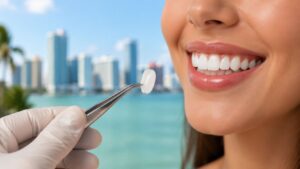
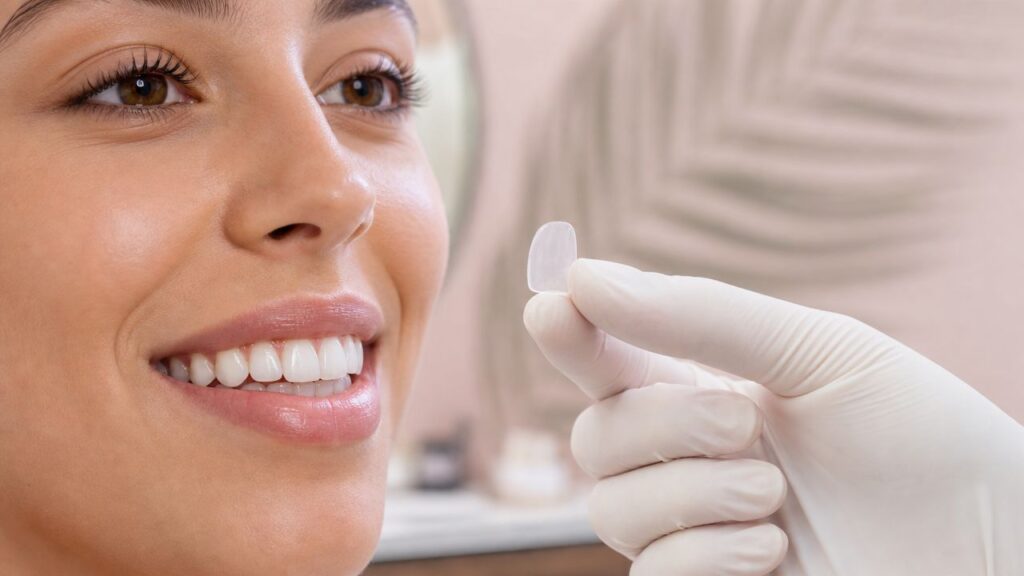
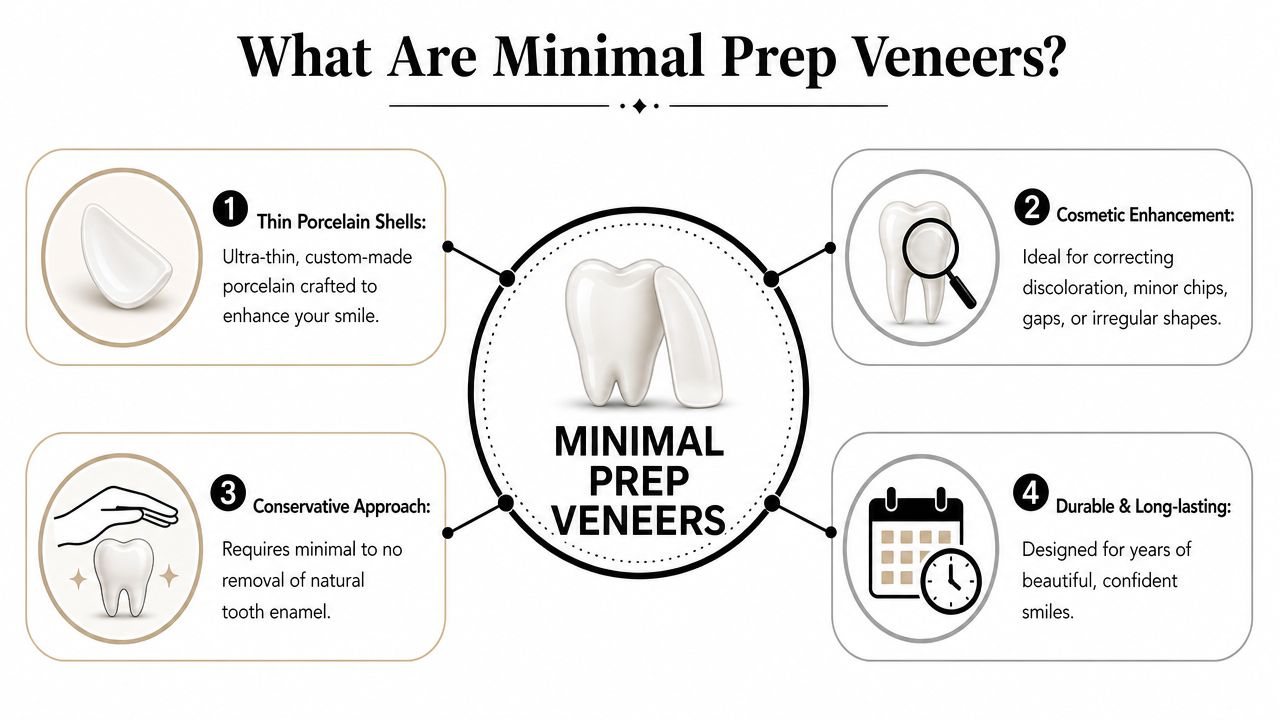
Minimal prep veneers are thin custom shells that cover the front surface of teeth to improve color, contour, and symmetry. The easiest way to understand them is to think of them like contact lenses for teeth. They're delicate, precise, and designed to blend in rather than look bulky.
They can work well for cosmetic concerns such as minor chips, slight gaps, conoid teeth, and certain stains that don't respond the way a patient wants after whitening. The appeal is simple. They can create a polished smile without removing the amount of tooth structure typically associated with traditional veneers.
Their thin design is the point
Minimal prep veneers are typically 0.3 to 0.5 millimeters thick, and that ultra-thin design allows them to bond directly to the tooth with little to no enamel removal, preserving approximately 97 to 100 percent of natural tooth structure compared with traditional methods that remove 3 to 30 percent of tooth weight, according to clinical guidance on minimal prep veneers.
That level of preservation is a major reason patients ask about them. Enamel doesn't grow back. Whenever cosmetic dentistry can be done with less removal, that's worth serious consideration.
What they can and can't fix
Minimal prep veneers are strongest when the goal is refinement, not total reinvention. They can improve:
- Small chips and worn edges that make front teeth look uneven
- Mild spacing such as a visible diastema
- Shape discrepancies including narrow or undersized teeth
- Certain color concerns when a patient wants more than whitening alone can deliver
They aren't a shortcut around every cosmetic issue. Teeth that are severely rotated, crowded, very dark, heavily restored, or compromised by bite problems may need a different approach.
Clinical reality: Conservative veneers succeed when there's room to add beauty without adding bulk.
For patients in Miami exploring cosmetic dentistry, that distinction matters. The best result isn't the least invasive treatment in theory. It's the least invasive treatment that still looks natural and functions well.
Key Benefits of This Gentle Smile Makeover
The biggest advantage of minimal prep veneers isn't just appearance. It's how many common patient fears they help reduce. For someone who wants a brighter smile but feels nervous about dental work, that combination can be compelling.
Why patients are drawn to them
Several benefits stand out in day-to-day practice:
- More natural tooth preservation because the treatment is designed to keep healthy enamel whenever possible
- A gentler appointment experience with less drilling than many people expect from veneers
- Less need for temporary restorations in many cases because the preparation is so conservative
- Natural-looking improvement that can soften chips, close narrow spaces, and refine tooth shape without making the smile look overdone
That last point is important in Miami, where many patients want cosmetic work that looks polished in person, on video calls, and in bright outdoor light. The goal usually isn't a dramatically artificial smile. It's a cleaner, balanced version of what already suits the face.
A good fit for anxious patients
People who avoid treatment often assume cosmetic dentistry will feel intense. Minimal prep veneers can change that expectation. When the treatment is conservative and carefully planned, the experience is often easier than patients imagined.
In a comfort-focused office, that matters even more. Amenities don't replace clinical skill, but they do help patients settle into the process. A calm room, clear communication, and less invasive dentistry can make cosmetic care feel approachable instead of intimidating.
Benefits beyond appearance
A smoother, more symmetrical smile can also make daily oral care easier in certain cases. Edges that trap plaque, rough chipped surfaces, and awkward contours may become simpler to clean after cosmetic correction. Veneers don't replace cleaning and exams, but they can support a more harmonious smile that patients feel motivated to maintain.
For patients searching dentist in Miami, FL or cosmetic dentist near me, this is often the attraction. They want a treatment that improves confidence without feeling like a major surgical event. Minimal prep veneers can meet that need when the case selection is right and the treatment plan stays conservative.
Minimal Prep vs Traditional Veneers
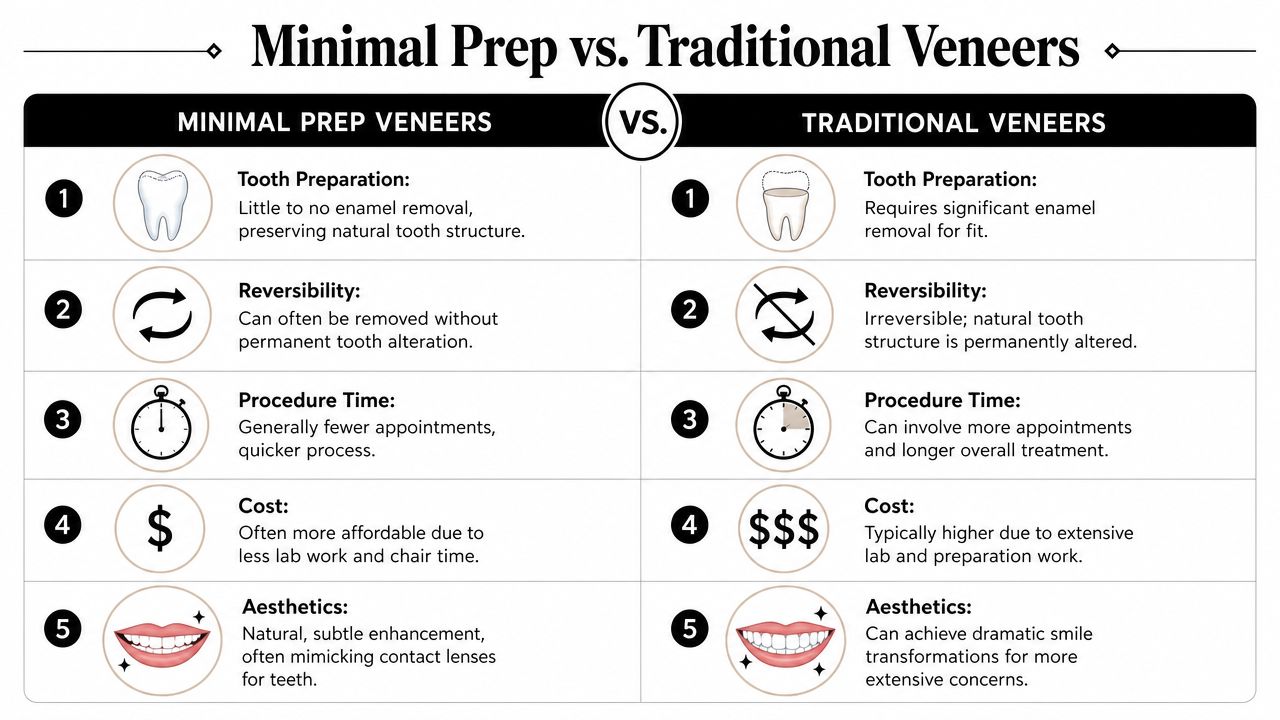
Choosing between minimal prep and traditional veneers isn't about picking the newer-sounding option. It's about deciding how much change is needed, how much enamel should be altered, and what kind of result will look balanced on the patient's natural teeth.
Minimal prep veneers are built for restraint. Traditional veneers are often better when a smile needs broader correction in color, alignment illusion, or shape.
The preparation difference
For minimal prep veneers, the enamel reduction is controlled and limited. A standardized facial reduction of 0.5 mm to 0.7 mm may be required, with depth variations of 0.1 mm at the cervical third, 0.2 to 0.5 mm at the middle third, and 0.7 to 1.0 mm at the incisal third to create proper ceramic thickness and avoid overcontouring, as described in this published review of porcelain laminate veneer preparation.
Traditional veneers generally require more reduction than that. The reason is practical. If a tooth needs a more dramatic color change or shape change, the restoration needs enough room to sit naturally without looking too thick.
Side by side considerations
| Feature | Minimal prep veneers | Traditional veneers |
|---|---|---|
| Enamel removal | Limited and targeted | Greater reduction |
| Best for | Smaller cosmetic corrections | Broader smile redesign |
| Final look | Subtle and enamel-preserving | More transformative when needed |
| Reversibility | Sometimes more conservative, but not automatically reversible | Less conservative overall |
One of the biggest misconceptions is that "no-prep" or minimal prep always means no enamel is touched. That isn't always true. In many cases, a small amount of contouring is what keeps the result from looking bulky around the gumline or along the edge of the tooth.
The wrong veneer plan usually fails for one simple reason. The restoration is asked to do more than the tooth position allows.
Which patients often do better with each option
Minimal prep veneers usually make sense when teeth are already fairly well aligned and the changes are modest. Traditional veneers may be the better route when the teeth are heavily discolored, unevenly positioned, or shaped in a way that needs a stronger visual reset.
For patients who need more than a veneer can responsibly deliver, other services may be better medicine than cosmetic camouflage. Invisalign can help with crowding or rotation. Crowns may be the safer restorative choice for teeth with larger structural damage. A thorough exam, bite evaluation, and digital planning matter more than the label attached to the veneer.
Who Is an Ideal Candidate for This Treatment
Minimal prep veneers aren't for every smile, and that's exactly why proper screening matters. The strongest candidates are patients with healthy gums, enough enamel for bonding, and cosmetic concerns that are visible but not severe.
Signs someone may be a good candidate
A patient may be a strong fit when the concerns are modest and focused on the front teeth. Common examples include:
- Minor chips on otherwise healthy enamel
- Small gaps between teeth
- Slightly irregular shapes that make one tooth look too short, narrow, or uneven
- Mild discoloration that doesn't match the rest of the smile
- Generally aligned teeth with no major crowding
These are the cases where veneers can enhance the smile rather than fight against the existing tooth position.
When another treatment may be smarter
Some patients want veneers because they seem faster than orthodontics or restorative care. That can backfire. If the teeth are crowded, flared, heavily restored, or affected by bite imbalance, a veneer may need too much thickness to hide the problem well.
A patient with alignment issues may benefit more from invisible braces or Invisalign before cosmetic finishing. A tooth with major structural loss may need a crown rather than a veneer. If someone has active grinding, gum inflammation, or untreated decay, those issues should be managed first.
Effective dental care is crucial. Cosmetic work sits on top of biology. It doesn't replace healthy gums, stable biting forces, or sound tooth structure.
The myth of universal no-prep candidacy
Marketing often makes no-prep veneers sound universal. They aren't. Clinical guidance has challenged the idea that every patient can skip preparation and still get a natural result. In crowded or misaligned teeth, some targeted contouring may be what prevents a thick appearance or edge irregularity.
That matters for those seeking a cosmetic dentist near me while hoping for a quick answer. The right candidate for minimal prep veneers usually has a smile that already has enough space and proportion to accept a thin restoration gracefully. The wrong candidate may get a result that looks added on rather than integrated.
Selection rule: If a veneer has to hide crowding, severe darkness, or major bite imbalance, the plan usually needs to change.
For Miami patients, the consultation should answer one practical question. Will this treatment make the smile look naturally better, or will it merely place a cosmetic cover over a problem that needs a different solution?
The Minimal Prep Veneer Procedure at Ultra Smile DentalSpa
Most patients want to know two things before they book. How long will this take, and what will it feel like? With minimal prep veneers, the process is usually straightforward and far less intimidating than many expect.
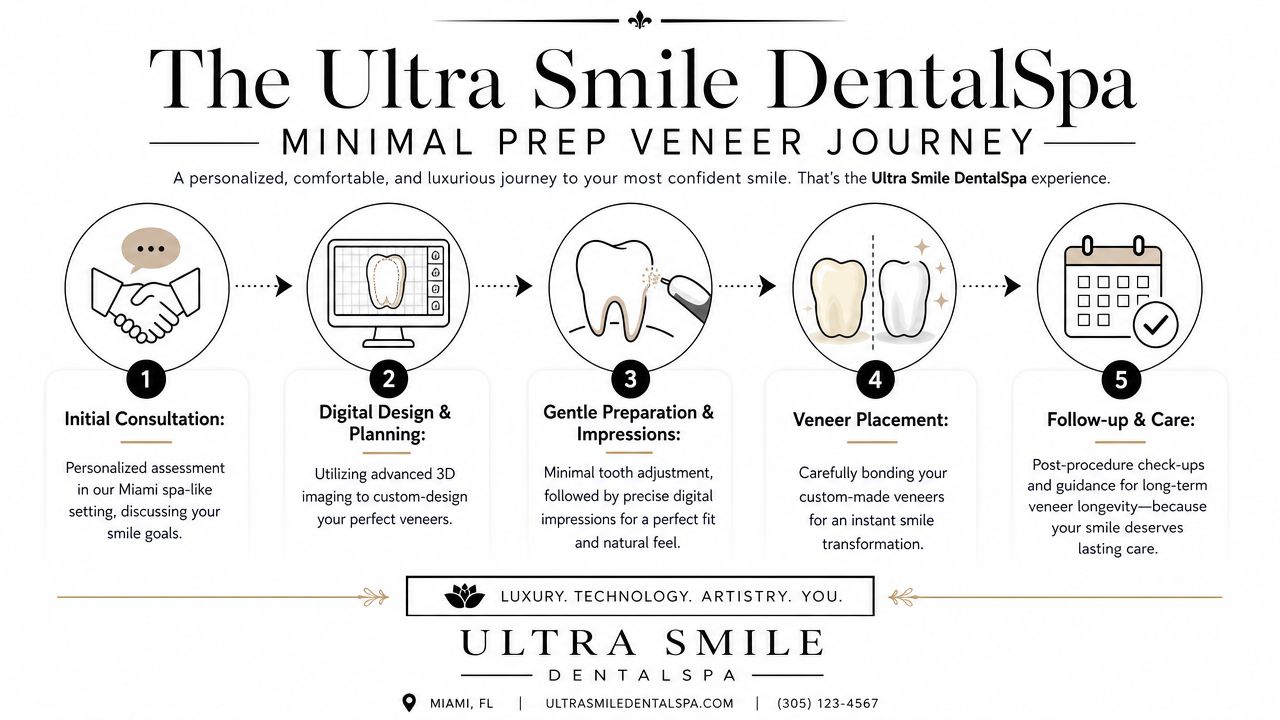
The treatment commonly takes 2 to 3 visits over a 3 to 4 week period, including consultation with digital imaging, laboratory fabrication, and bonding. Most patients experience little to no discomfort, and temporary restorations are rarely needed because the treatment is so conservative, according to this overview of the no-prep veneer process.
A visual overview helps make that timeline easier to picture.
What the appointments usually involve
The first visit is typically the consultation and planning phase. Records, photos, and digital smile design help determine whether minimal prep is appropriate and what shape, proportion, and shade will look natural.
The second phase may involve very light preparation, impressions or digital scans, and laboratory fabrication. Because the treatment is conservative, this appointment is often easier than patients expected.
Later in the process, the patient returns for placement and bonding. The veneers are tried in, adjusted as needed, and bonded with attention to fit, edge shape, and smile symmetry.
How the experience feels in a comfort-focused office
For anxious patients, the setting matters almost as much as the technique. A spa-like office changes the rhythm of the visit. Refreshments, custom aromatherapy, streaming entertainment during treatment, and a warm towel at the end can make cosmetic dentistry feel calmer and more humane.
That comfort-first approach is one reason some patients who initially search for an emergency dentist or a dentist near me later decide to move forward with elective cosmetic care too. Once the fear of the dental chair softens, more treatment options become possible.
This short video gives additional context on what veneer treatment can involve.
What patients can expect after placement
Adjustment is typically quick. The bite may feel slightly different at first because the front teeth now have a more refined contour. That usually settles as the mouth adapts.
Patients are usually advised to keep up with routine cleanings and exams, maintain good brushing and flossing habits, and return if anything feels off. Veneers should look effortless, but they shouldn't be treated casually. Precision in planning and bonding is what makes the final result feel smooth, comfortable, and believable.
Investment Longevity and Caring for Your Veneers
Cost matters, and most patients appreciate a direct answer. Minimal prep veneers are a cosmetic investment, so the decision should account for both the upfront fee and how long the result is expected to serve the smile.
For a single composite, lab-manufactured minimal prep veneer, the national average cost is $1,068, with a typical range of $783 to $1,760. That is lower than the $1,455 national average for traditional porcelain veneers, according to CareCredit's overview of minimally invasive veneer costs.
Cost depends on more than the veneer itself
The final fee can vary based on the material, whether the veneer is fabricated directly or through a lab, and the complexity of smile design. In Miami, local demand, cosmetic detail work, and material selection can influence pricing as well.
Some practices also offer financing or staged treatment planning to make care easier to manage. Cosmetic veneers are not always covered by insurance, but the practice may still help patients review benefits, estimate costs, and understand payment options before treatment begins.
Longevity is where the real trade-off shows up
Less invasive doesn't always mean longer lasting. That's a conversation worth having early. For more detail on wear expectations, patients can review how long veneers last.
A conservative veneer can be a smart choice, but longevity depends on case selection, bite forces, oral habits, and maintenance. Patients who clench or grind may need a night guard. Patients who bite ice, tear packages with their front teeth, or skip routine care often shorten the life of cosmetic work.
Good veneer planning isn't only about the day they're bonded. It's about whether the smile can still look and function well years later.
How to protect the investment
Daily care doesn't need to be complicated:
- Brush gently and consistently with a non-abrasive toothpaste
- Floss around the veneers to keep the gums healthy and margins clean
- Keep regular dental visits for exams, cleanings, and early detection of small issues
- Use a night guard if recommended to reduce overload from grinding
- Avoid using teeth as tools for opening, tearing, or crunching hard objects
Minimal prep veneers can be beautiful and practical, but they're still a precision restoration. The more carefully they're selected and maintained, the more value they deliver over time.
Frequently Asked Questions About Minimal Prep Veneers
Patients usually have a few final questions before they commit, especially if they're comparing veneers with bonding, whitening, or other cosmetic dentistry options in Miami.
Are minimal prep veneers the same as Lumineers
Not exactly. "Minimal prep veneers" describes a conservative treatment approach. Lumineers is a branded veneer concept often associated with little or no tooth reduction. Some patients use the terms interchangeably, but clinically they aren't identical categories.
The more important question isn't the brand name. It's whether the tooth position, enamel, smile goals, and bite allow a very thin veneer to look natural without appearing bulky.
How do they compare with composite bonding
Composite bonding can be a good option for smaller cosmetic corrections, especially when a patient wants same-day improvement or a lower initial investment. Bonding is often easier to repair, but veneers generally offer a different level of material finish and stain resistance depending on the case.
The choice depends on the tooth, the amount of change needed, and how the patient weighs longevity, polish, and maintenance. A consultation should compare both options objectively rather than pushing one by default.
Do minimal prep veneers hurt
Most patients find the process easier than expected because the treatment is conservative and often involves very limited tooth alteration. For a closer look at comfort concerns, this page on whether porcelain veneers hurt gives helpful context.
Anxiety can still make any appointment feel more intense in anticipation. That's why the environment, pacing, and communication style matter so much during cosmetic care.
How long do no-prep veneers last compared with traditional veneers
This is one of the most important trade-offs. While no-prep veneers preserve 90 percent more tooth structure, their average lifespan is often 5 to 7 years, compared with 10 to 15 years for traditional veneers, due to weaker bonding mechanics. A multi-center analysis also found that 34 percent required replacement within 5 years because of marginal staining or fracture, while traditional veneers had 12 percent failure in the same period, according to this summary of no-prep veneer longevity and replacement rates.
That doesn't mean no-prep is a poor option. It means patients should choose it with open eyes. Conservative treatment can preserve tooth structure, but it may involve more maintenance or earlier replacement in some cases.
Will dental care still matter after veneers
Absolutely. Veneers improve the visible front surface of a tooth, but they don't make a patient immune to gum disease, decay around margins, bite problems, or emergencies. Routine dental x-rays, new patient exams, cleaning and exams, and timely care remain essential. If a patient later develops deeper structural damage, treatments such as restorative dentistry, tooth extraction, or even dental implants near me may become part of the conversation for other teeth.
A cosmetic smile lasts longest when it's built on healthy daily habits and regular dental care.
Patients in Downtown Miami, Midtown Miami, and Hallandale Beach who want a more natural-looking smile without an aggressive approach can schedule a consultation with Ultra Smile DentalSpa. The practice provides general, restorative, and cosmetic dental care in Miami, FL, with a comfort-focused environment designed for patients who want clear guidance, gentle treatment, and realistic answers about what minimal prep veneers can and can't do.