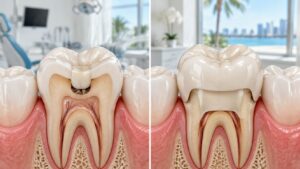
A chipped front tooth can become the first thing someone notices in every photo. A dark spot that never responds to whitening can make a person hide their smile at a Brickell brunch, at work in Downtown Miami, or while checking a reflection along South Beach. The practical question isn't just which treatment looks better today. It's which option will fit the patient's budget, maintenance tolerance, comfort with enamel changes, and long-term plans.
For patients searching for a cosmetic dentist near me or a dentist in Miami, FL, the decision usually comes down to porcelain veneers versus composite bonding. Both can improve chips, gaps, uneven edges, and discoloration, but they create different commitments. The comparison below focuses on durability, appearance, preparation, repairability, cost over time, candidacy, and flexibility, so patients can approach a consultation with realistic expectations.
Table of Contents
- Two Ways to Fix the Same Smile
- What Each Option Actually Is and How It Works
- Side-by-Side Comparison That Drives the Decision
- Cost in Miami Over Five, Ten, and Twenty Years
- Which Option Fits Your Smile Situation
- What to Expect at Ultra Smile DentalSpa in Miami
- How to Choose and Book Your Consultation
Two Ways to Fix the Same Smile
A Miami patient might notice a small chip in a front tooth while lifting a coffee cup at a café. Another might scroll through older photos and realize that one darker tooth draws attention away from the rest of the smile. Neither situation automatically calls for the most extensive treatment. The right answer depends on what caused the concern, how many teeth are involved, and how permanent the desired change should feel.
Composite bonding usually offers the conservative route. A dentist applies tooth-colored resin directly to the tooth, shapes it, hardens it with a curing light, and polishes it. It can repair a modest chip or close a small gap without the same level of commitment associated with porcelain.
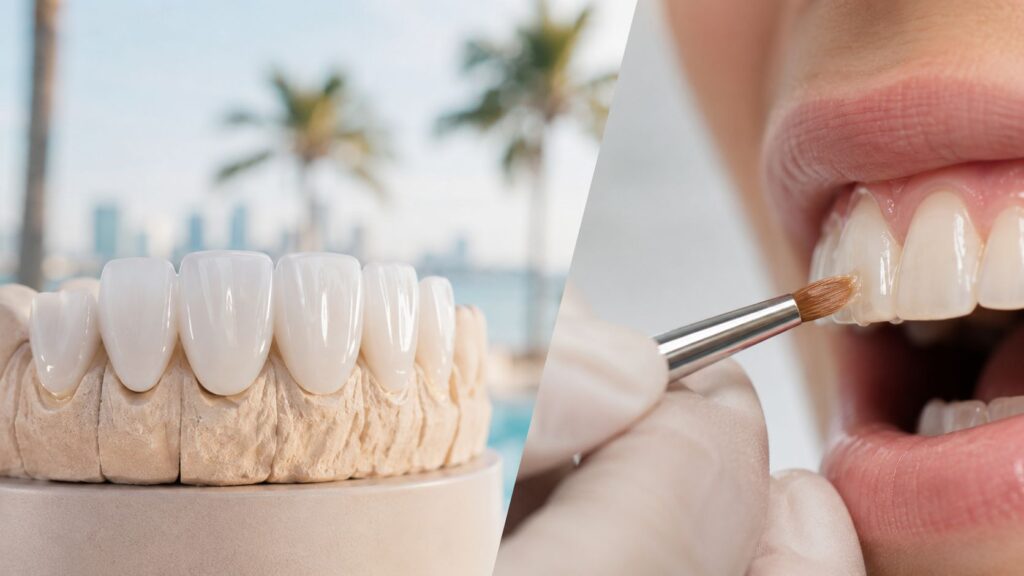
Porcelain veneers take a more planned approach. A dental laboratory fabricates thin ceramic shells to fit the front surfaces of selected teeth. The result can provide more consistent color, shape, and surface stability, but the process generally involves enamel preparation and a commitment to future replacement.

The three questions that matter most are straightforward:
- How long should the result last? Porcelain generally has the stronger long-term durability record, while composite can require more frequent polishing, repair, or replacement.
- How much flexibility does the patient want later? Bonding preserves more tooth structure and is easier to modify. Veneers provide a more controlled result but are less reversible.
- What does ownership cost over time? A lower initial fee doesn't automatically mean a lower lifetime cost if the restoration needs repeated maintenance.
A patient dealing with gum inflammation, untreated decay, an unstable bite, or significant grinding may need dental care before cosmetic treatment. Healthy gums, adequate enamel, and a stable bite create a safer foundation for either option.
Practical rule: The least expensive treatment today isn't always the least expensive or least restrictive choice over the life of the smile.
A consultation with a Miami cosmetic dentist should clarify both paths without steering every patient toward the more expensive material. Sometimes composite bonding is the smarter decision. Sometimes porcelain veneers justify the added commitment.
What Each Option Actually Is and How It Works
Porcelain veneers are thin, custom-made ceramic shells that cover the visible front surface of a tooth. The dentist first evaluates the enamel, gumline, bite, tooth color, and smile proportions. Digital scans or impressions help communicate the intended shape to the laboratory, while shade selection and a preview allow the patient to discuss the proposed result before final placement.
Because veneers usually require removal of a thin layer of enamel, the treatment is considered non-reversible. Local anesthetic may be offered when preparation could cause sensitivity. The dentist prepares the teeth, records the final details, and places temporary veneers when needed. At the later appointment, the patient tries in the finished restorations, checks the shade and contour, and receives final bonding after the dentist verifies the fit and bite.
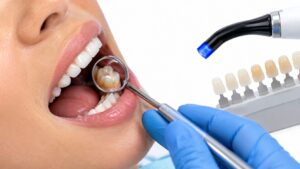
Composite bonding happens directly in the dental chair. The dentist cleans and prepares the tooth surface, selects a shade, applies tooth-colored resin, and sculpts the material to restore the edge, close a small space, or alter the contour. A curing light hardens each layer, and the dentist finishes by checking the bite and polishing the surface.
For a small repair, bonding often takes roughly 30 to 60 minutes per tooth. Porcelain veneers commonly require two to three visits over two to four weeks, depending on the case and laboratory schedule. Those time estimates are treatment-planning ranges, not guarantees, because the number of teeth, preparatory dental care, and the complexity of the smile design can change the sequence.
What the patient may notice
During bonding, patients generally hear the curing light and polishing instruments while the dentist builds the tooth shape in stages. Veneer treatment involves more steps, including scans or impressions, shade discussions, temporary restorations, and a final try-in. Some patients prefer the immediate nature of bonding, while others value the preview and controlled fabrication process used for porcelain.
Neither cosmetic option should cover untreated disease. A new patient exam may include dental x-rays when clinically appropriate, gum evaluation, bite assessment, and discussion of habits such as nail biting or nighttime grinding. Patients who also need teeth whitening, restorative dentistry, a tooth extraction, or dental implants may need a coordinated plan before cosmetic work begins.
For a closer look at material selection and restorative planning, patients can review advanced dental materials used in cosmetic dentistry.
Side-by-Side Comparison That Drives the Decision
The central difference in porcelain veneers vs composite bonding is the trade-off between control and flexibility. Porcelain tends to provide stronger long-term stability in well-selected cases. Composite tends to preserve more enamel and makes future adjustment easier.
| Criteria | Porcelain Veneers | Composite Bonding |
|---|---|---|
| Durability | Stronger long-term record, with ceramic veneers showing a mean observation period of 7.8 years in one systematic review | More variable longevity, with a mean observation period of 4.8 years in the same review |
| Clinical survival | A prospective porcelain veneer evaluation reported 97.5% survival by restoration and 90.0% by patient over the study period, with seven-year success probabilities also reported | A randomized-trial review reported a pooled survival rate of 88% across 24 to 97 months, while broader reviews found wide variation by restoration type and conditions |
| Stain resistance | Ceramic is generally more resistant to surface discoloration and tends to maintain a stable shade | Resin can absorb or show staining more readily, especially when exposed to coffee, tea, wine, and frequent polishing needs |
| Aesthetic control | Custom laboratory fabrication supports consistent shade, shape, translucency, and surface texture | A skilled dentist can create a natural result chairside, but the material may not reproduce enamel-like light transmission as consistently |
| Tooth preparation | Usually requires thin enamel reduction and is considered non-reversible | Usually requires little or no enamel removal and is generally more reversible |
| Visits | Commonly involves preparation, temporaries, laboratory fabrication, try-in, and final bonding | Often completed in one visit for a limited repair |
| Repairability | A chip or fracture often requires replacement of the veneer rather than a simple patch | Small chips and wear can often be repaired or reshaped directly |
| Best fit | Full smile makeovers, deep discoloration, and patients prioritizing long-term uniformity | Small chips, modest gaps, conservative treatment, and patients who want future flexibility |
The systematic review of bonded composite and ceramic veneer restorations found 85.4% overall survival for the composite group after 429 restorations, while ceramic veneers showed the stronger survival profile overall. A separate clinical evaluation of porcelain laminate veneers reported 97.5% survival when the restoration was the statistical unit, with outcomes also varying when the patient was used as the unit of analysis. These findings support a practical recommendation, not a promise: porcelain is usually the better durability choice when the teeth, bite, and gums are suitable.
Appearance and maintenance
Porcelain usually wins for long-term color stability and uniformity. Composite can look excellent immediately after placement, particularly for one small repair, but it may require periodic polishing or repair as the surface ages. Miami patients who drink coffee, enjoy cocktails, or want a highly uniform smile should discuss how daily habits may affect maintenance.
Commitment and flexibility
Composite keeps more options open if a patient's goals change. It can often be adjusted, removed, or repaired with less disruption to the underlying tooth. Porcelain requires a more deliberate decision because enamel preparation creates a long-term restorative pathway, even though the veneers themselves will eventually need replacement.
Cost in Miami Over Five, Ten, and Twenty Years
The sticker price is only the first line of the comparison. In Miami, composite bonding commonly ranges from roughly $250 to $600 per tooth, while porcelain veneers commonly range from about $1,200 to $2,500 per tooth, based on the cost comparison provided for this treatment decision. Actual fees depend on the number of teeth, preparation, laboratory work, diagnostic records, bite management, and the complexity of the cosmetic plan.
A complete smile arch multiplies the per-tooth fee quickly. That makes it important to ask whether a treatment is being considered for one front tooth or a broader smile makeover. Patients should also ask how the practice handles polishing, chip repair, replacement, temporary restorations, and future maintenance.
| Time Horizon | Porcelain Veneers per tooth | Composite Bonding per tooth |
|---|---|---|
| Five years | Often still within the initial service period when properly planned and maintained | May need polishing, repair, resurfacing, or replacement depending on wear and habits |
| Ten years | Often remains serviceable, although individual veneers can require attention | A replacement or major refresh may be part of the ownership plan |
| Twenty years | May require a replacement cycle, but the original investment can cover a longer service interval | Multiple replacement cycles can narrow or eliminate the initial price advantage |
Composite bonding is often described as needing refresh or replacement around five to ten years, while porcelain veneers are often described as serviceable for ten to twenty years, depending on case selection and maintenance, as summarized in the clinical review of veneer materials and outcomes. Another cost comparison argues that bonding may cost roughly 50% to 70% less per tooth upfront, yet repeated replacement over a 20-year horizon can narrow the lifetime gap. Those figures are planning guides, not a personal quote.
Insurance usually doesn't cover treatment performed solely for cosmetic purposes. However, a patient may still need coverage and financing questions answered before treatment, especially if cosmetic work is combined with restorative dentistry. A patient planning to remain in Miami, wanting fewer retreatment visits, and valuing predictable shade stability may find porcelain offers stronger long-term value. Someone prioritizing the lowest initial cost or planning treatment one tooth at a time may sensibly begin with bonding.
Patients can review cosmetic dentistry cost considerations before requesting a personalized estimate.
Which Option Fits Your Smile Situation
A material shouldn't be selected in isolation. The tooth's condition, the size of the change, the patient's age, and the desired level of commitment all matter.
A small chip or gap on one front tooth
Composite bonding is usually the direct recommendation. It can restore a small defect quickly, preserve enamel, and avoid committing the entire smile to a new shade or shape. The trade-off is that the resin may need polishing or repair sooner than ceramic, and the repaired tooth may age differently from neighboring teeth.
Porcelain could still make sense if the tooth has extensive discoloration, repeated repairs, or a shape that requires greater control. For a limited defect, though, bonding usually offers the better balance of speed and conservation.
One severely darkened or internally stained tooth
Porcelain is usually more reliable for masking deep discoloration. Whitening may not change the underlying shade enough, while a ceramic veneer can provide a more controlled color match. The dentist still needs to evaluate the tooth's health, previous root canal treatment, enamel condition, and bite before recommending coverage.
Composite may suit a patient who wants a temporary or more conservative attempt first. Its shade can be adjusted, but deep internal discoloration can make the final result less predictable.
A broad smile makeover
For a smile makeover involving many visible teeth, porcelain usually earns the recommendation when uniformity and long-term stability are the priorities. Laboratory fabrication helps coordinate the shade, length, contours, and translucency across the smile. The patient accepts more preparation, a higher initial investment, and the responsibility of maintaining a committed restorative plan.
Composite can still work for a conservative staged approach, particularly when the patient wants to test a new shape before choosing ceramic. It may require more frequent maintenance across a larger surface area.
A younger patient with changing goals
Composite bonding often keeps more options open. A patient in their twenties may not yet know whether a preferred smile shape will remain appealing after orthodontics, whitening, career changes, or future restorative treatment. Preserving enamel and retaining the ability to adjust the result can be more valuable than choosing the longest-lasting material immediately.
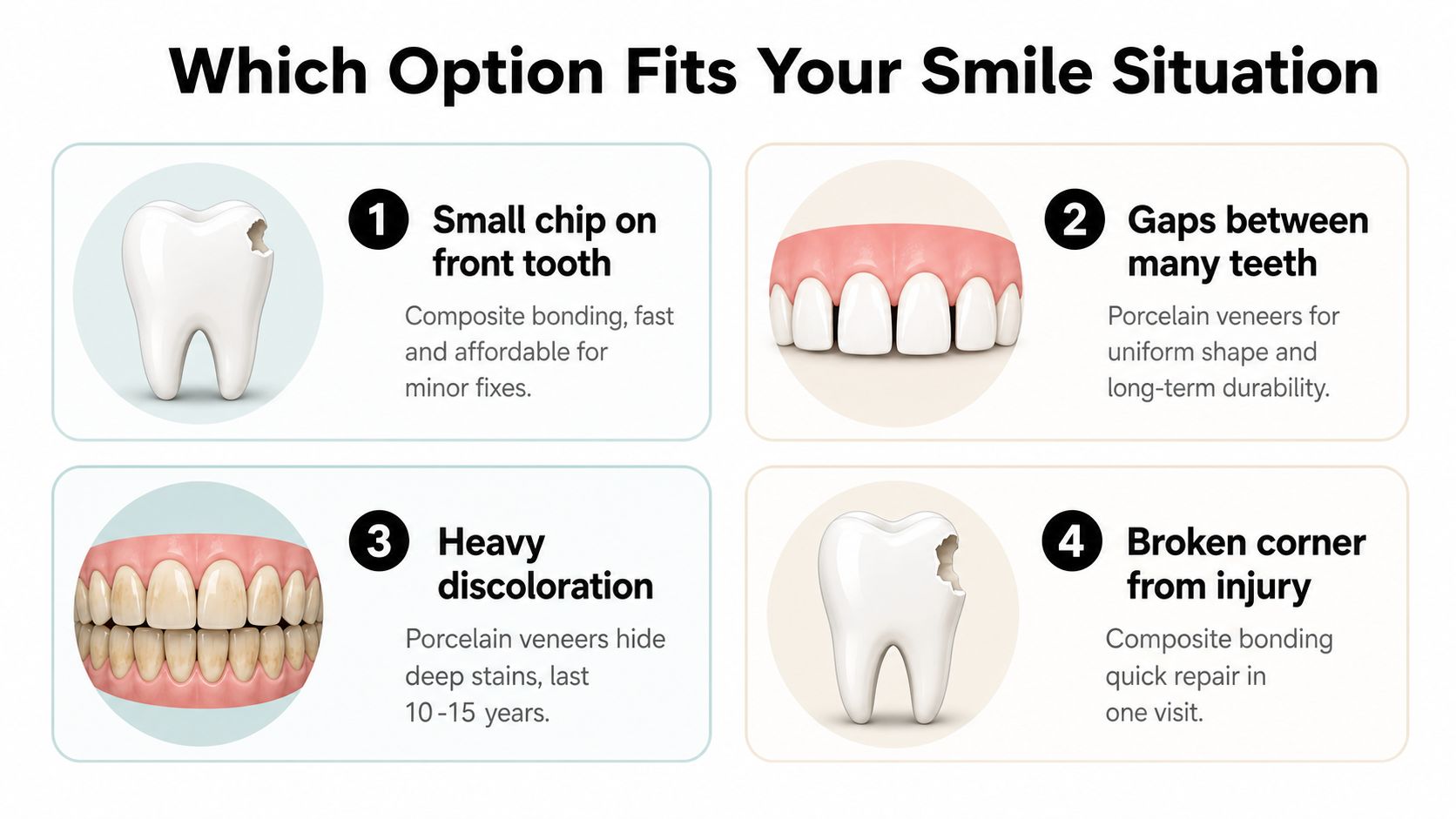
The self-check is simple. Is the concern one tooth or many? Is the stain superficial or deep? Is enamel preservation more important than long-term color stability? Does the patient want a reversible trial, or a carefully designed result that can remain consistent for many years?
What to Expect at Ultra Smile DentalSpa in Miami
A cosmetic consultation should feel like a planning appointment, not a sales presentation. The first visit typically begins with a conversation about the patient's smile concerns, preferred level of change, work or social timeline, and comfort with enamel preparation. Digital photography, a clinical exam, bite evaluation, and gum assessment help the dentist determine whether bonding, porcelain, whitening, orthodontic treatment, or restorative care belongs in the plan.
A mock-up can help patients preview possible tooth shapes and proportions before preparation. This stage gives the patient a chance to discuss length, width, edge position, and shade while changes are still part of the design conversation. Patients with dental anxiety can also discuss comfort preferences before treatment begins, including noise-canceling options, streaming entertainment, sedation choices when appropriate, and a calm treatment pace.
The visit sequence
Bonding for a limited number of teeth may be completed during a single visit. The dentist selects the shade, applies the composite in layers, sculpts the anatomy, cures the resin, checks the bite, and polishes the result.
Veneers require more coordination. The preparation appointment records the teeth and provides temporary veneers when indicated. A dental laboratory crafts the ceramic restorations, and the final bonding visit includes a try-in, shade and contour review, bite verification, and permanent cementation. The final reveal should confirm that the teeth function comfortably as well as appear balanced.
Ultra Smile DentalSpa offers porcelain veneers and dental bonding as part of its cosmetic dentistry services in Miami. The practice also provides general and restorative care, including cleanings and exams, teeth whitening, crowns, Invisalign, dental implants, root canals, and wisdom teeth extraction. That broader service range can matter when a patient needs gum treatment, an emergency dentist, a tooth extraction, or implant planning before cosmetic work.
The right outcome is a patient who understands what will happen, what maintenance may involve, and why a selected material fits the condition of the teeth. Comfort matters, but informed consent matters just as much.
How to Choose and Book Your Consultation
The best choice depends on four filters.
Longevity versus flexibility: Patients who want the longest service profile and stable color usually lean toward porcelain. Patients who want easier adjustment, repair, and future changes usually lean toward composite.
Budget versus ownership cost: Bonding typically creates the lower initial fee. Porcelain may make more financial sense for a patient who wants fewer replacement cycles and plans to maintain the smile for many years.
Number of teeth: A small chip or one modest gap often favors bonding. A broad smile makeover, multiple uneven teeth, or a consistent shade across the visible smile often favors porcelain.
Comfort with permanence: Patients who don't want enamel reduction should discuss bonding first. Patients ready for a committed restorative plan, including eventual replacement, may prefer porcelain.
The direct recommendation is clear. Choose composite bonding for a single-tooth repair, a younger patient whose goals may change, or anyone placing enamel preservation first. Choose porcelain veneers for a full smile makeover, deep intrinsic staining, or a patient ready to commit to a long-term ceramic result. Neither choice replaces the need for healthy gums, a stable bite, and appropriate dental diagnosis.
Before a Miami consultation, patients should bring photos showing the smiles they like, a list of previous dental treatments, information about grinding or clenching, and questions about preparation, temporaries, repair, replacement, and total ownership cost. Useful questions for Dr. Notowitz and the Ultra Smile DentalSpa team include:
- Which teeth need treatment, and which can remain untouched?
- Would whitening or Invisalign change the plan?
- How much enamel preparation is expected?
- What happens if a restoration chips?
- What maintenance should be expected over five, ten, or twenty years?
- How would future dental implants, crowns, or other restorative care affect the plan?
A consultation gives patients a chance to compare both materials on their own teeth rather than choosing from generic photographs. It also helps identify whether a cosmetic concern requires bonding or veneers, or whether preventive, periodontal, orthodontic, or restorative dental care should come first.
Ultra Smile DentalSpa offers cosmetic consultations for patients comparing porcelain veneers and composite bonding, along with general, restorative, and emergency dental services in Miami. Patients can review treatment options and request a visit through Ultra Smile DentalSpa to discuss the smile goals, timeline, and level of permanence that fit their needs.