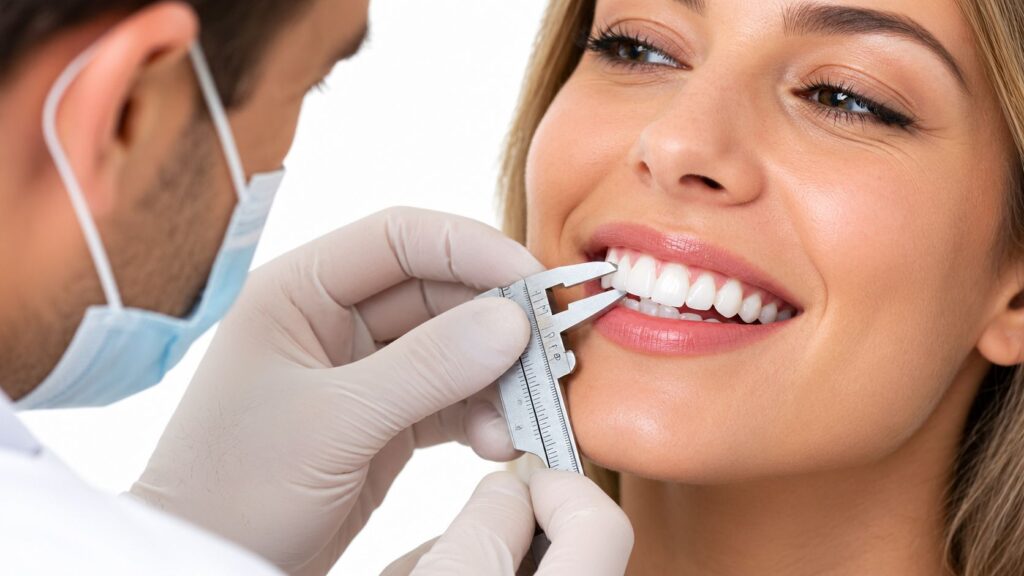
Most traditional veneers remove about 0.5 mm of enamel, while no-prep options remove little to none. This amount is measured in fractions of a millimeter, not slices of tooth structure.
A patient searching for a cosmetic dentist near me in Miami may be wondering whether veneers mean having healthy teeth aggressively shaved down. That concern is understandable, especially after seeing dramatic images online that show preparation for crowns, not typical veneer preparation. Modern porcelain veneers are thin shells placed over the visible front surface, and the preparation is usually planned to preserve as much natural enamel as possible.
The exact answer depends on the veneer type, the tooth's shape and position, the patient's bite, and the desired change in color or contour. A careful dentist in Miami, FL should explain the planned depth for each tooth before preparation begins, rather than presenting one number as if every smile were identical.
Table of Contents
- How Much Enamel Is Typically Removed for Veneers
- Enamel Preparation by Tooth Region
- No-Prep, Minimal-Prep, and Traditional Veneers Compared
- Why Enamel Preservation Matters for Bond Strength
- What to Expect During a Veneer Consultation in Miami
- Choosing the Right Veneer Approach for Your Smile
How Much Enamel Is Typically Removed for Veneers
A nervous Miami patient may arrive for a first cosmetic consultation with one question: will the teeth still look and feel like natural teeth after preparation? In most cases, the answer begins with a small measurement. Traditional porcelain veneer preparation commonly targets about 0.4 to 0.6 mm, with 0.5 mm considered acceptable for clinical use, according to a British Dental Journal study of veneer preparation techniques (British Dental Journal study on veneer preparation depth).
That is a thin layer from the facial surface, meaning the front of the tooth that shows in a smile. It isn't comparable to removing large sections of a tooth. No-prep veneers may require 0 mm of removal in suitable cases, while minimal-prep designs may involve only a very small amount. Traditional veneers can require more space when a patient needs a noticeable change in shape, alignment, or shade.
Practical rule: The safest preparation is not automatically the smallest preparation. It is the smallest preparation that creates a natural contour, a stable bond, and the requested cosmetic result.
A veneer needs room to sit flush with the surrounding teeth. If the ceramic is placed without enough space, it may look bulky or feel too prominent. If excessive enamel is removed, the preparation may move closer to dentin, the softer inner layer beneath enamel. That can affect sensitivity and bonding conditions.
Why the number varies
The facial surface isn't equally thick from the gumline to the biting edge. A dentist may therefore use depth guides, calibrated burs, digital planning, or a combination of methods rather than treating every part of the tooth identically. The preparation also changes when a patient needs a more opaque ceramic to mask significant discoloration.
An in vitro study found that even when operators aimed for an even 0.5 mm reduction, the actual depth varied across the tooth, with greater reduction at some cervical and proximal margins and dentin exposure at those sites in most teeth (study of the distribution of porcelain veneer preparation). This finding explains why technical precision matters as much as the planned number.

The preparation also differs from a tooth extraction, a crown, or treatment from an emergency dentist. Veneers address the visible front surface for cosmetic changes. Patients with decay, cracks, infection, gum disease, or an unstable bite may need restorative dentistry or other dental care before cosmetic treatment is considered.
Enamel Preparation by Tooth Region
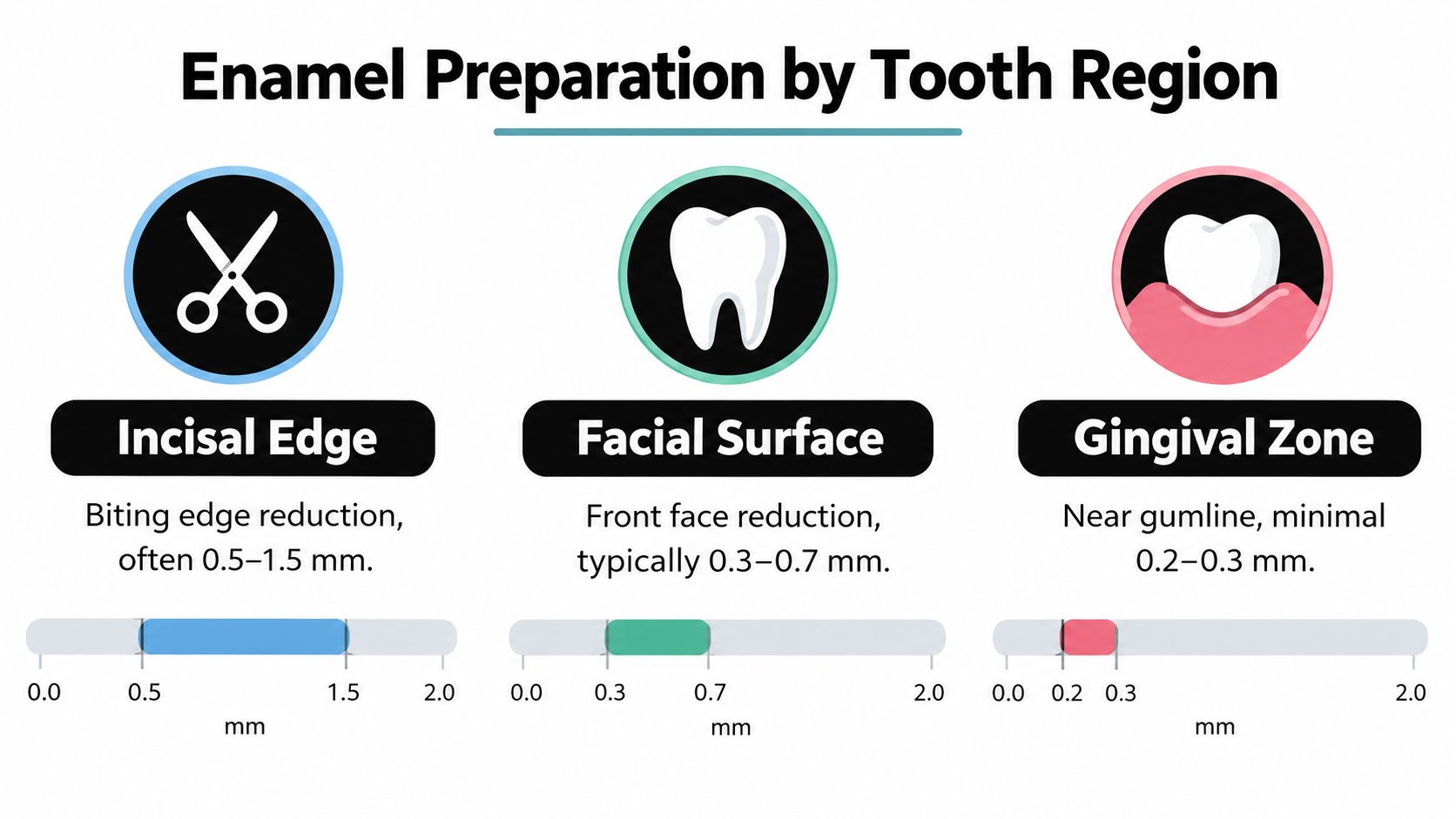
A patient may hear that veneers require a small amount of enamel removal, then wonder why the plan includes different depths across one tooth. The front surface is not uniform. Dentists divide it into three preparation zones: the cervical third beside the gumline, the middle third across the central facial surface, and the incisal third near the biting edge. Each zone has different anatomical and cosmetic demands, so one number cannot describe every veneer preparation.
Published guidance commonly places facial reduction at about 0.3 mm in the cervical third and about 0.5 mm across much of the visible surface. Some designs allow up to 0.7 mm when a more opaque ceramic needs additional room to mask discoloration, according to guidance on conservative porcelain laminate veneer preparation. The review of porcelain veneer preparation principles also explains why these figures vary by tooth region and restoration design.
Near the gumline
The cervical third usually receives the most conservative preparation. Enamel here may be only about 0.3 to 0.4 mm thick, so removing excessive material can reach dentin, the inner tooth layer beneath enamel. Dentin is more sensitive and provides different bonding conditions.
As noted in the review cited above, a clinician may plan approximately 0.1 mm for some minimal-prep designs or around 0.3 to 0.4 mm for a conventional preparation. The final choice depends on the tooth's shape, color, position, and the ceramic selected.
The margin is the boundary where the veneer ends on the tooth. Keeping this boundary in enamel generally supports stronger adhesive bonding and helps create a cleaner transition beside the gum. Its position also needs to respect the gum tissue rather than just follow a preset measurement.
Across the middle of the tooth
The middle third usually offers more working room. Instead of removing material to a single visual estimate, the dentist can create controlled depth with preparation guides, calibrated burs, or both. These tools work like a ruler built into the procedure. They help mark the intended reduction and limit uneven cutting as the surface is refined.
The goal is a smooth facial platform that gives the ceramic enough space to follow the planned contour without making the tooth look bulky. The dentist may adjust the design for severe staining, a rotated tooth, or substantial reshaping. A more opaque veneer can require more room than a translucent veneer placed over a tooth with favorable color.
Near the biting edge
The incisal third meets the opposing teeth during biting. The review cited above describes designs using approximately 0.7 to 1.0 mm in this region, depending on whether the veneer covers, overlaps, or stops near the edge. The dentist must coordinate ceramic thickness with smile length, speech, and jaw movement.
A PubMed-indexed study of 90 extracted teeth found an ideal labial reduction depth of 0.4 to 0.6 mm, yet no preparation method reached that range consistently across the entire surface (study of porcelain veneer preparation accuracy). For patients, the practical point is clear: the target depth matters, but anatomy and the dentist's control matter just as much.
No-Prep, Minimal-Prep, and Traditional Veneers Compared
A patient with straight, evenly colored teeth may need almost no reshaping. Someone with dark discoloration, a rotated tooth, or a prominent edge may need a different plan. The labels no-prep, minimal-prep, and traditional veneers describe how much room the dentist creates for ceramic. They are treatment approaches, not guarantees that one option will suit every smile.
No-prep veneers involve little to no enamel removal in carefully selected cases. They can work when the teeth have favorable alignment, enough space for a thin ceramic layer, and only modest changes are needed. They are less suitable for significant color masking, major reshaping, or a tooth that already projects forward. Adding ceramic without managing the existing contour can make the tooth look bulky.
Minimal-prep veneers preserve most of the natural enamel while creating limited space for the restoration, as described in our guide to minimal-prep veneers. This approach may suit small changes in contour, spacing, or brightness. The dentist still needs to plan carefully. Ceramic needs enough room to reach the intended shape without pressing against neighboring teeth or changing the bite.
Traditional veneers provide more control over tooth shape, position, and shade. Contemporary preparation commonly falls within about 0.3 to 1.0 mm, depending on the tooth region and the design requirements (peer-reviewed review of veneer preparation approaches). More reduction does not automatically produce a better result. It may be appropriate when the treatment requires stronger color masking or a larger change in contour.
Veneer Types by Enamel Removal
| Veneer type | Typical enamel removal | Best for | Bonding focus |
|---|---|---|---|
| No-prep veneer | 0 mm in suitable cases | Minor contour or shade changes when tooth position allows | Bonding to available enamel without unnecessary reduction |
| Minimal-prep veneer | Often around 0.5 mm, with site-specific variation | Conservative cosmetic changes and favorable anatomy | Preserving a high proportion of enamel |
| Traditional veneer | Approximately 0.3 to 1.0 mm, depending on region and design | More significant shade, shape, or contour changes | Creating ceramic space while retaining enamel where possible |
These ranges describe categories rather than promises. A tooth with dark internal discoloration may need a different ceramic thickness from one receiving a small edge correction. A deep bite can also change the design because the veneers must work with the opposing teeth during chewing. The preparation depth is one part of the decision, alongside tooth position, enamel available for bonding, bite forces, and the patient's cosmetic goals.
Longevity and reversibility
Removed enamel does not grow back, so the specific preparation cannot be reversed. A conservative approach leaves more natural structure available for future maintenance, but no-prep treatment is not automatically risk-free. Poor contour, inadequate space, an unstable bite, or unsuitable case selection can create problems even when little enamel is removed.
A 2021 prospective comparative analysis reported a mean survival rate of 9.67% for conventional veneers versus 100% for no-prep or minimal-prep veneers in the studied groups. The result reflects that study's design and patient selection, rather than every patient's expected outcome (prospective comparative analysis of veneer survival). The same linked evidence also reports a 2026 review with success rates up to 97.4% when veneers were bonded to enamel in well-selected cases.
Taken together, these findings suggest that durability depends on case selection, enamel support, bite management, and accurate design, not preparation depth alone. The thinnest option is not always the safest or longest-lasting choice. A veneer plan should create enough space for the desired result while preserving healthy enamel whenever the tooth's anatomy allows.
Why Enamel Preservation Matters for Bond Strength
Enamel is the tooth's hard outer shell. Dentin sits beneath it and contains microscopic channels that can make adhesive bonding less predictable and sensitivity more likely after preparation. Keeping the veneer margin, the edge where the veneer meets the tooth, in enamel gives the restoration a more favorable surface to bond with whenever the tooth's shape allows.
Clinical guidance recommends that veneer preparation remain within enamel and stay no deeper than 0.5 mm in the cited recommendation (clinical guidance on enamel-limited veneer preparations). That small measurement serves a larger purpose. Preserved enamel gives the adhesive more of the natural tooth surface it bonds to reliably, helping create a stable foundation for the veneer.
What enamel-only bonding changes
A veneer bonded mainly to enamel has a predictable bonding substrate, meaning the surface that receives the dental adhesive. The preparation also remains farther from the inner tooth structures that can react to temperature or pressure. Enamel preservation does not remove every possibility of sensitivity, since the gums, bite, existing restorations, and individual tooth condition also matter. It does reduce the need to remove healthy structure without a clear design reason.
The reduction ranges described earlier, about 0.3 mm near the gumline and up to 0.7 mm when a more opaque shade change requires extra ceramic space, provide a planning framework. They do not mean every region of every tooth should be prepared to the same depth. The dentist may need less space near one margin and more on another surface, depending on color, contour, alignment, and the selected veneer material.
Bonding principle: A shallow preparation matters because it can preserve enamel and support adhesion, not simply because the measurement is small.
When more space may be reasonable
Enamel preservation still allows preparation when the planned result requires it. Deep discoloration, uneven proportions, worn edges, or a change in facial contour can require additional room for ceramic. A veneer made too thin for a significant color or shape correction may appear opaque, overly prominent, or different from the approved design.
The dentist balances three practical needs: retain healthy tooth structure, create enough room for the veneer, and maintain a comfortable bite. That balance matters more than choosing “no-prep from the treatment name alone. No-prep describes a preparation approach, not a guarantee that the result will suit every tooth.
Patients can review porcelain veneers and their composition to understand how ceramic characteristics relate to shade and thickness. Material selection, shade planning, tooth contour, preparation depth, and bonding technique must work together.
Future maintenance
Preserving enamel leaves more natural tooth structure available if the veneer later needs repair, replacement, or removal. Some clinicians are also exploring techniques that may help separate ceramic or composite restorations while limiting contact with the underlying tooth. These removal methods continue to develop, so patients should ask what the treating dentist would do if the selected veneer required replacement.
What to Expect During a Veneer Consultation in Miami
A veneer consultation should answer the enamel question before any tooth is prepared. Patients searching for a cosmetic dentist near me in Miami can expect the appointment to begin with an evaluation of dental health, gum condition, tooth structure, bite, and smile goals.

The first conversation
The dentist should ask what the patient wants to change. A brighter smile may call for a different plan from closing a gap, correcting a worn edge, or making uneven teeth appear more symmetrical. Patients should also mention clenching, grinding, prior dental work, sensitivity, and any concern about permanent enamel removal.
A complete evaluation may include clinical photographs, dental x-rays when indicated, a digital scan or impression, and an assessment of how the upper and lower teeth meet. Existing decay, gum inflammation, infection, or structural damage may need treatment before cosmetic dentistry. In some cases, cleaning and exams, teeth whitening, restorative dentistry, or a night guard may be more appropriate first steps.
The smile design stage
Digital impressions can show tooth proportions and help the dentist plan the veneer contours. A mock-up or temporary preview can help patients evaluate length, width, symmetry, and how the proposed design affects speech and the bite. Shade selection should also consider the surrounding teeth and whether the patient wants whitening before veneers are made.
The most useful questions are specific:
- Preparation depth: Which tooth regions will receive preparation, and what depth is planned in each region?
- Enamel location: Will the margins remain in enamel, and what happens if the tooth's anatomy differs from the digital plan?
- Treatment alternatives: Could teeth whitening, Invisalign, composite bonding, or minimal-prep veneers address the concern?
- Future care: What maintenance, bite protection, repair, or replacement could the veneers require?
The dentist should explain why a particular preparation is recommended rather than labeling it conservative. A patient who understands the reason for each step can make a more informed decision and feel less anxious about the procedure.
The consultation may also reveal that another service is needed. A tooth with extensive damage might require a crown, while a missing tooth could call for dental implants near me rather than a veneer. Severe pain, swelling, or trauma calls for an emergency dentist, not a cosmetic appointment.
A short overview of the consultation and smile planning process can be viewed below.
Before preparation begins
The patient should receive a clear explanation of what will happen on the preparation day, how the teeth will be protected during the laboratory phase, and how the final veneers will be checked. The dentist should also discuss the fact that enamel removal is permanent and that the selected restoration may need replacement or repair in the future.
Patients from Downtown Miami, Midtown Miami, and Hallandale Beach can use the consultation to compare their cosmetic goals with their oral health needs. A calm appointment, clear imaging, and direct discussion of millimeters can replace guesswork with a personalized plan.
Choosing the Right Veneer Approach for Your Smile
The answer to how much enamel is removed for veneers should never be separated from the reason treatment is being considered. A patient seeking a subtle change with favorable tooth alignment may be a candidate for no-prep or minimal-prep treatment. Another patient with deep discoloration, a prominent contour, or worn edges may need more room for a natural-looking traditional veneer.
Conservative preparation is generally the preferred starting point because enamel supports strong bonding and helps limit unnecessary sensitivity risk. Still, the smallest number isn't always the best clinical choice. A veneer that lacks enough space may compromise contour, shade masking, or function.
Questions that support a sound decision
- Is the tooth healthy? Decay, gum disease, cracks, and infection should be addressed before cosmetic bonding.
- Does the planned design fit the bite? The veneer must work during speaking, chewing, and normal jaw movement.
- Can the desired shade be achieved conservatively? A dentist should explain whether the existing color can be masked without excessive reduction.
- Where will the margin sit? Enamel-preserving margins support a more favorable bonding foundation.
- What happens later? Patients should understand maintenance, repair, removal, and replacement before consenting.
A qualified Miami cosmetic dentist can also explain when teeth whitening, composite bonding, invisible braces, restorative dentistry, or another treatment would better match the patient's needs. Veneers are a permanent cosmetic commitment, so the decision should follow a detailed examination rather than a single online measurement.
Ultra Smile DentalSpa offers porcelain veneers and personalized cosmetic consultations for patients who want to understand enamel-preserving options before treatment. Patients can visit Ultra Smile DentalSpa to schedule a Miami consultation, review smile goals, and discuss the preparation approach that fits their teeth.