In Miami, a single porcelain veneer typically costs $900 to $2,500 per tooth, and most porcelain veneers last 10 to 15 years with proper care. For many adults comparing a cosmetic dentist near me or a dentist in Miami, FL, that makes veneers a serious long-term smile investment rather than a quick beauty treatment.
A lot of patients start in the same place. They smile in photos with lips closed, notice a chip on a front tooth every morning, or feel frustrated that whitening no longer fixes the color they see in the mirror. Others are balancing cosmetic goals with practical questions about comfort, maintenance, insurance, and whether veneers are worth the commitment.
Porcelain veneers can create a dramatic improvement in shape, color, symmetry, and overall smile balance. They can also come with details many websites barely mention, especially the permanent nature of enamel preparation and the fact that veneers themselves can't be whitened later. This guide aims to clarify decisions for those considering a dentist near me, cosmetic dentist near me, or related care such as teeth whitening, cleaning and exams, dental x-rays, new patient exams, emergency dentist visits, tooth extraction, restorative dentistry, or dental implants near me in Miami.
Table of Contents
- What Are Porcelain Veneers and Who Needs Them
- The Porcelain Veneer Treatment Process in Miami
- Benefits Longevity and Cost of Veneers
- Key Risks and Long-Term Commitments
- Porcelain Veneers vs Other Cosmetic Options
- Caring For Your New Smile After Veneers
- Why Choose Ultra Smile DentalSpa for Your Veneers in Miami
- Your Top Questions About Porcelain Veneers Answered
What Are Porcelain Veneers and Who Needs Them
A patient often comes in with one clear frustration. The teeth look healthy, but the smile still feels off in photos because of dark stains, worn edges, small gaps, or uneven shapes. Porcelain veneers are designed for that kind of problem.
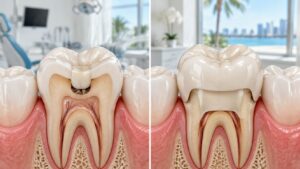
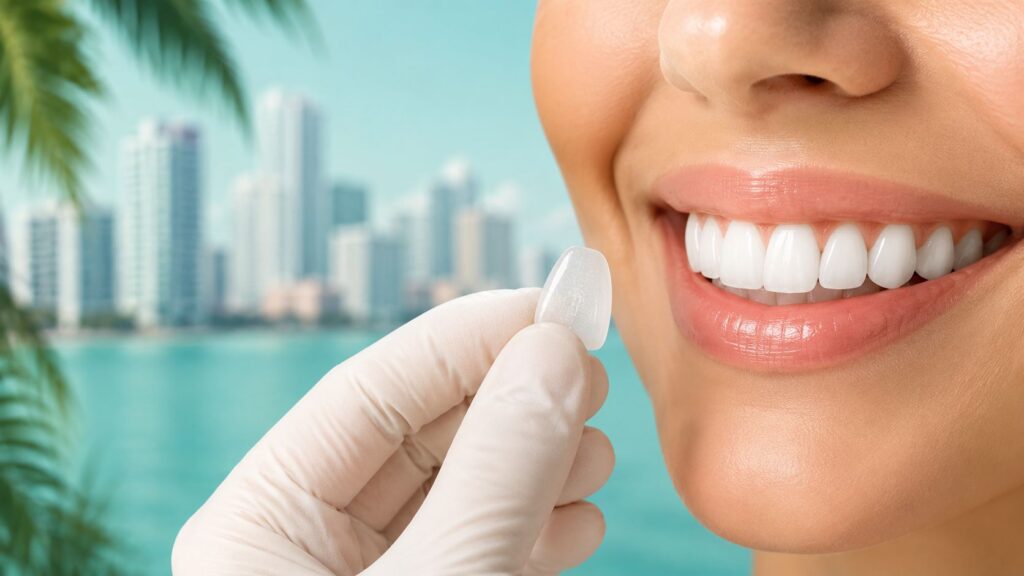
Porcelain veneers are thin, custom-made ceramic shells bonded to the front of selected teeth to improve color, shape, size, and overall symmetry. They cover the visible surface of the tooth, so the change can be dramatic while still looking natural when the case is planned well.
They are a strong option for teeth that have discoloration that does not respond to whitening, small chips, mild spacing, edge wear, and minor cosmetic misalignment. They are not the right answer for every smile. If the main issue is active decay, gum disease, heavy clenching, or major bite instability, those conditions need treatment before veneers are considered.
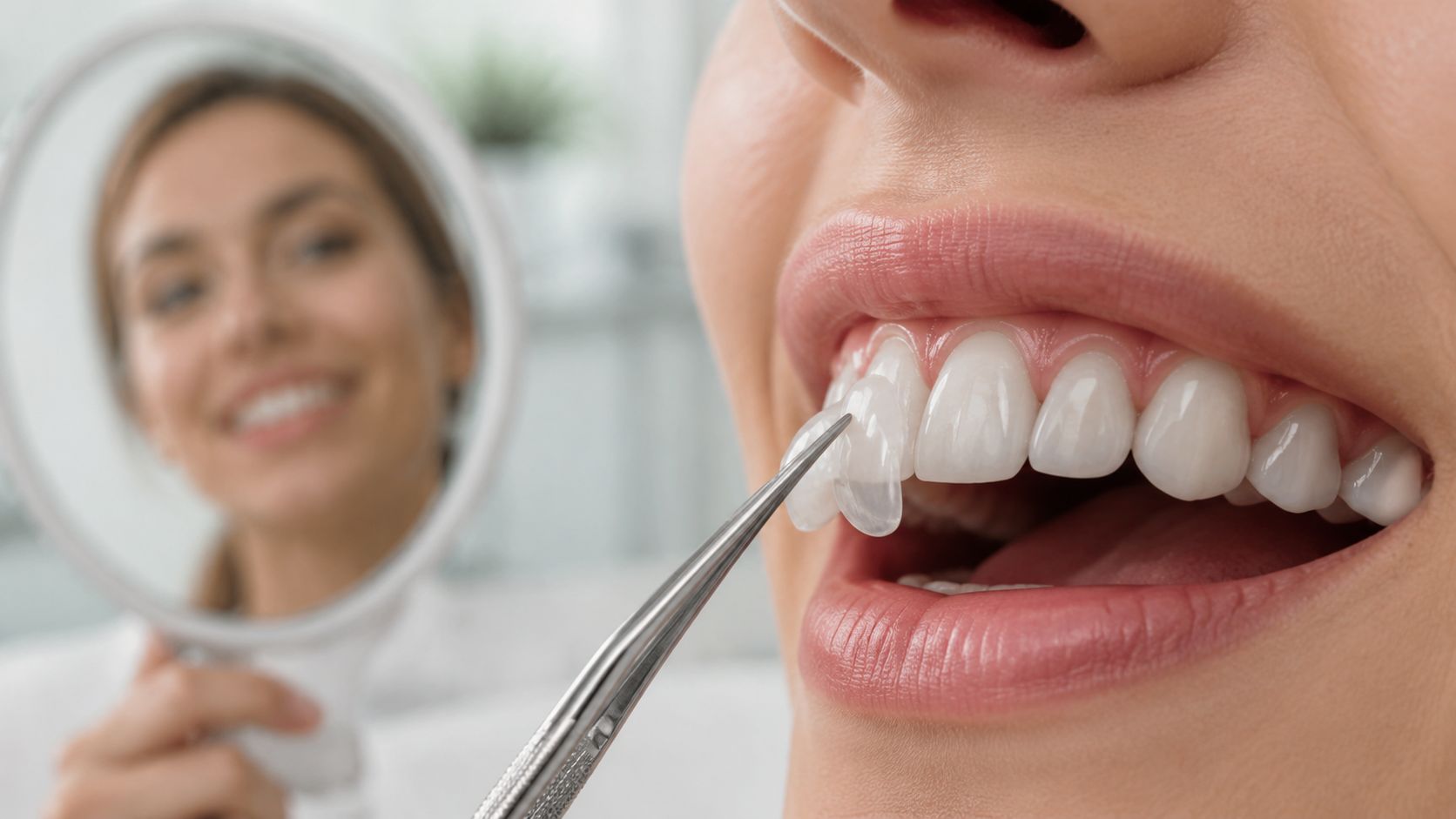
What veneers can correct
Veneers are usually chosen for visible concerns on the front teeth, especially when the patient wants a cleaner, brighter, more balanced smile without changing every tooth in the mouth. Common reasons include:
- Deep discoloration: Teeth that remain dark, blotchy, or uneven after professional whitening.
- Small chips and worn edges: Front teeth that look shortened, rough, or uneven.
- Minor spacing: Small gaps that affect smile balance.
- Mild shape differences: Teeth that look too narrow, too short, rounded, or mismatched.
- Subtle alignment concerns: Mild crowding or rotation where the goal is visual improvement rather than full orthodontic correction.
The limitation matters just as much as the benefit. Veneers can change the look of a tooth, but they cannot whiten on their own after they are made. That means shade selection at the start matters. If a patient plans to whiten nearby natural teeth, that should usually happen before veneers are fabricated so the final color stays coordinated.
Who's usually a good candidate
A good veneer candidate usually has healthy gums, enough enamel for bonding, and a specific cosmetic goal involving the visible smile zone. Good candidates also understand the long-term commitment. In many cases, preparing a tooth for a porcelain veneer means removing a small amount of enamel, and that change is permanent.
That point gets skipped in a lot of marketing. I do not skip it with patients. Veneers can look beautiful and last well, but they are a treatment choice that should be made with full awareness of maintenance, replacement over time, and the fact that the teeth will continue to need professional care.
Patients who ask about veneers are sometimes better served by another option. A person searching for a cosmetic dentist may need Invisalign for tooth position, bonding for one small chip, or a crown for a tooth that has lost too much structure. A person looking for a dentist in Miami may need a full exam first to confirm that the teeth and gums are healthy enough for cosmetic treatment.
Comfort matters too. Patients who are nervous about sensitivity during preparation often feel better after reading how porcelain veneers feel during treatment and recovery.
For adults in Downtown Miami, Midtown Miami, and Hallandale Beach, veneers are often appealing because they can create a refined cosmetic change in a shorter timeframe than orthodontic treatment. The best results come from careful case selection, conservative planning, and honest discussion about what veneers can and cannot do.
The Porcelain Veneer Treatment Process in Miami
The veneer process feels much easier when patients know exactly what's coming. Patients often worry less about the cosmetic result than about the unknowns. Will it hurt, how many visits are involved, and what will the teeth look like between appointments?
The process starts with planning. It ends with bonding. Everything in between matters because the final result depends on preparation, fit, bite, and shade control.
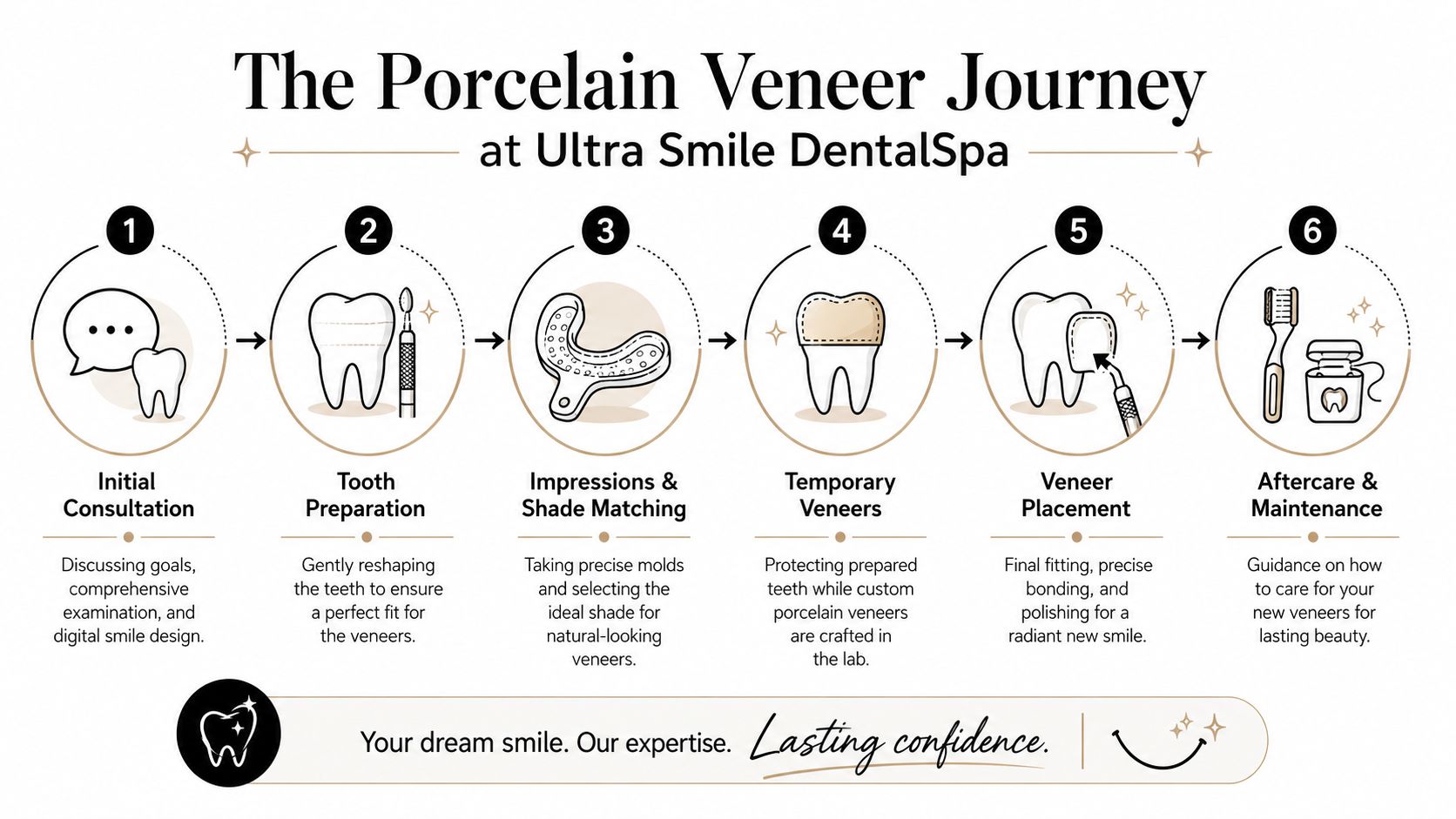
Consultation and smile design
At the first visit, the dentist reviews the patient's goals, examines the teeth and gums, and studies how the smile fits the face. In this initial assessment, cosmetic planning intertwines with general dental care. If a patient needs cleaning and exams, dental x-rays, or treatment for an underlying problem, those steps come first.
For many patients in Miami, this visit is also where the emotional part settles down. They stop wondering whether veneers will look fake and start understanding how shape, proportion, and shade are chosen.
Tooth preparation and temporary veneers
Once the plan is approved, the teeth are gently prepared so the veneers can sit naturally rather than looking bulky. This is the step that makes veneers a true commitment, because it usually involves enamel reduction.
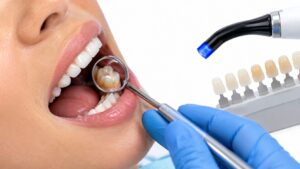
Precise impressions or digital records are then taken, and the shade is selected. Temporary veneers are often placed while the final porcelain restorations are being crafted. During this period, patients get a preview of the general look and feel.
For anyone anxious about sensitivity, this detailed explanation of whether porcelain veneers hurt can help clarify what patients typically experience during and after treatment.
A visual overview helps many patients understand the flow of appointments:
Final placement and polishing
At the bonding appointment, the dentist checks the fit, margin, shape, and bite before permanently placing the veneers. This isn't a rushed step. Small refinements here can make the difference between a smile that looks merely white and one that looks natural.
Patients often expect the final visit to feel dramatic. In reality, it usually feels precise. Each veneer is bonded into place, the bite is checked again, and the surfaces are polished.
Good veneer dentistry doesn't rely on brightness alone. The best smiles look balanced in motion, not just perfect in a still photo.
In a Miami office designed around comfort, details such as aromatherapy, entertainment during treatment, and a calmer clinical setting can make the appointments feel much less intimidating. That's especially helpful for patients who usually avoid care until they need an emergency dentist, a tooth extraction, or other urgent treatment.
Benefits Longevity and Cost of Veneers
A patient usually reaches this point with three practical questions. Will veneers look natural on my face. How many years can I reasonably expect from them. What is the total cost once planning, materials, and follow-up are included.
Porcelain remains a popular choice for front teeth because it gives the dentist precise control over shape, brightness, translucency, and surface character in a way that is hard to match with simpler cosmetic fixes. That matters when the goal is not just whiter teeth, but a smile that fits the lips, gumline, and facial proportions.
Why patients choose porcelain
The biggest benefit is predictability. Porcelain veneers can address several concerns at once, such as worn edges, uneven size, stubborn discoloration, small gaps, and minor shape irregularities. For the right patient, that can produce a cleaner result than trying to improve each tooth one by one with whitening, bonding, or orthodontic compromises.
Other advantages are practical as well:
- Natural light reflection: High-quality porcelain reflects light in a way that is closer to enamel than many direct materials.
- Better stain resistance: Porcelain holds its color well with coffee, tea, and red wine, although the surrounding natural teeth can still darken over time.
- Controlled symmetry: Matching multiple front teeth is often easier with porcelain because the restorations are designed together, not pieced together over separate visits.
That last point is often underestimated. A smile can look very different depending on how the central incisors, laterals, and canines relate to each other in motion, not just in a close-up photo.
How long they last
With good case selection, careful bonding, and consistent home care, porcelain veneers commonly last 10 to 15 years, and many last longer. Longevity depends on habits as much as materials. Patients who clench, grind, bite nails, chew ice, or use their teeth as tools place more stress on the porcelain and the bonding interface.
For longer-term clinical context, Dentalpedia's review of veneer durability summarizes survival data from published studies and shows that well-made porcelain veneers can perform for many years. In practice, I tell patients to think in terms of maintenance, not permanence. Veneers are durable restorations, but they are still restorations.
That distinction matters because longevity is tied to commitment. A patient who wants veneers for a wedding next season should also be comfortable maintaining them years later if one chips, debonds, or needs replacement.
What veneers cost in Miami
Cost varies because veneer treatment is customized. The fee reflects the dentist's planning process, the amount of design work involved, the quality of the ceramic lab, the number of teeth treated, and how much bite adjustment or preliminary care is needed before veneers are placed.
In Miami, porcelain veneers are usually priced per tooth, and the total can rise quickly when several visible teeth are treated together. Patients evaluating their options should review a detailed breakdown of veneers cost in Miami before committing to treatment, especially if they are deciding between a small refinement and a larger smile design.
Insurance usually provides little or no help because veneers are typically elective. That is why I encourage patients to look past the per-tooth number and ask better questions. What happens if one veneer needs to be remade later. Are temporaries, records, mock-ups, or night guards included. How likely is future whitening of untreated teeth, knowing veneers themselves will not whiten after they are bonded.
A lower quote can be reasonable. It can also leave out planning, customization, or follow-up that affects how the final smile looks and how long it holds up.
Key Risks and Long-Term Commitments
Most veneer articles spend plenty of time on photos and very little time on commitment. That's backwards. Patients deserve clarity before any enamel is touched.
The first risk is manageable and common. Some people notice temporary sensitivity after preparation or shortly after bonding. That usually improves. The more important issues are the long-term obligations that come with the procedure.
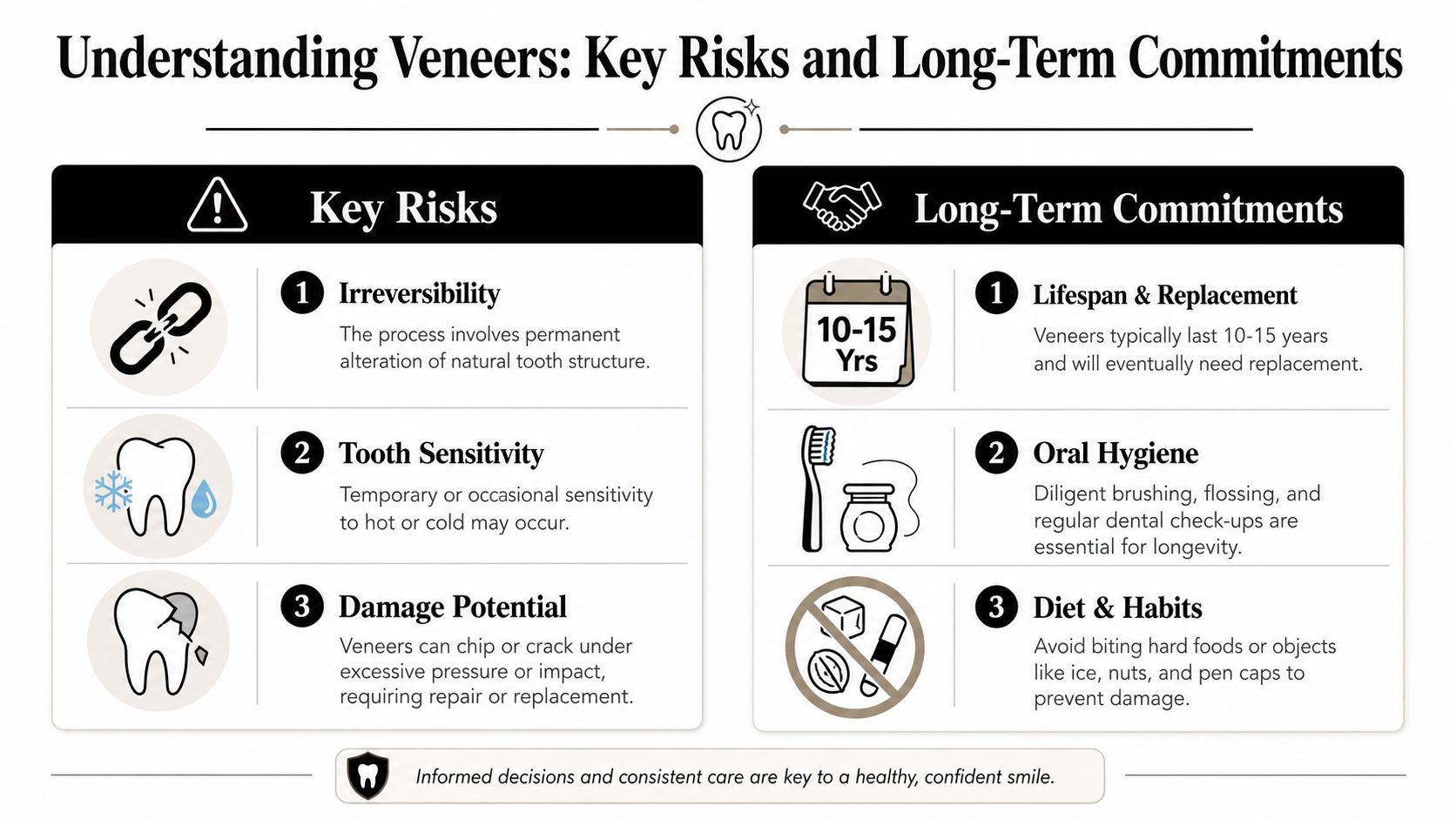
The procedure is usually irreversible
This point needs plain language. Once enamel is shaved for traditional veneers, that tooth doesn't go back to its untouched state.
The clearest patient explanation appears in Friedman Dental Group's discussion of veneer questions, which emphasizes that enamel reduction is non-reversible and that patients must continue having veneers on those teeth in the future, even if one chips or cracks.
This is not a trial run. Veneers may be elective, but the preparation step creates a lasting obligation.
That doesn't make veneers a bad choice. It means they should be a thoughtful choice.
Veneers can't be whitened later
Another issue that many people don't hear early enough is whitening mismatch. Porcelain is often called stain-resistant, which is true in everyday use. But the veneer itself can't be whitened once it's bonded.
If a patient's natural teeth darken over time from age, coffee, tea, or other habits, the veneers won't lighten with whitening gel to match a new target shade. A mismatch can develop. The patient-centered discussion in this veneers Q and A thread about whitening limitations highlights that replacement, not whitening, is what fixes the veneer shade when this happens.
Other practical risks
A few more trade-offs should be understood before treatment:
- Damage risk: Veneers can chip or crack if a patient bites ice, pen caps, or other hard objects.
- Replacement reality: Even excellent veneers won't last forever.
- Maintenance burden: Gum health, bite stability, and regular checkups all affect how well veneers age.
Patients who understand these points usually make better choices and are happier with the result long term.
Porcelain Veneers vs Other Cosmetic Options
A patient may come in asking for veneers because they want a brighter, more even smile before a wedding or a job change. After the exam, the better answer may be whitening, bonding, Invisalign, or a crown. The right treatment depends on what is bothering you, what condition the teeth are in, and how much long-term commitment makes sense for you.
Veneers work best when several front teeth need coordinated cosmetic changes at the same time. They are especially useful for improving color, shape, worn edges, and small gaps in a way that looks balanced across the smile. They are less useful if the main issue is tooth position, a weak tooth that needs full coverage, or one small defect that can be repaired more conservatively.
Common options and where they fit
The quickest way to decide is to evaluate each option by its purpose, expected longevity, cost range, and how much tooth structure it usually affects.
| Treatment | Best For | Expected Longevity | Average Cost (per tooth) | Invasiveness |
|---|---|---|---|---|
| Porcelain veneers | Color, shape, chips, small gaps, smile redesign | Long-lasting with good care | $900 to $2,500 in Miami | Moderate |
| Composite veneers | Lower-cost cosmetic improvement | Shorter than porcelain in many cases | Lower than porcelain in many cases | Lower to moderate |
| Dental bonding | Small chips, minor reshaping, isolated repairs | Best for smaller, more limited fixes | Usually lower than porcelain | Low |
| Crowns | Teeth with major structural damage or large restorations | Used when full coverage is needed | Varies | Higher |
| Invisalign | Alignment and bite correction | Depends on the case and retainer use | Varies | Low to moderate |
In practice, the decision usually comes down to one question. Are we changing the look of the tooth, moving the tooth, or protecting a weakened tooth? Those are very different goals, and the best treatment changes with the goal.
How veneers differ from whitening, bonding, crowns, and Invisalign
Whitening makes sense when teeth are healthy and the main complaint is shade. It is the most conservative cosmetic option. It will not change shape, close spaces, or hide chips. It also matters that veneers do not whiten later, so patients who may want a brighter overall shade should usually address whitening before veneer shade is finalized.
Bonding is useful for a single chip, a small gap, or minor edge reshaping. It preserves more natural tooth in many cases and costs less up front. The trade-off is that bonding tends to stain, wear, and need touch-ups sooner than porcelain.
Crowns solve a different problem. If a tooth has a large filling, fracture, root canal history, or significant structural loss, a crown may be the safer restoration because it covers the whole tooth. Veneers are cosmetic restorations first. Crowns are often chosen when strength and protection matter as much as appearance.
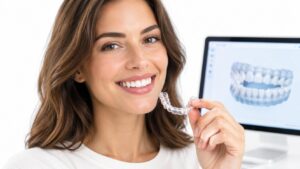
Invisalign is often the better choice when crowding, spacing, or bite position is the main concern. If teeth are healthy but in the wrong place, moving them is often more conservative than reshaping them to create the appearance of alignment. Some patients still choose veneers after Invisalign, but usually for refinement rather than correction alone.
How I help patients choose
A useful way to sort the options is this:
- Choose whitening if the teeth are healthy and the problem is mostly color.
- Choose bonding for a small defect that can be corrected without treating multiple teeth.
- Choose veneers when several visible teeth need coordinated changes in shade, contour, width, or length.
- Choose crowns when a tooth is weakened and needs full coverage, not just cosmetic improvement.
- Choose Invisalign when alignment is the primary issue and you want to correct tooth position rather than cover it.
The biggest mistake is picking veneers because they sound like the premium option. Veneers are an excellent treatment in the right case, but they are not the most conservative option, and they are not reversible once enamel is prepared. A good cosmetic plan improves the smile while respecting the health of the teeth and the maintenance you will be committing to for years.
Caring For Your New Smile After Veneers
The daily routine after veneers isn't complicated, but consistency matters. Veneers look their best when the teeth and gums around them stay healthy.
Daily habits that protect veneers
A simple care routine usually includes:
- Brush gently: Use a soft toothbrush and non-abrasive toothpaste.
- Floss every day: Healthy gums help veneers keep a clean, natural-looking margin.
- Watch pressure habits: Avoid biting ice, hard candy, fingernails, or pen caps.
- Use a night guard if needed: Patients who clench or grind can place too much force on front teeth.
- Keep recall visits: Professional cleanings and exams help catch gum changes, bite issues, or edge wear early.
What patients should expect over time
Porcelain is durable, but the mouth still changes. Gums can recede. Bite forces can shift. Natural teeth can stain differently than veneer surfaces. Routine follow-up is part of protecting the investment.
For busy adults in Miami, the simplest approach is to treat veneers the same way they treat any high-value restoration. Protect them, clean around them carefully, and don't skip regular dental care just because the smile looks good.
Why Choose Ultra Smile DentalSpa for Your Veneers in Miami
Choosing a veneer provider isn't only about the final photo. It affects comfort during treatment, the precision of the planning, and how supported a patient feels through the process.
Ultra Smile DentalSpa serves patients in Downtown Miami, Midtown Miami, and Hallandale Beach with a model that combines modern dentistry and a calmer in-office experience. For patients who have delayed cosmetic work because of anxiety, that matters. A quieter setting, refreshments, aromatherapy, streaming entertainment, and a hot towel finish can make treatment feel less clinical and more manageable.
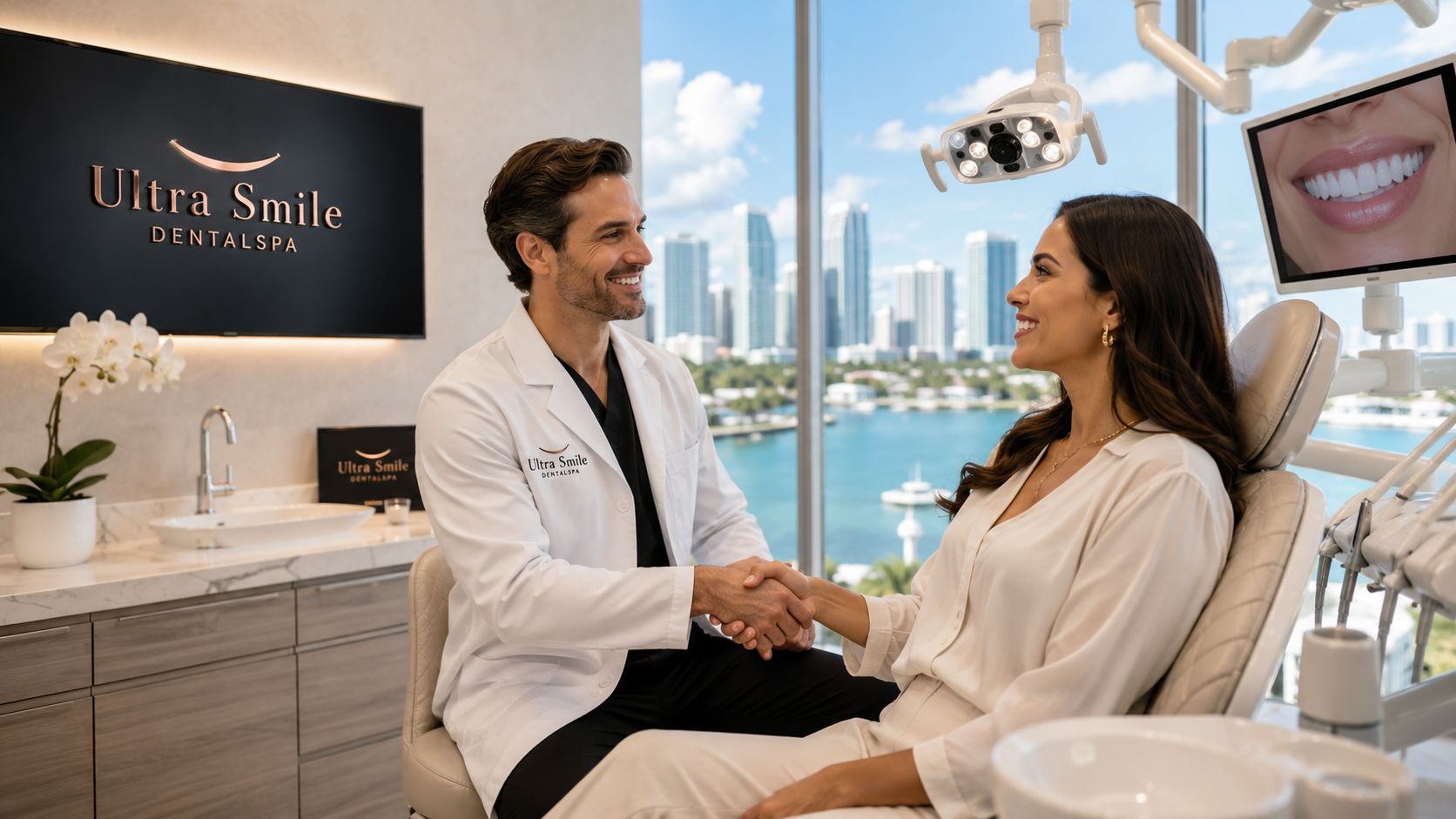
What makes the experience different
Patients considering a dentist in Miami, FL often want more than cosmetic skill. They also want clear communication, careful planning, and a team that can handle broader dental needs if something else is discovered during the exam.
Ultra Smile DentalSpa offers:
- Full-service care: Cosmetic, restorative, and general services in one setting, including cleanings, dental x-rays, crowns, whitening, Invisalign, implants, root canals, night guards, wisdom teeth extraction, and emergency dentist care.
- Advanced planning: Digital tools and premium materials support more predictable smile design.
- Bilingual support: Clear communication helps patients feel informed at every stage.
- Patient-centered comfort: The environment is designed for people who want a gentler experience, not just a faster appointment.
Why that matters for veneer patients
Veneers sit at the intersection of art and function. The smile has to look right, but the bite, gum health, and long-term maintenance also have to make sense. A practice that handles both cosmetic goals and broader dental care can evaluate the whole picture before treatment begins.
That matters whether the patient is comparing a cosmetic dentist near me, asking about teeth whitening, or trying to decide between veneers and other services such as restorative dentistry or dental implants near me.
Your Top Questions About Porcelain Veneers Answered
Do veneers ruin natural teeth
They shouldn't be framed that way, but they do require a real commitment. Traditional veneers usually involve enamel reduction, so the teeth are permanently altered. That's why case selection and planning matter so much.
Can a patient get just one or two veneers
Yes, in the right case. A single veneer or a small number can work well when the issue is isolated, such as one chipped or discolored front tooth. Matching becomes more demanding when fewer teeth are treated, so shade and translucency control matter.
How are natural-looking shades chosen
A natural result usually comes from choosing a shade that fits the patient's skin tone, lip line, neighboring teeth, and smile goals. The brightest option isn't always the best option. The best veneer shade tends to look believable in daylight, conversation, and photos.
Does dental insurance cover porcelain veneers in Miami
Usually not. Veneers in Miami are generally classified as cosmetic and are almost universally excluded from standard dental insurance coverage, as explained in this Miami dental insurance and veneers overview.
Can someone still need other dental treatment first
Absolutely. A patient interested in veneers may still need cleaning and exams, dental x-rays, gum treatment, restorative dentistry, or even emergency dentist care before cosmetic work begins. In some cases, a person asking about veneers may be a better candidate for Invisalign, bonding, crowns, or another treatment entirely.
If a brighter, more balanced smile is the goal, Ultra Smile DentalSpa offers porcelain veneer consultations for patients across Downtown Miami, Midtown Miami, and Hallandale Beach. Patients who are comparing a dentist near me, a cosmetic dentist near me, or a trusted dentist in Miami, FL can schedule a visit to review smile goals, costs, comfort options, and whether veneers are the right fit for their teeth long term.