A lot of people in Miami put off dental care for the same reason. A tooth feels a little sensitive, a crown feels “mostly fine, or an old dental visit still sits in memory as something tense and uncomfortable. Then the question starts looping: is this something small, or is it turning into a bigger problem?
General dentistry procedures are meant to answer that question early, calmly, and clearly. For adults searching for a dentist near me, a dentist in Miami, FL, an emergency dentist, or help with a tooth extraction, the most helpful starting point is understanding what each procedure is for, what it feels like, and what to expect from the visit itself.
Table of Contents
- Your Guide to Gentle Dental Care in Miami FL
- The Foundation of a Healthy Smile Preventive Care
- Restoring Your Teeth Fillings Crowns and Bridges
- Saving Natural Teeth Root Canals and Extractions
- Protecting Your Smile Night Guards and Advanced Solutions
- Your Comfort Is Our Priority at Ultra Smile DentalSpa
- Insurance Financing and Scheduling Your Visit in Miami
Your Guide to Gentle Dental Care in Miami FL
A patient in Downtown Miami might notice a dull ache while drinking iced coffee. Someone in Midtown may keep postponing a cleaning because the sound of dental tools still brings back an old bad experience. A Hallandale Beach professional may know a chipped tooth needs attention, but keep waiting for “a better week that never comes.
That hesitation is common. Dental care gets easier when the process feels familiar instead of mysterious.

General dentistry procedures cover the care most adults need over time, from cleanings and exams to fillings, crowns, root canals, and extractions. They matter because oral disease is extremely widespread. Over 3.5 billion people worldwide were living with oral diseases as of 2023, as summarized in this dental care statistics overview.
For many patients, the hardest part isn't the procedure itself. It's not knowing what the appointment will feel like. Will there be pain? How long will it take? Will the dentist explain things in plain language? Will there be pressure to agree to treatment on the spot?
A calmer visit usually starts with clarity. Patients tend to feel better when they know what the dentist sees, why treatment is being recommended, and what each step will feel like.
That's why a clear walkthrough matters. Patients looking through a list of common dental procedures often aren't just researching services. They're deciding whether this is finally the office where they'll feel comfortable coming in.
In Miami, where schedules are packed and many adults delay care until something hurts, gentle dentistry isn't about making treatment look fancy. It's about removing fear, lowering uncertainty, and helping people protect their smile before small problems become urgent ones.
The Foundation of a Healthy Smile Preventive Care
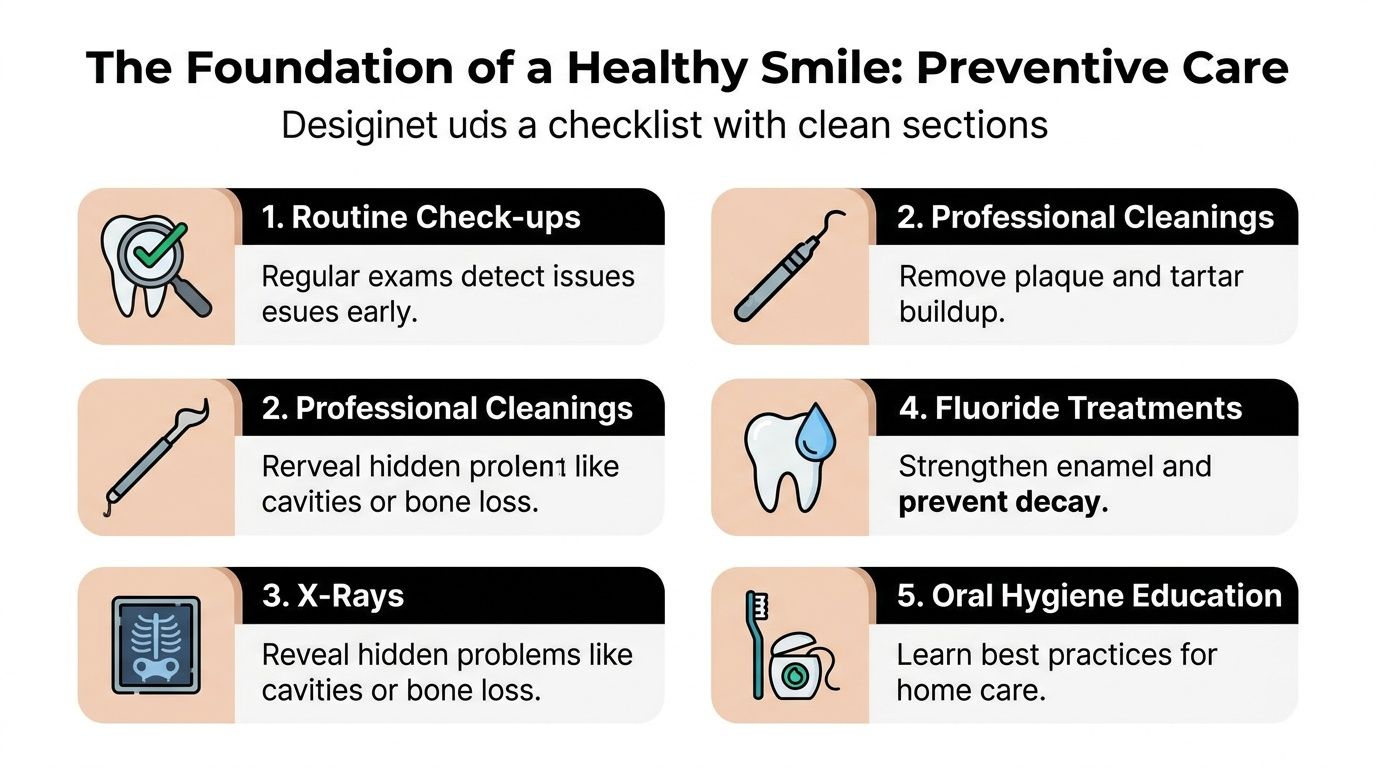
Preventive care is the part of dentistry that saves patients the most stress later. A routine visit often looks simple from the outside, but each piece has a job. The cleaning removes buildup, the exam checks the health of teeth and gums, and the screening helps catch problems early, when they're easier to treat.
Patients should receive professional cleanings and thorough examinations every six months, according to Miami Smile Institute's general dentistry guidance. That schedule gives the dental team repeated chances to spot changes before they turn into pain, swelling, or a broken tooth.
What happens at a routine preventive visit
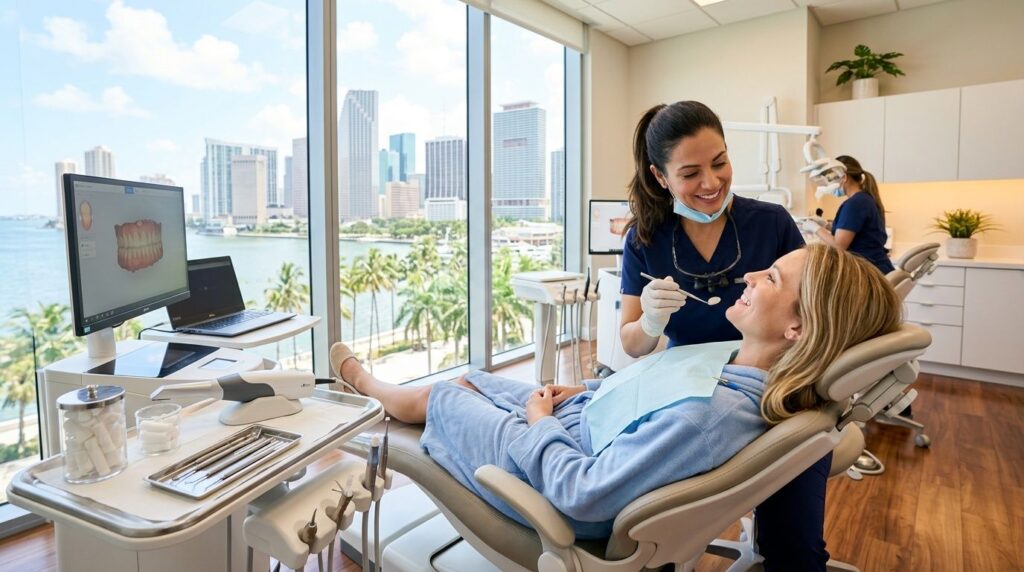
A new patient exam or recall visit usually includes several parts, but it doesn't feel rushed when it's done thoughtfully.
- Review of concerns: sensitivity, jaw tension, bleeding gums, rough edges, old dental work, or changes in bite.
- Clinical exam: the dentist checks teeth, gums, restorations, and areas that may need monitoring.
- Professional cleaning: plaque and tartar are removed from places brushing misses.
- Oral cancer screening: a visual and physical check of the soft tissues.
- Treatment planning: findings are translated into plain language, with next steps that make sense.
Patients are often surprised that preventive appointments can feel comfortable. The sensations are usually pressure, vibration, water, and polishing, not sharp pain. If a certain area is tender, the hygienist can adjust pace and technique.
A short visual can help patients understand the basics before the appointment:
Why dental X-rays matter even without pain
One of the most common questions in general dentistry is whether X-rays are really necessary when nothing hurts. The answer is that pain is a late signal in many dental problems.
Early decay or gum disease is often invisible to the naked eye. Clinical examinations paired with X-rays are essential to identify hidden pathology before patients experience symptoms, as explained in this review of dental imaging in clinical care. That's why imaging is tied to personalized risk, not used the same way for every person.
A simple comparison helps:
| Concern | What a patient may notice | What an exam or X-ray may reveal |
|---|---|---|
| Early cavity | Nothing at all | Decay between teeth |
| Gum disease changes | Occasional bleeding | Bone loss or deeper issues |
| Failing filling | Mild sensitivity | Breakdown under old dental work |
Practical rule: if a problem can only be seen once it hurts, treatment is often more involved.
For adults searching for cleaning and exams, dental X-rays, or new patient exams in Miami, prevention is usually the least stressful appointment they'll ever have. It's also the appointment most likely to keep them from needing more complex care later.
Restoring Your Teeth Fillings Crowns and Bridges
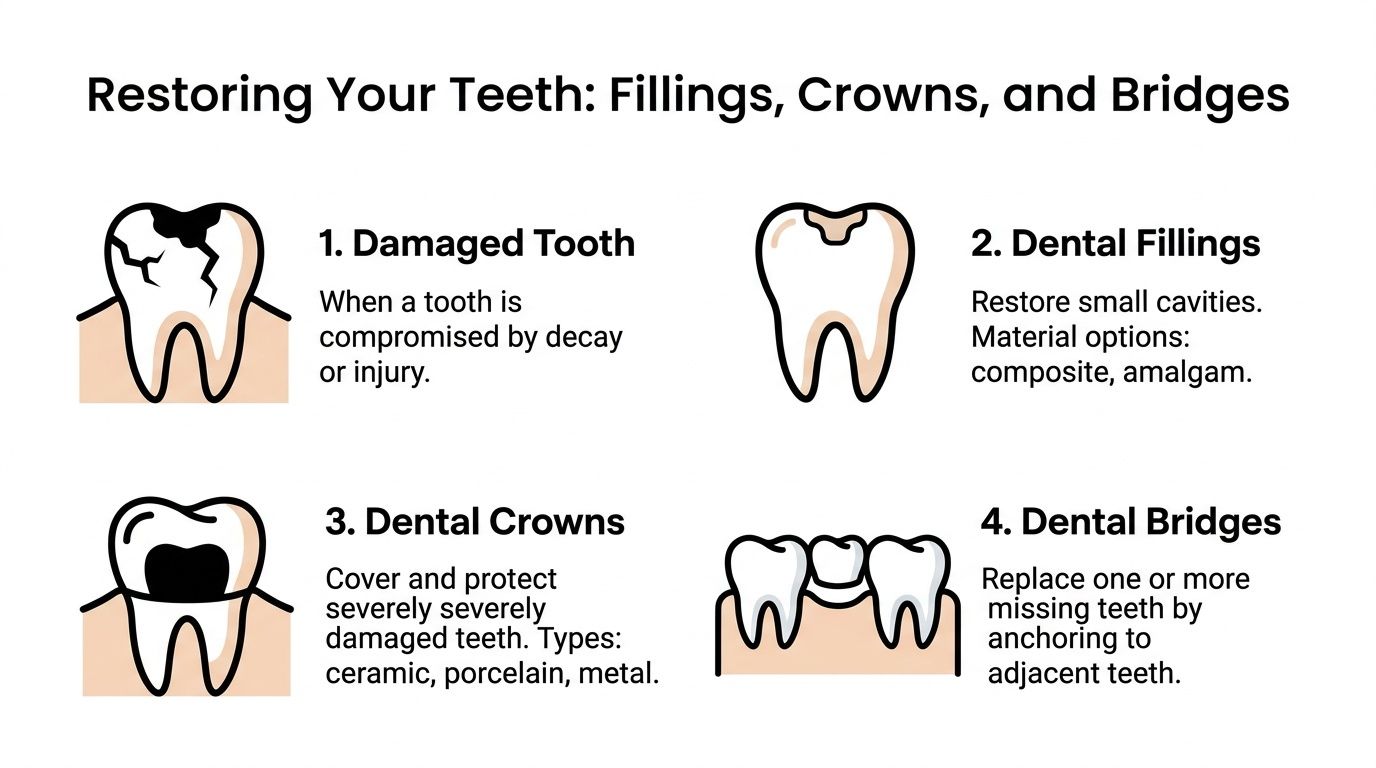
Once a tooth is decayed, cracked, or structurally weak, restorative dentistry steps in. These procedures don't just “fix a tooth cosmetically. They rebuild function, protect the remaining structure, and make chewing feel normal again.
That need is prevalent. More than 90% of adults worldwide have experienced at least one cavity, and individuals have 2.6 teeth with untreated decay on average, making fillings and crowns among the most common restorative treatments used in general dentistry.
When a filling is enough
A composite filling is usually recommended when decay is smaller and the tooth still has enough healthy structure. Composite is tooth-colored, so it blends naturally with the surrounding enamel.
From the patient's perspective, a filling appointment is often shorter and easier than expected. The area is numbed, the damaged portion is removed, and the material is placed in layers and shaped to fit the bite. The feeling is mostly pressure, rinsing, and time spent keeping the mouth open.
A filling is often the conservative choice when the goal is to preserve as much natural tooth as possible.
When a crown protects more than a filling can
A crown covers the visible part of a tooth when that tooth is too weakened for a filling alone. This often comes up after a large cavity, a crack, heavy wear, or a root canal.
Patients often ask how a crown feels different from a filling. The answer is that a crown acts more like a fitted helmet. It surrounds the tooth and helps it handle daily force when chewing.
Here's the simplest side-by-side view:
| Treatment | Best for | What it does | What it usually feels like after |
|---|---|---|---|
| Filling | Smaller areas of decay | Replaces a limited damaged area | Mild soreness or bite adjustment |
| Crown | Larger damage or weakened tooth | Covers and protects the tooth | Temporary gum tenderness, then stability |
Traditional crowns usually involve shaping the tooth, taking impressions, wearing a temporary, and returning for final placement. Some Miami patients like that process just fine. Others want fewer appointments because work, parenting, and commuting already fill the week.
Same-day crown technology changes that experience. Instead of waiting between visits, digital design and in-office fabrication can allow a crown to be prepared and placed in a single appointment. For busy adults searching dentist in Miami, FL or emergency dentist options after breaking a tooth, that convenience can make treatment feel much more manageable.
A crown shouldn't feel bulky forever. Once the bite is adjusted correctly, the goal is for the tooth to feel natural in daily use.
How bridges replace a missing tooth
A bridge replaces a missing tooth by anchoring to neighboring teeth and suspending a replacement tooth in the gap. It restores appearance, chewing, and the continuity of the smile.
Bridges can be a practical option when a patient wants to replace a missing tooth without moving into surgical treatment right away. They're often part of broader restorative dentistry, and in some cases a patient may also compare them with dental implants near me searches to understand longer-term options.
What patients usually notice after a bridge is renewed balance. Food catches less. Speech often feels more normal. Smiling doesn't require the same degree of self-consciousness.
Saving Natural Teeth Root Canals and Extractions
Few phrases create more anxiety than “root canal or “tooth extraction. In reality, these procedures are often the treatments that stop pain, control infection, and protect the rest of the mouth from further trouble.
That need isn't rare. About 1 billion people globally have experienced tooth trauma at some point in their lives, and trauma often leads to procedures such as root canals or extractions when a tooth is badly damaged.
Why root canals usually relieve pain
A root canal treats infection or inflammation inside the tooth. The procedure removes the unhealthy tissue, cleans the inside of the tooth, and seals it so the tooth can stay in place.
The part patients fear is usually the pain they already have before the appointment. The procedure itself is intended to remove the source of that pain. With effective numbing, most patients describe pressure and vibration more than sharp discomfort.
Common signs that may lead to a root canal include:
- Lingering sensitivity: hot or cold discomfort that doesn't fade normally.
- Pain with biting: pressure on the tooth feels sharp or deep.
- Swelling or tenderness: the gum near the tooth feels irritated.
- Darkening or injury history: the tooth has changed after trauma.
For an adult looking for an emergency dentist in Miami because a tooth suddenly became unbearable, saving the natural tooth is often the most reassuring outcome.
When tooth extraction is the right call
Some teeth can't be predictably saved. Severe fractures, advanced infection, impacted wisdom teeth, and certain emergency situations may make tooth extraction the healthier choice.
Patients often want to know what extraction feels like. With the area numb, the feeling is usually pressure and movement, not cutting pain. Afterward, there can be soreness, but the painful source that brought the patient in is often gone.
A dentist may recommend extraction when:
| Situation | Why removal may help |
|---|---|
| Tooth is badly broken | There isn't enough healthy structure to rebuild |
| Infection is extensive | Keeping the tooth may prolong the problem |
| Wisdom tooth is causing issues | It may crowd, inflame, or trap debris |
| Trauma has made the tooth non-restorable | Replacement planning becomes more predictable |
Pregnancy is another area where patients often get confusing advice. The American College of Obstetricians and Gynecologists states that needed dental care, including root canals, extractions, and composite fillings, is safe during pregnancy, and delaying treatment for decay or infection can lead to more complicated problems. That guidance appears in ACOG's opinion on oral health care during pregnancy and through the lifespan.
Protecting Your Smile Night Guards and Advanced Solutions
Not every dental procedure is about repairing visible damage. Some of the most valuable care prevents damage from happening in the first place.
One of the clearest examples is a night guard for teeth grinding. Many adults clench or grind during sleep without realizing it. They wake up with jaw tightness, tension headaches, or teeth that seem “sore for no reason. Over time, that pressure can wear enamel, chip edges, strain restorations, and create hairline cracks.
How a night guard prevents bigger problems
A custom night guard acts like a cushion between the upper and lower teeth. It helps absorb force and reduces the repeated stress that grinding puts on enamel and jaw joints.
Patients usually adapt to a custom appliance much better than to a store-bought guard because the fit is more precise. A custom option is shaped around the bite instead of forcing the mouth into a bulky generic position. Adults dealing with clenching can learn more about custom night guards for teeth grinding.
A night guard is small, but its job is big. It protects the work already done in the mouth and can prevent a simple grinding habit from turning into cracked teeth or morning jaw pain.
Where general dentistry can lead next
Healthy teeth and gums create the base for everything else. Once decay, inflammation, and bite problems are under control, patients often start thinking about the next step in their smile.
That next step may include:
- Dental implants: for replacing a missing tooth with a stable, long-term option.
- Cosmetic dentistry: for shape, color, and symmetry concerns.
- Teeth whitening: for brightening a smile after health issues are addressed.
- Restorative updates: replacing older dental work that no longer fits or functions well.
A general dental office can also serve as the hub for broader care planning. Ultra Smile DentalSpa offers general, restorative, cosmetic, and implant-related services in one setting, which can simplify decision-making for patients who want preventive care and advanced treatment coordinated together.
For many Miami adults, that matters because the ultimate goal isn't just getting through one procedure. It's building a plan that protects comfort, appearance, and long-term function.
Your Comfort Is Our Priority at Ultra Smile DentalSpa
For patients with dental anxiety, comfort isn't a bonus feature. It changes whether they schedule the visit at all. The atmosphere of a practice, the pace of communication, and the small details during treatment can make the difference between another delay and finally getting care.
What the visit feels like
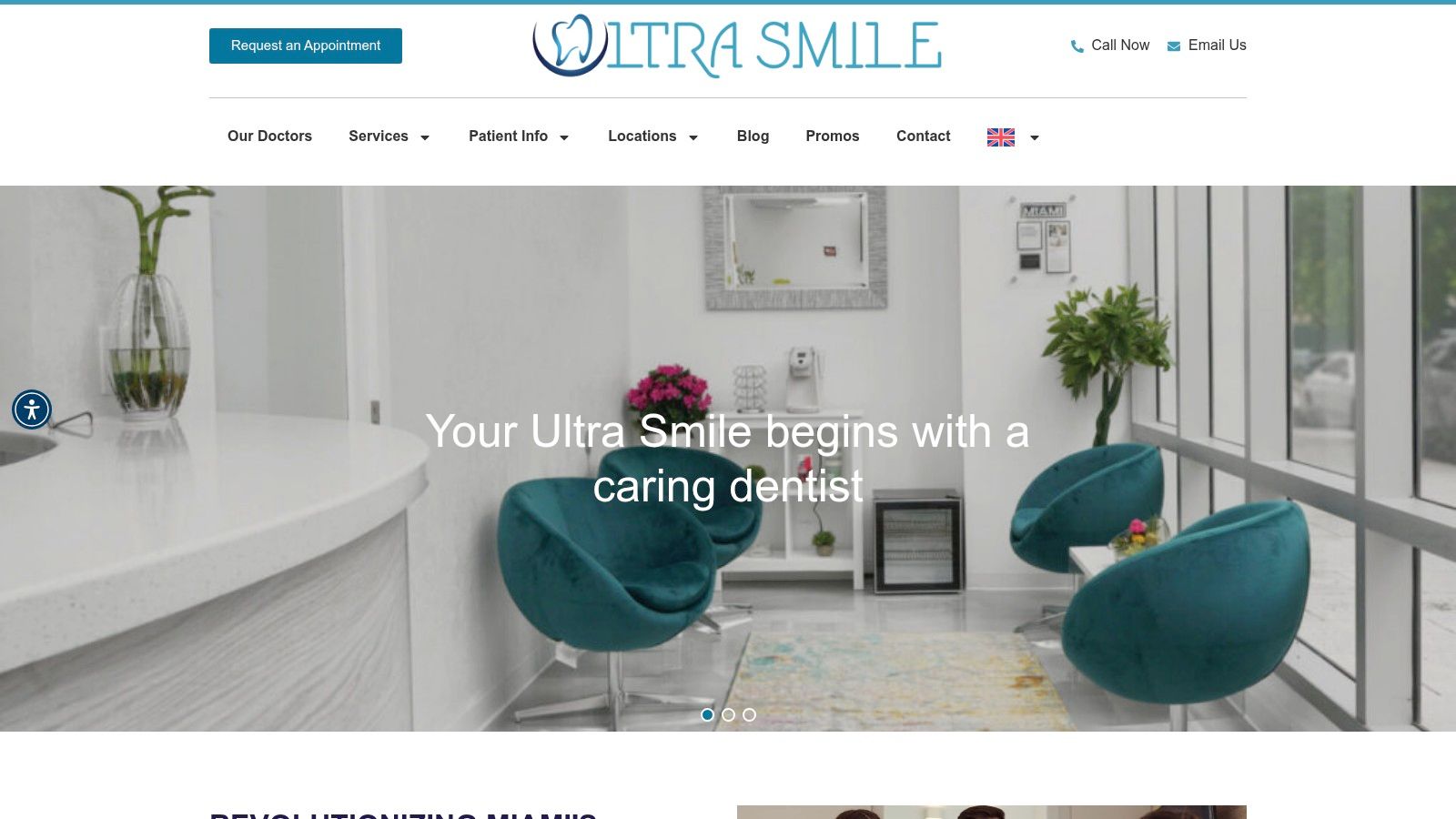
At a spa-like dental office, the experience starts before any instrument is picked up. A patient may be greeted with refreshments, helped settle in, and offered details that lower tension instead of increasing it. Aromatherapy can soften the clinical feel of the room. Personal TVs with streaming entertainment can shift attention away from the procedure. A warm towel after treatment can leave the visit ending on a calmer note than many people expect from dental care.
Those details don't replace clinical skill. They support it.
Patients also tend to feel safer when the team explains what's happening in real time. That might sound like simple language about when numbing starts to work, what type of pressure is normal, or when a sound is coming from polishing rather than drilling. Bilingual communication matters too, especially in Miami, because patients make better decisions when they fully understand their options in the language that feels most natural.
A comfort-focused visit often includes:
- Clear pacing: treatment starts when the patient feels ready, not rushed.
- Check-ins during care: the team pauses if sensitivity or anxiety rises.
- Sedation discussion when appropriate: fear is addressed directly, not brushed aside.
- Recovery guidance: patients leave knowing what to expect later that day.
How comfort and prevention work together
There's also a bigger shift happening in dentistry. National data showed that between 1999 and 2009, diagnostic and preventive procedures made up a larger share of all dental procedures, while restorative work declined in relative frequency, pointing toward a stronger focus on prevention, as detailed in AHRQ's review of dental procedure trends.
That trend fits what many anxious patients need most. They don't want to come in only when something is broken, infected, or urgent. They want a place where routine care feels manageable enough to keep up with.
Comfort supports consistency. When patients aren't dreading the appointment, they're more likely to return for the cleanings and exams that help them avoid bigger procedures.
For adults in Downtown Miami, Midtown Miami, and Hallandale Beach, that kind of environment can change the entire pattern of dental care. Instead of reacting to pain, they can maintain their health with a routine that feels sustainable.
Insurance Financing and Scheduling Your Visit in Miami
Cost concerns stop many people from booking even when they know they need treatment. Clear information helps. A patient who needs a cleaning, a filling, a crown, or an urgent evaluation should be able to ask about insurance and payment options before arriving, not after treatment is already underway.
Simple next steps
Patients in Miami, Midtown Miami, and Hallandale Beach can make scheduling easier by preparing a few basics before reaching out:
- Insurance details: have the dental plan information ready, if available.
- Main concern: mention pain, swelling, a broken tooth, overdue cleaning, or interest in cosmetic work.
- Timing needs: share whether the issue feels urgent or flexible.
- Past records if available: recent X-rays or prior treatment notes can sometimes help.
Many practices, including this one, accept major dental insurance plans and offer financing paths for patients without coverage. That combination can make both routine and restorative care feel more reachable.
Patients searching for a dentist near me, cosmetic dentist near me, dental implants near me, or help with an urgent tooth extraction often don't need more information. They need a simple starting point and a team that will answer questions without pressure.
Patients who are ready to book a cleaning, new patient exam, restorative consultation, or urgent dental visit can contact Ultra Smile DentalSpa to schedule care in Miami. The practice serves Downtown Miami, Midtown Miami, and Hallandale Beach with general dentistry procedures designed to protect oral health, relieve discomfort, and make the dental experience feel more comfortable from the first visit onward.