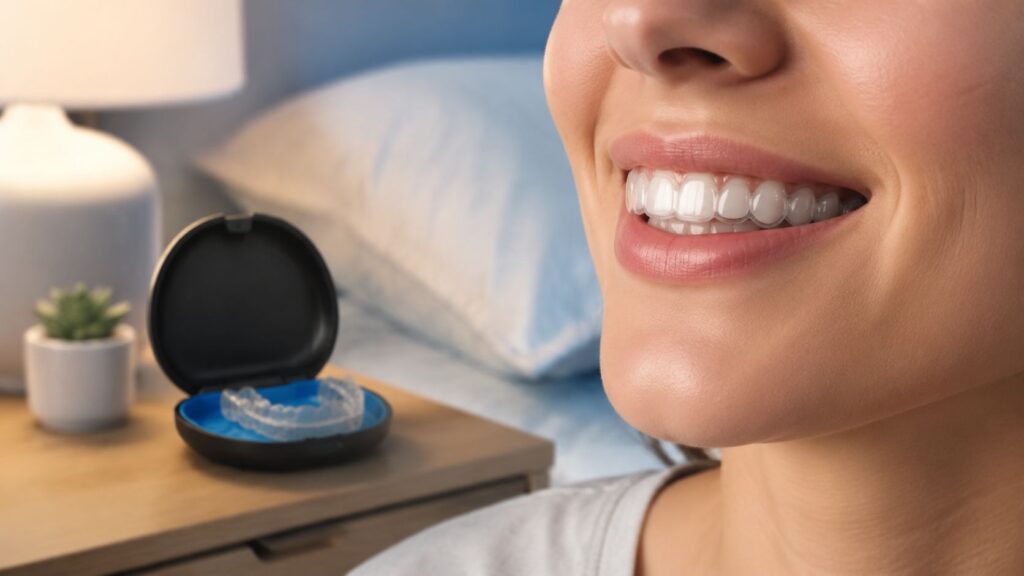
Waking up with a sore jaw, a dull headache, or teeth that suddenly feel sensitive can make the whole day start off wrong. Many people in Miami assume it's stress, poor sleep, or just a bad pillow. Often, nighttime grinding is part of the problem, and the damage can build before someone realizes what's happening.
Patients searching for a dentist near me, a dentist in Miami, FL, or even an emergency dentist after a cracked tooth are often dealing with the effects of bruxism without knowing the name for it. A properly selected night guard for teeth grinding can protect enamel, ease strain on the jaw, and help preserve cosmetic and restorative dental work. Just as important, it should fit comfortably enough to wear consistently.
Table of Contents
- Your Miami Dentist for Teeth Grinding Relief
- Are You Grinding Your Teeth at Night
- How a Night Guard Protects Your Smile
- OTC vs Custom-Fit Night Guards Which Is Right for You
- Your Custom Night Guard Process at Ultra Smile DentalSpa
- Cost Care and Lifespan of Your Night Guard
- FAQs About Night Guards in Miami
Your Miami Dentist for Teeth Grinding Relief
Someone goes to bed tired after a long day in Downtown Miami, sleeps through the night, and still wakes up feeling like the jaw never rested. The temples ache. The teeth feel tender when drinking cold water. Sometimes a partner says they heard grinding. Sometimes the first clue is a chipped edge on a front tooth.
That pattern is common in dental offices. It's also one reason so many people start searching for a dentist in Miami, FL only after the discomfort becomes hard to ignore. Nighttime grinding can affect people with otherwise healthy smiles, patients with veneers or crowns, and busy professionals who don't have time for recurring jaw pain.
Bruxism is not rare. Global sleep bruxism affects about 21% of the population, with North America showing the highest prevalence at 31%. In the United States, prevalence is estimated at 33% among adults and 20% among children ages 6 to 12 according to published bruxism prevalence data. That helps explain why protective treatment comes up so often during routine dental care.
A local problem that deserves a calm, precise solution
For many patients near Downtown Miami and Midtown, the hardest part isn't only the grinding itself. It's fitting treatment into real life. Dental anxiety, work schedules, and uncertainty about whether the problem is “serious enough keep people waiting longer than they should.
A good first step is getting a proper diagnosis and learning whether symptoms point to clenching, grinding, TMJ strain, worn enamel, or another bite issue. Patients who want to learn more about treatment options can review night guards for bruxism and TMJ disorders.
Early protection matters more than most people think. Teeth don't regenerate enamel once it's lost.
Why the right dentist matters
A night guard isn't just a piece of plastic. For the right patient, it's part of a larger plan that may also include cleaning and exams, dental x-rays, a new patient exam, restorative care for damaged teeth, or cosmetic planning to protect veneers and whitening results.
That's especially important in Miami, where many patients want relief from pain without sacrificing the appearance of their smile.
Are You Grinding Your Teeth at Night
The tricky part about bruxism is that it usually happens while a person is asleep. Many people don't know they grind until a dentist sees wear patterns or a partner hears the sound.

Grinding and clenching can place a surprising amount of pressure on teeth and jaw joints. When grinding teeth, the force exerted can reach up to 250 pounds, which is sufficient to damage enamel; a night guard acts as a physical barrier to mitigate this damage, as noted in this overview of night guard benefits.
Common signs patients notice first
Some symptoms are obvious. Others are easy to dismiss for months.
- Morning jaw soreness: The jaw feels tired, tight, or mildly locked when waking up.
- Frequent headaches: Tension often shows up around the temples.
- Tooth sensitivity: Worn enamel can make hot and cold foods feel sharper.
- Flattened or chipped teeth: Edges may look shorter, rougher, or uneven.
- Partner reports noise: A spouse or partner may hear grinding before the patient suspects it.
- Dental work taking stress: Crowns, veneers, fillings, and even implant restorations can take repeated pressure.
For some patients, the first urgent visit is after a fractured tooth. At that point, treatment may involve a night guard plus restorative dentistry, and in severe situations, even tooth extraction or follow-up replacement planning such as dental implants near me searches.
Why grinding happens
Bruxism usually has more than one contributing factor. Stress is a common trigger. Sleep disruption can play a role. Bite imbalance, clenching habits during the day, and airway issues may also be part of the picture.
A night guard protects teeth from damage. It doesn't cure the grinding habit itself.
That distinction matters. Patients often buy a guard expecting the grinding to stop entirely. The better approach is to use the guard for protection while also looking at likely causes, such as stress patterns, sleep quality, jaw alignment, or airway concerns.
A short visual explanation can help make the pattern easier to recognize:
How a Night Guard Protects Your Smile
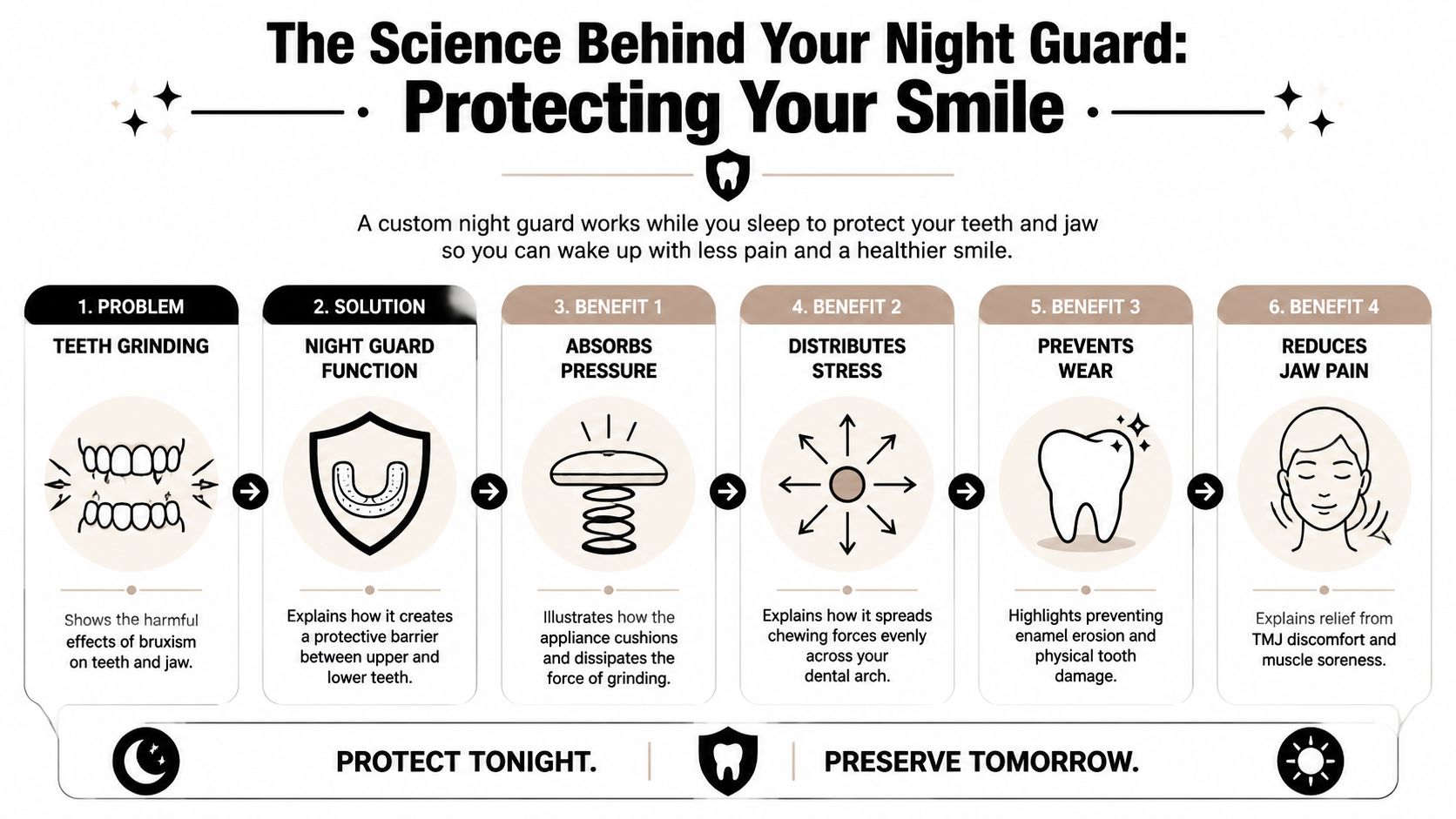
A night guard works because it creates a barrier between the upper and lower teeth. Instead of enamel grinding directly against enamel, the appliance absorbs and spreads out the pressure.
What the appliance actually does
The main job of a night guard for teeth grinding is protection, not behavior change. According to clinical guidance on night guard use and tooth damage reduction, consistent use helps prevent structural tooth wear and can also ease TMJ symptoms by decreasing jaw muscle tension. The same source notes that a 2021 ADA survey found more than 70% of dentists observed signs of teeth grinding and clenching in their patients.
That protection matters because grinding can wear enamel, chip teeth, and damage restorations such as crowns, veneers, and implants. Oral devices don't necessarily reduce the frequency of bruxism episodes, but they do help control tooth wear and reduce morning jaw discomfort.
Why this matters for cosmetic and restorative work
Patients investing in cosmetic dentistry, teeth whitening, veneers, crowns, or implant restorations usually think about color, symmetry, and function. They don't always think about nighttime forces undoing that work.
A properly chosen guard helps shield:
- Natural enamel: It reduces direct grinding contact.
- Veneers and crowns: It lowers the risk of chips and fractures.
- Implant restorations: It helps reduce overload on restorations.
- TMJ structures: Less muscle tension can mean less soreness in the morning.
Practical rule: The cost of protecting a smile is usually lower than the cost of rebuilding one after repeated grinding damage.
There's also a comfort benefit. Many patients don't only want to avoid dental repairs. They want to stop waking up with jaw fatigue that makes breakfast, meetings, and exercise feel harder than they should.
For the right patient, a custom appliance becomes preventive care in the same category as regular exams and early restorative treatment. It helps preserve both oral health and the appearance of the smile.
OTC vs Custom-Fit Night Guards Which Is Right for You
Over-the-counter guards and custom guards are not interchangeable. They serve different situations, and the wrong choice can leave a patient uncomfortable, under-protected, or still waking up with jaw pain.
Where store-bought guards can help
A pharmacy or online boil-and-bite guard may be reasonable as a short-term option for a mild grinder. For people with light symptoms, softer thermoplastic products can sometimes provide enough cushioning to get by.
That said, they come with trade-offs. They tend to feel bulkier. Fit can be inconsistent. If the mold isn't stable, the appliance may shift during sleep or create pressure in the wrong places. Patients with TMJ irritation often notice that poor fit makes the jaw feel worse, not better.
When custom is the better clinical choice
For stronger clenching and more persistent grinding, custom is usually the safer route. According to guidance on night guard thickness and material selection, heavy, chronic grinders generally need a 2 mm to 3 mm rigid hard acrylic or dual-laminate guard, while lighter grinders may do well with a thinner, more flexible appliance. The same source explains that dual-laminate designs combine a soft inner layer with a hard outer shell, which gives a useful balance of comfort and durability and outperforms boil-and-bite options in long-term protection and compliance.
That difference in thickness and material is not cosmetic. It directly affects how the appliance handles force.
| Feature | Over-the-Counter (Boil & Bite) | Custom-Fit (from Ultra Smile DentalSpa) |
|---|---|---|
| Fit | Molded at home, often less precise | Designed for the patient's exact bite |
| Comfort | Can feel bulky or unstable | Typically more secure and easier to wear consistently |
| Material choice | Limited | Selected based on grinding intensity and jaw needs |
| Best use | Mild, temporary situations | Mild, moderate, and severe cases with clinical guidance |
| Durability | Often wears down faster | Better suited for long-term use |
| TMJ support | May be inconsistent | Better controlled fit and force distribution |
Patients comparing options can also review custom night guards vs store-bought options.
A simple way to decide
A custom appliance is usually the better option if any of these apply:
- Teeth are chipping or flattening: That points to stronger force and higher risk.
- Jaw pain is frequent: Fit and bite balance matter more when muscles and joints are involved.
- Dental work needs protection: Veneers, crowns, and implant restorations deserve a stable barrier.
- A store-bought guard failed: If it feels bulky, slips out, or gets chewed through, it's not doing enough.
For someone searching cosmetic dentist near me or emergency dentist after the consequences have already shown up, precision then starts to matter.
Your Custom Night Guard Process at Ultra Smile DentalSpa
Many patients expect the process to be awkward or uncomfortable. It's usually much simpler than they think, especially when digital tools replace old-style impression material.
What happens at the first visit
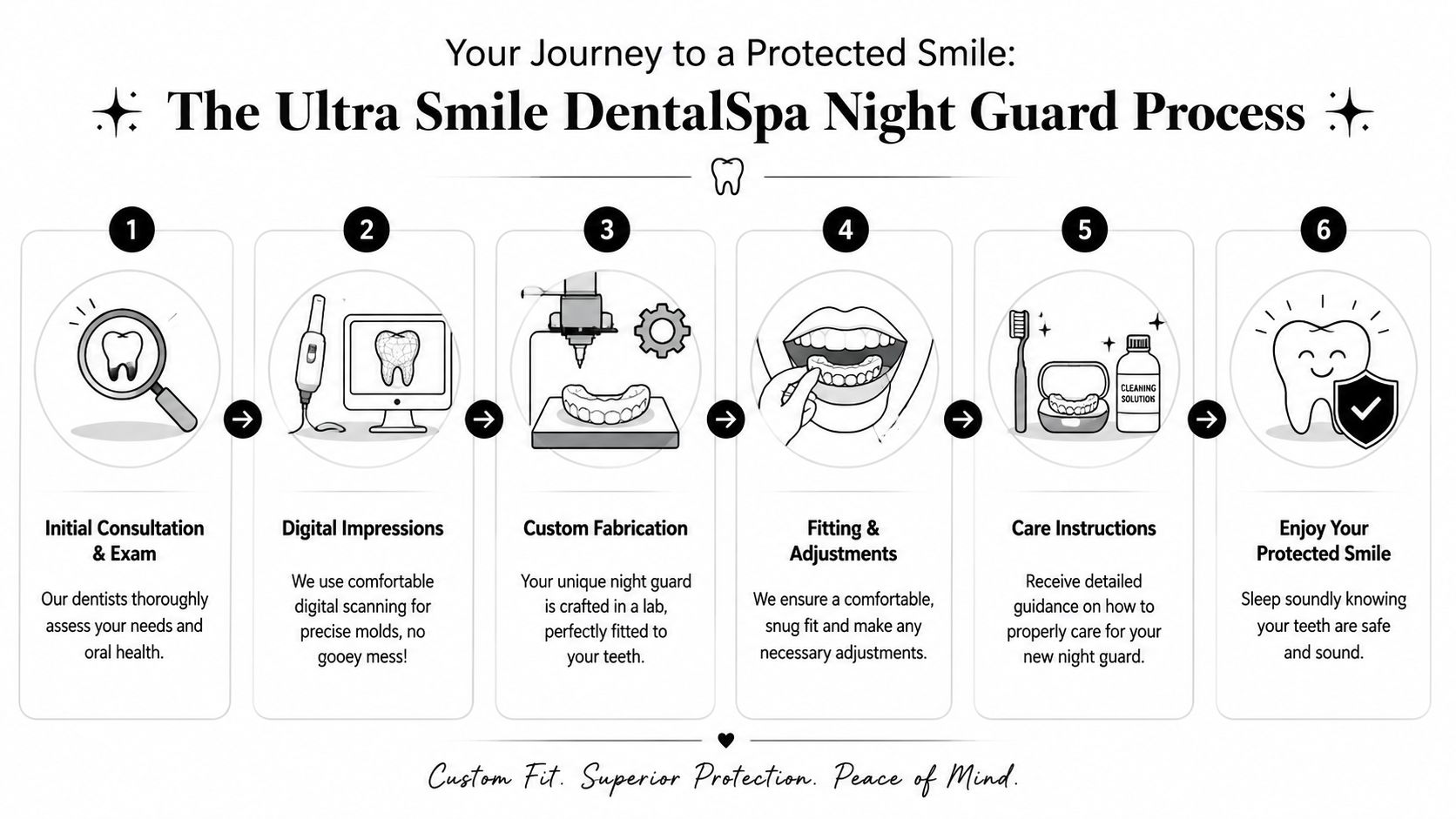
The process starts with a full evaluation, not a guess. The dentist checks for wear patterns, bite stress, cracked edges, muscle tenderness, and signs of TMJ involvement. If the patient is new to the practice, this can be part of a new patient exam with dental x-rays if needed.
That step matters because not every sore jaw needs the same appliance. Some patients are mainly clenchers. Others grind side to side. Some have cosmetic restorations that need extra protection. Some also need restorative treatment before a guard is made.
The best night guard is the one designed for the actual bite, not a generic version of it.
From digital scan to final fit
After diagnosis, the next step is capturing the shape of the teeth accurately. Digital scanning is often the easiest part for nervous patients because there's no messy tray material. The scan creates a precise model used to fabricate the guard.
That precision is more than a convenience issue. According to Oral-B guidance on occlusal guards and fit, custom-fit occlusal guards are the primary intervention for preventing tooth enamel loss and fractures from long-term bruxism, and an incorrect mold can compromise stability and effectiveness.
A typical process looks like this:
Evaluation and diagnosis
The dentist identifies whether grinding, clenching, TMJ strain, or restoration risk is present.Digital impressions
A scanner captures the arches with precision.Material selection
The appliance is matched to the patient's level of force and comfort needs.Laboratory fabrication
The guard is made to fit the bite rather than forcing the bite to fit the guard.Delivery appointment
The fit is checked carefully, and small adjustments are made.Follow-up if needed
If any pressure spots or bite issues show up, the appliance can be refined.
For patients with dental anxiety, the environment matters too. A calming setting, supportive staff, and a more personalized visit can make the process feel manageable rather than clinical and stressful.
Cost Care and Lifespan of Your Night Guard
A custom night guard is an investment in prevention. For many patients, it helps avoid more expensive restorative work later, especially when grinding threatens enamel, fillings, crowns, veneers, or implant restorations.
What a patient pays can vary based on the appliance and insurance benefits. Some plans help with medically necessary protective appliances, and many offices can help patients understand coverage before treatment begins. For people without insurance, a clear treatment plan matters just as much as the appliance itself.
How to care for it properly
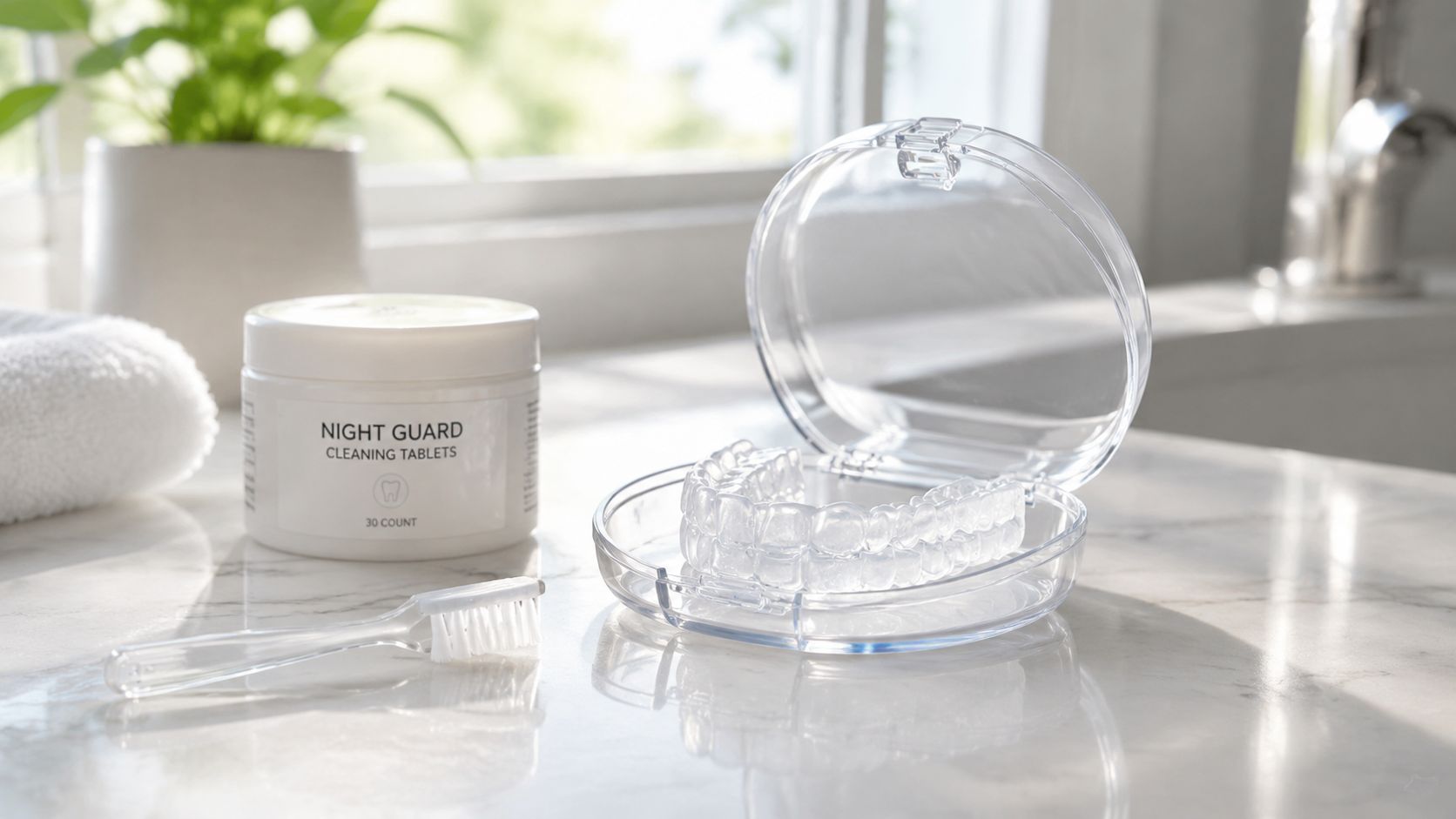
Good care protects both the appliance and the mouth wearing it.
- Rinse it each morning: This clears away saliva and surface debris right away.
- Brush it gently: Use a soft toothbrush and avoid aggressive scrubbing.
- Store it in its case: That reduces contamination and accidental damage.
- Keep it away from heat: Hot water can warp the material.
- Bring it to dental visits: The dentist can check wear and confirm the fit still works.
A dirty or warped appliance won't feel good, and if it doesn't feel good, patients stop wearing it.
When it may be time for a replacement
Wear depends on how hard someone grinds. According to guidance on night guard lifespan and replacement, custom-fitted hard acrylic night guards typically last 3 to 5 years, while soft over-the-counter guards may last only 3 to 6 months before replacement is needed.
Signs a guard may need attention include:
- Visible thinning or deep bite marks
- Cracks or rough edges
- A fit that suddenly feels loose or uneven
- Return of jaw discomfort despite regular use
If a patient has changed dental work, had tooth extraction, started restorative treatment, or completed cosmetic changes, the fit may also need to be reassessed.
FAQs About Night Guards in Miami
A few practical questions come up almost every time bruxism is diagnosed. The answers usually help patients decide whether to move forward now or keep waiting.
| Question | Answer |
|---|---|
| Will a night guard protect veneers, crowns, or implants? | Yes. A properly designed appliance helps protect both natural teeth and restorations from direct grinding forces. That's one reason patients interested in cosmetic dentistry or dental implants often benefit from one. |
| Will it stop the grinding habit? | Not necessarily. A night guard protects the teeth and jaw from damage, but it doesn't automatically remove the root cause. Stress, sleep issues, airway concerns, and bite factors may still need attention. |
| Is a soft guard always more comfortable? | Not always. Some mild grinders prefer softer materials, but heavy grinders often do better with hard acrylic or dual-laminate designs because they hold shape better and distribute force more predictably. |
| What if there's no dental insurance? | Many offices offer payment options or transparent treatment planning for patients without coverage. It's still worth getting evaluated before more damage leads to larger restorative needs. |
| Can a night guard help with TMJ discomfort? | It can help reduce muscle tension and protect the bite, which often improves morning soreness. But TMJ symptoms should still be evaluated carefully because not every jaw problem has the same cause. |
| Should someone wait until a tooth breaks? | No. Waiting usually turns a protective treatment into a repair case. A chipped tooth may require bonding, a crown, or more involved restorative treatment. |
When to book an appointment
Searching for dentist near me, dentist in Miami, FL, cosmetic dentist near me, or emergency dentist usually means the problem has started affecting daily life. The earlier the bite is evaluated, the easier it is to protect the smile before more damage happens.
For patients in Downtown Miami, Midtown Miami, and Hallandale Beach, the right next step is a dental exam that looks at the whole picture. That includes grinding patterns, jaw symptoms, current restorations, and whether other services like cleaning and exams, restorative dentistry, teeth whitening, or even dental implants near me planning belong in the conversation.
If jaw pain, morning headaches, sensitive teeth, or visible wear are starting to affect daily life, it's time to get answers. Ultra Smile DentalSpa provides personalized, spa-like dental care for patients in Downtown Miami, Midtown Miami, and Hallandale Beach, with thoughtful treatment planning for bruxism, TMJ-related discomfort, cosmetic concerns, and restorative needs. Schedule a consultation to find out whether a custom night guard is the right next step for protecting your smile and getting more comfortable sleep.