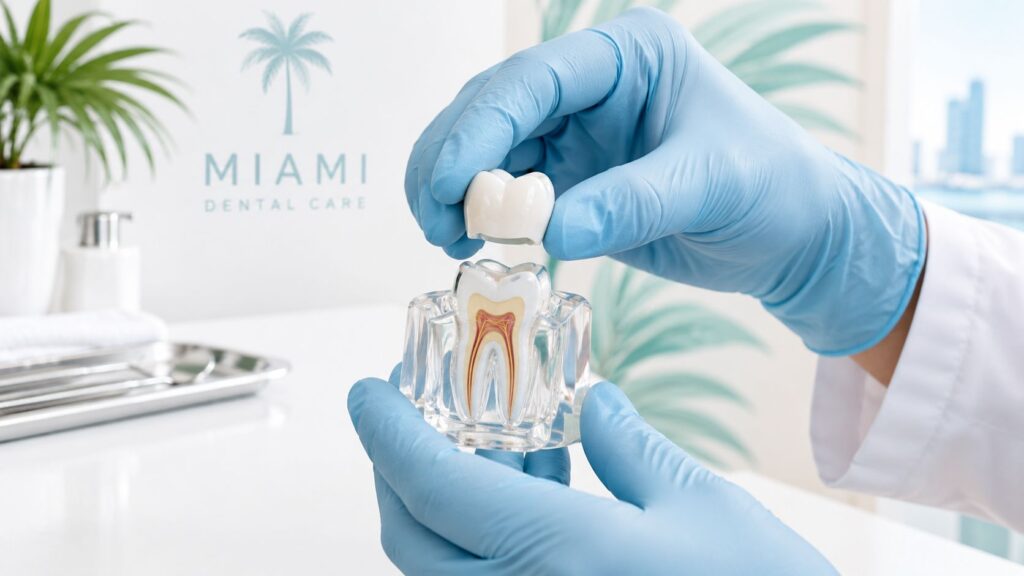
A throbbing toothache can make an ordinary Miami day feel impossible. Hot coffee hurts, cold water sends a sharp jolt through the jaw, and a cracked tooth may ache whenever it takes pressure. For someone searching “dentist near me, “dentist in Miami, FL, or “emergency dentist, the immediate concern is usually simple: stop the pain and find out whether the tooth can be saved.
Crown and root canal treatment often provides that path. Root canal therapy addresses infection or inflammation inside the tooth, while a crown can protect the remaining tooth and restore comfortable chewing. The right plan still depends on the tooth's location, the amount of healthy structure left, and the quality of the seal after treatment.
Table of Contents
- Relief Starts Here With a Trusted Dentist Near Me in Miami FL
- Understanding Crowns and Root Canals and How They Work Together
- When You Need Both Treatments and When You Might Not
- What to Expect During Your Crown and Root Canal Treatment Visits
- Recovery Aftercare and Why Timing Your Crown Matters
- Costs Timelines and Alternatives to Consider in Miami
- Your Comfort First Visit at Ultra Smile DentalSpa in Miami FL
Relief Starts Here With a Trusted Dentist Near Me in Miami FL
A patient may arrive at a dental office after several sleepless nights, holding the cheek and avoiding one side of the mouth. Another may have felt a small crack while eating and then noticed lingering sensitivity. These symptoms can come from decay, a damaged filling, a fracture, or infection inside the tooth. Only an examination and dental X-rays can distinguish those causes reliably.
At Ultra Smile DentalSpa, Dr. Neda Bahmadi and the team serve patients near Downtown Miami, Midtown Miami, and Hallandale Beach with restorative, general, and cosmetic dental care. The setting combines modern dental technology with a calmer hospitality experience, including refreshments, aromatherapy, streaming entertainment, and a hot towel finish. Bilingual staff and transparent treatment planning can also help patients who feel nervous about dental visits understand each step before treatment begins.
What the treatment is designed to accomplish
Root canal treatment removes diseased tissue from inside the tooth rather than removing the entire tooth. A crown, when appropriate, covers and supports the tooth after the internal treatment has been completed. Together, these procedures can relieve pain, preserve natural tooth structure, and help restore a healthy-looking smile.
The word “root canal often causes anxiety, but the purpose of modern treatment is pain relief. Local anesthesia keeps the area numb while the dentist cleans and seals the canals. Patients who need urgent attention can contact an emergency dentist for an evaluation, especially when swelling, severe pain, a loose restoration, or difficulty biting develops.
Practical rule: Severe tooth pain shouldn't be managed by waiting indefinitely. A timely evaluation gives the dentist a chance to control infection, protect the tooth, and explain whether a crown, filling, tooth extraction, or another restoration fits the situation.
A crown isn't automatically required after every root canal. Back teeth commonly need protection because they absorb strong chewing forces, while some front teeth may retain enough structure for a bonded filling. The safest decision comes from examining the individual tooth, not from applying a blanket rule.
Understanding Crowns and Root Canals and How They Work Together
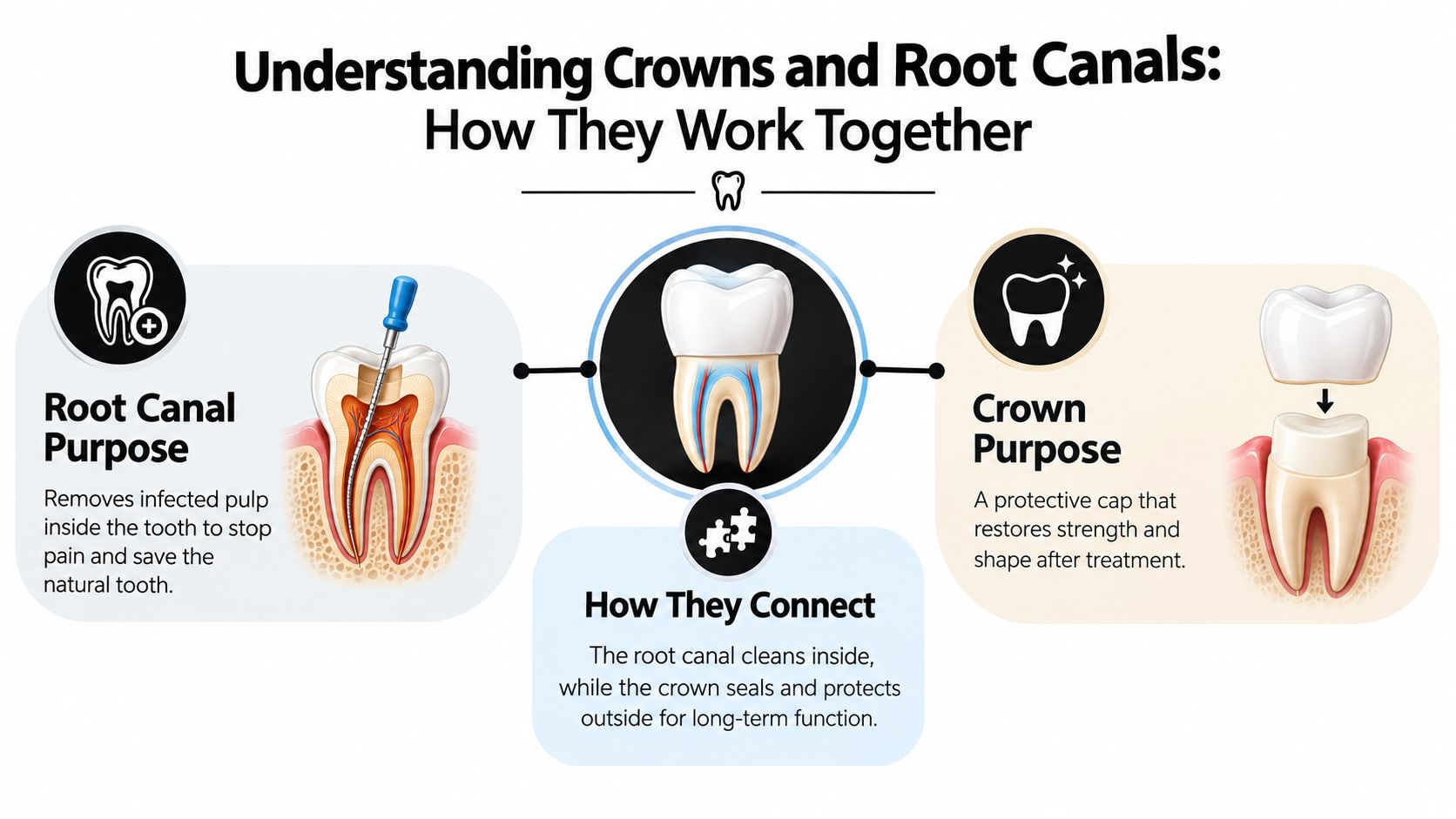
A root canal and a crown perform different jobs. Understanding that distinction makes the treatment plan easier to follow.
The inside of the tooth
A root canal treats the soft tissue inside the tooth, called the pulp. When deep decay, a crack, or injury allows bacteria to reach that space, the pulp can become inflamed or infected. The dentist creates access to the canals, removes the diseased tissue, cleans and shapes the internal spaces, and seals them.
That process addresses the source of the pain and helps preserve the natural root. It doesn't rebuild tooth walls that decay or fracture have already weakened.
The outside of the tooth
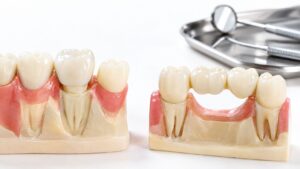
A dental crown is a custom restoration that fits over the prepared tooth. It restores the tooth's shape, supports chewing, and can improve appearance when the visible structure has been damaged. The crown acts much like a protective helmet, while the treated root remains the foundation beneath it.
This foundation-and-helmet comparison also explains why the procedures are often paired. The root canal makes the inside healthy enough to retain the tooth, and the crown protects the outside from forces that could cause the remaining walls to split.
Why the tooth still needs an individualized plan
A 2025 review emphasizes that restoration choice should be individualized rather than treated as one-size-fits-all, as described in this review of restoring root-filled teeth. The same evidence base reports 91.5% clinical and radiographic success after endodontic treatment restored with either a filling or a crown, so the practical question is often which restoration fits the tooth and its load.
A molar with broad decay and thin remaining walls has different needs from a front tooth with a small access opening and strong surrounding enamel. The dentist evaluates the bite, cracks, remaining walls, gum support, and appearance before recommending full coverage or a more conservative option.
When You Need Both Treatments and When You Might Not
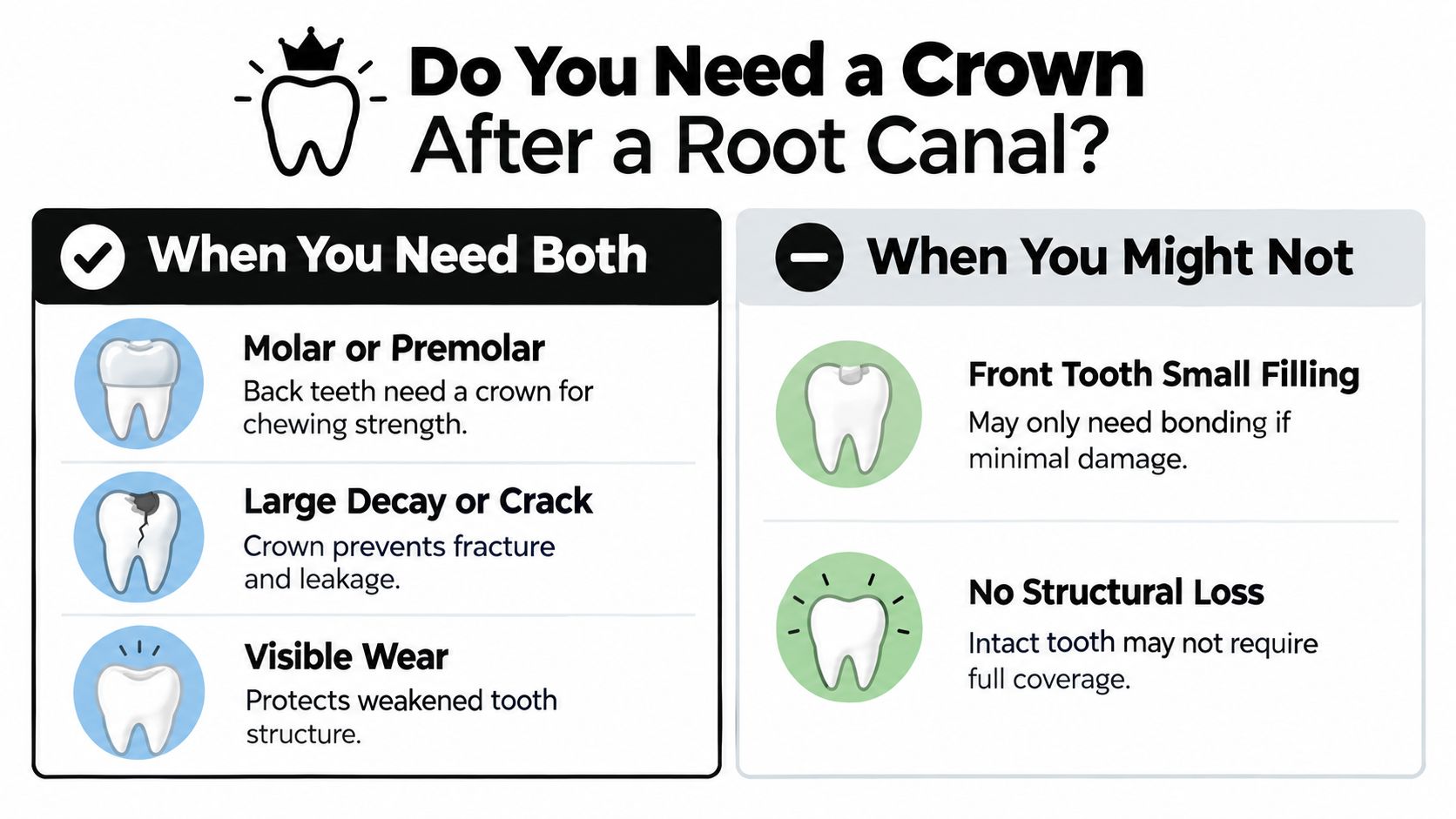
The most useful answer to “Does a root canal need a crown? starts with tooth type. A molar or premolar generally faces heavier chewing pressure than a front tooth, so cusp coverage often offers important protection. A front tooth with limited structural loss may function well with a bonded direct restoration.
Situations that favor a crown
A crown becomes more compelling when decay, old fillings, a crack, or the root canal access has removed substantial tooth structure. Grinding and clenching can add stress, as can a history of trauma or previous repairs. In those cases, the crown helps hold the remaining walls together and restores the biting surface.
The ferrule effect is another important part of the assessment. Restorative references commonly recommend about 1.5 to 2.0 millimeters of sound tooth structure above the finish line to improve resistance to fracture and crown dislodgement, according to this reference on restoring the endodontically treated tooth. That healthy ring of tooth structure gives the crown a bracing effect around the cervical area.
A post may help retain a core when too little tooth remains to hold it, but it doesn't replace missing tooth walls or create a ferrule. The dentist's objective is to preserve healthy structure, not to remove more tooth solely to accommodate a restoration.
Situations where a filling may be reasonable
A bonded filling may be appropriate when most of the tooth remains intact, the access opening is limited, and there are no major cracks. This is more common with certain front teeth, although the final decision still depends on the individual bite and the tooth's history.
Patients can read Ultra Smile DentalSpa's guidance on whether a crown is necessary after a root canal before discussing the options during an appointment. If the tooth has a fracture extending below the gum or cannot be predictably restored, restorative dentistry may need to shift toward tooth extraction and replacement with dental implants or a bridge.
What to Expect During Your Crown and Root Canal Treatment Visits
Knowing the sequence can reduce uncertainty. The dentist will adjust the process to the tooth and the patient's symptoms, but most plans begin with diagnosis and end with a sealed, functional restoration.
Diagnosis and comfort planning
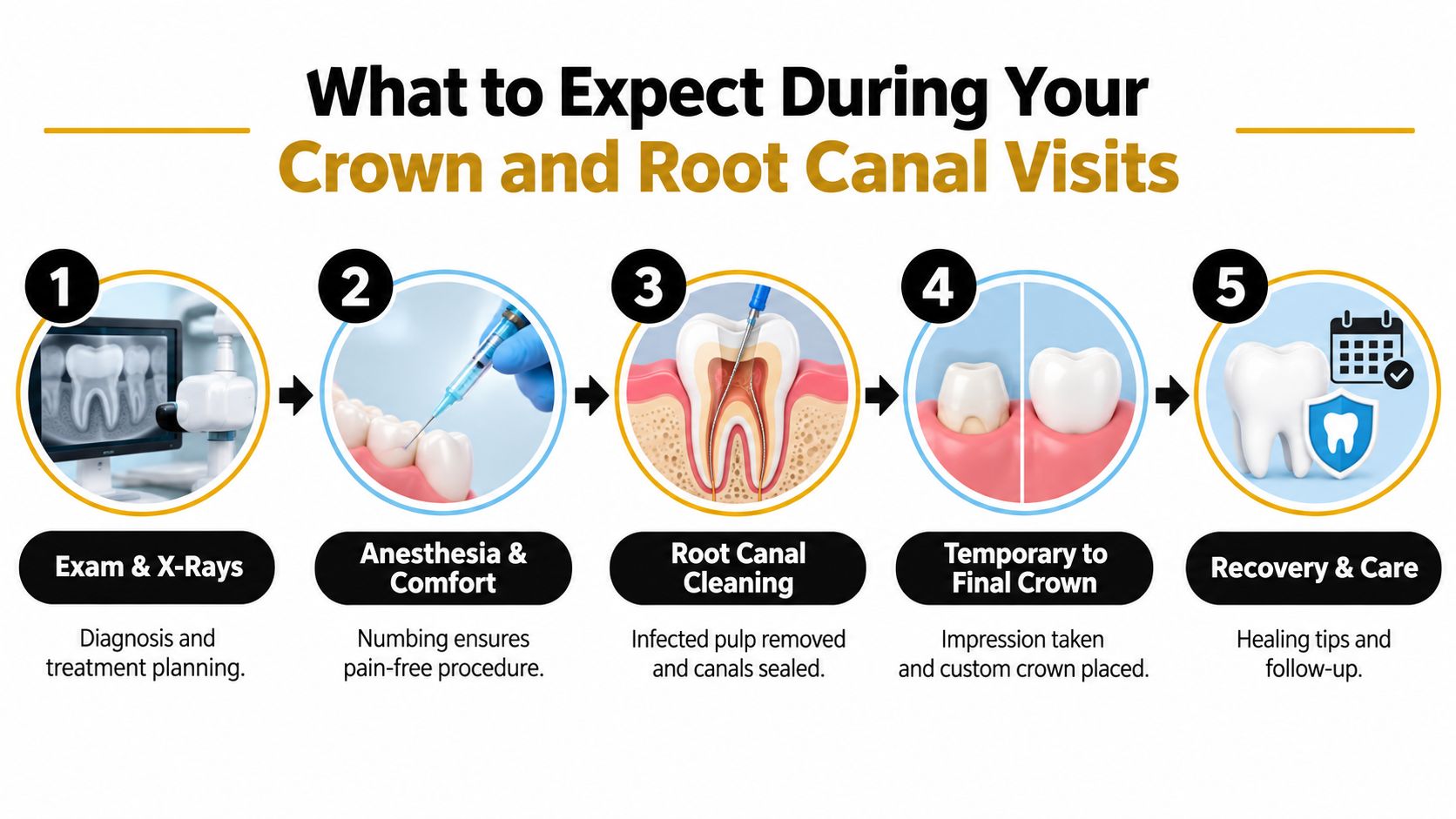
A new patient exam includes a discussion of symptoms, medical history, previous dental work, and the moment the pain began. Dental X-rays help the dentist evaluate the roots, surrounding bone, decay, and possible cracks. The findings guide the choice between a filling, crown, root canal, tooth extraction, or another treatment.
Before the procedure begins, local anesthesia numbs the area. Comfort-focused care can include explanations before each step, breaks when needed, and a calm environment. The purpose of anesthesia is to make the treatment manageable, not to leave the patient enduring the pain that brought them in.
Cleaning, sealing, and rebuilding
The dentist removes infected pulp, cleans the canals, and seals them to reduce the chance of contamination from inside the tooth. The visible portion is then rebuilt with a core material that provides a base for the final restoration. If the tooth requires a crown, the dentist prepares the outer surface and designs a restoration that fits the bite and neighboring teeth.
Some patients may qualify for same-day crowns, while others benefit from a two-visit process with a temporary crown before the final restoration. Ultra Smile DentalSpa offers same-day crown care alongside root canals and broader restorative services, allowing the dentist to match the workflow to the tooth, laboratory needs, and clinical priorities.
A short video can help patients visualize the general treatment sequence before an appointment:
After the crown is placed
The bite is checked so the new crown doesn't receive excessive pressure. The dentist also reviews temporary-crown precautions when applicable, brushing and flossing instructions, and symptoms that warrant a call. Patients can ask about materials, appearance, insurance, and payment planning before treatment begins.
Recovery Aftercare and Why Timing Your Crown Matters
After a root canal, mild tenderness is common while the tissues around the root settle. Treat the tooth gently, especially while a temporary restoration is in place. Choose softer foods, avoid hard or sticky items on that side, brush and floss carefully, and follow the dentist's instructions for medication and follow-up.
Call the dental office if pain increases instead of easing, swelling appears, your bite feels high, or the temporary restoration loosens. Severe swelling, spreading discomfort, or trouble swallowing requires prompt emergency dental attention.
Timing protects the treated tooth
A temporary seal is a short-term barrier, not the finished protection. Root canal treatment removes infection from inside the tooth, but the remaining structure can still fracture under chewing pressure. A crown works like a protective cap, covering vulnerable cusps when the tooth needs that level of support.
In a large retrospective study, endodontically treated teeth without a crown after obturation were lost at a 6.0 times greater rate than teeth crowned after obturation. The study reported a 95% confidence interval of 3.2 to 11.3 in this PubMed study of restored root canal treated teeth.
The same findings associate delayed placement with greater extraction risk. Teeth receiving a crown 4 months after root canal treatment were almost 3 times more likely to be extracted than teeth crowned within 4 months, with a hazard ratio of 3.38 and a 95% confidence interval of 1.56 to 6.33. This does not create one calendar for every patient. It does show why the definitive restoration should be planned promptly, once the dentist confirms the tooth is ready.
The strongest protection also depends on the amount of healthy tooth remaining above the gumline. This surrounding band, called the ferrule, helps the crown hold the tooth together during biting. A crown may be appropriate, yet the dentist still needs to assess ferrule height, cracks, remaining walls, symptoms, and bite forces before recommending it.
A 2025 review advises early cuspal coverage for posterior teeth when coverage is justified and the tooth has no remaining signs or symptoms, as discussed in this review of endodontically treated teeth. For practical healing reminders, patients can use Ultra Smile DentalSpa's root canal recovery guide and confirm crown timing with the treating dentist.
Costs Timelines and Alternatives to Consider in Miami
A patient in Miami may need a root canal and crown during one coordinated visit or through separate appointments. The schedule depends on whether the tooth qualifies for same-day restoration, how much rebuilding it needs, and whether the dentist wants time to confirm that symptoms have settled. Same-day care can shorten the process, but it is not appropriate for every tooth.
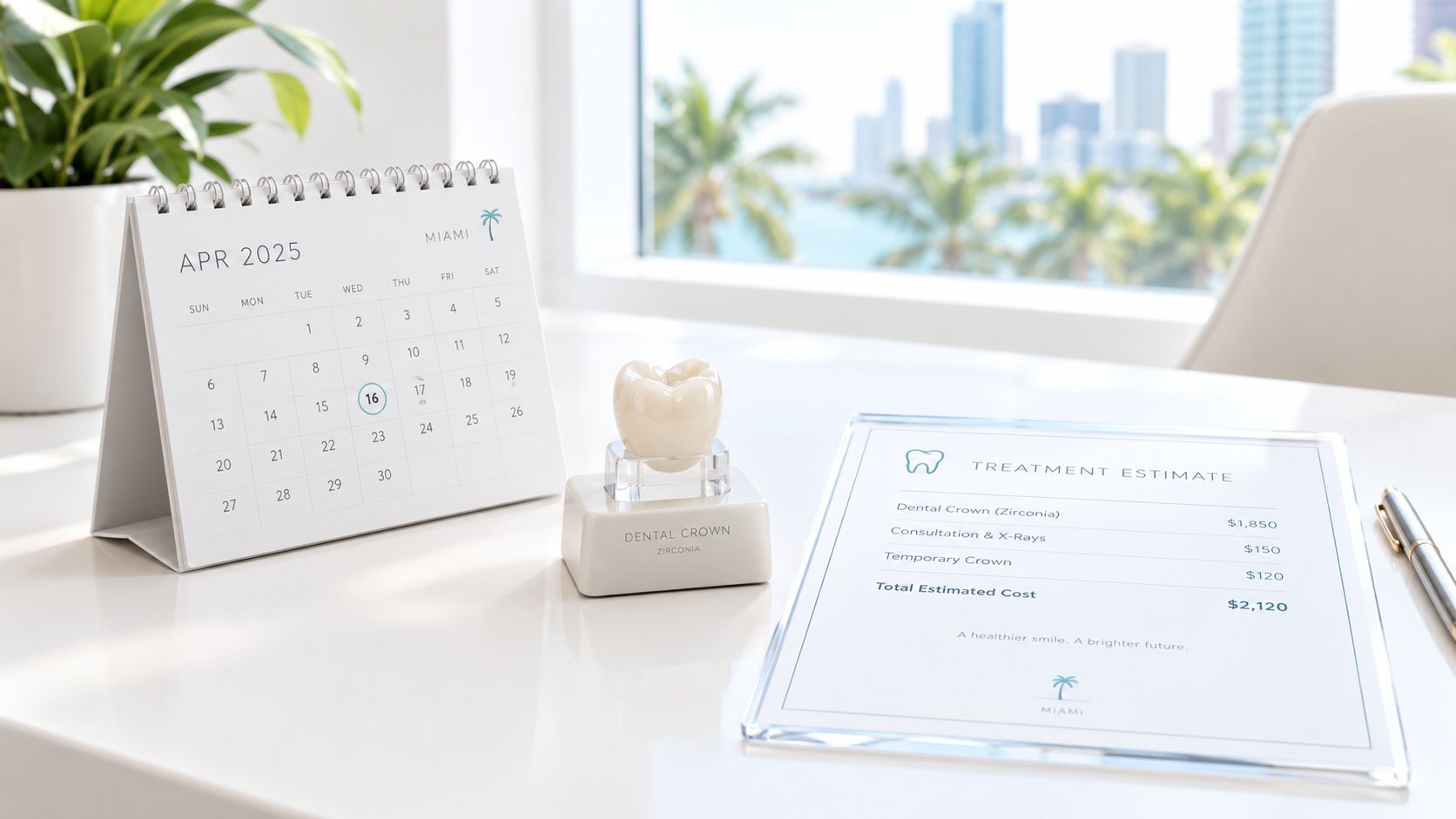
The fee also depends on the tooth's location, crown material, core buildup, insurance coverage, and the infection or restoration's complexity. A clear consultation should separate the root canal, buildup, crown, X-rays, and any additional treatment, so the estimate shows what each step covers.
Comparing the main paths
| Option | When it may fit | Main consideration |
|---|---|---|
| Root canal with crown | A restorable tooth has weakened walls or needs cusp coverage | Preserves the natural tooth while adding external protection |
| Root canal with bonded filling | A tooth retains substantial structure and has limited damage | More conservative, but the dentist must assess fracture risk |
| Tooth extraction | The tooth cannot be predictably restored | Removes the problem tooth but creates a replacement decision |
| Dental implant or bridge | A missing tooth needs functional and cosmetic replacement | Requires a separate planning process for the space |
A systematic review reported a 10-year survival rate of 81% for crowned root canal treated teeth, compared with 63% for teeth restored with direct materials such as resin composite or amalgam, according to this systematic review of long-term outcomes. The figures support crowns when remaining tooth structure and bite forces make cuspal protection appropriate. They do not mean every root canal treated tooth needs a crown. The dentist still evaluates cracks, ferrule, remaining walls, and restoration risk.
Patients searching for a cosmetic dentist near me may also ask about whitening, veneers, or smile design. Those treatments change appearance. Crowns, fillings, implants, and bridges restore or replace tooth structure. Exams and cleanings help monitor the treated tooth and identify new problems early. At Ultra Smile DentalSpa, patients can discuss timing, costs, insurance, and alternatives in a calm Miami setting before choosing a treatment plan.
Your Comfort First Visit at Ultra Smile DentalSpa in Miami FL
The right crown and root canal treatment plan should do more than address immediate pain. It should preserve a viable natural tooth, restore the bite, protect the smile, and give the patient clear instructions for maintaining the result. The timing evidence supports arranging the final crown without unnecessary delay. An 8-year retrospective study found survival of 85% when the crown was placed within 4 months of root canal treatment, compared with 68% when placement occurred after 4 months, as reported in this study on crown placement timing.
Ultra Smile DentalSpa provides root canals, crowns, bridges, same-day crowns, fillings, implants, bone grafts, wisdom teeth extraction, Invisalign, veneers, and teeth whitening near Downtown Miami, Midtown Miami, and Hallandale Beach. The practice pairs modern technology and premium materials with personalized hospitality, refreshments, aromatherapy, streaming entertainment, bilingual support, and a soothing hot towel finish. Patients can also discuss insurance, options without coverage, and a treatment sequence that fits their oral health needs.
A new patient exam with dental X-rays can clarify whether the painful tooth needs a root canal and crown, a filling, emergency care, or extraction followed by dental implants. The dentist can also explain how the tooth's remaining structure, ferrule, bite, and appearance affect the recommendation.
Patients with tooth pain, a cracked tooth, or a recently completed root canal can schedule a consultation with Ultra Smile DentalSpa for personalized crown and root canal treatment planning in Miami, FL. Contact the practice to request an appointment and receive calm, coordinated care for pain relief, tooth preservation, and a confident smile.