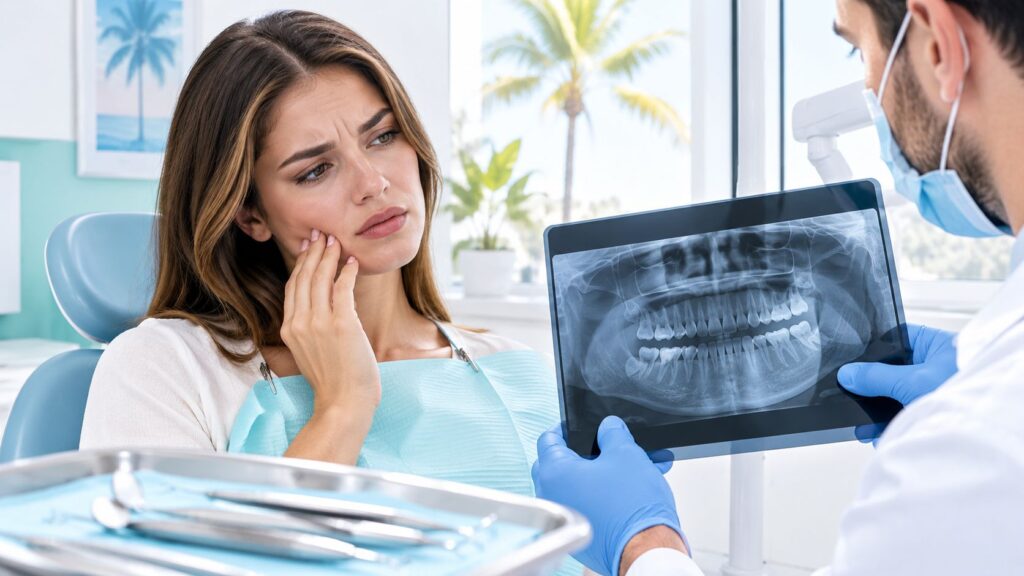
A throbbing ache at the very back of the lower jaw can make a normal Miami weekend feel suddenly difficult. The gum may swell around the last molar, chewing may become uncomfortable, and an unpleasant taste or fever may appear. Those symptoms deserve attention, but pain alone doesn't automatically mean a wisdom tooth must be removed.
The more useful question is whether an examination or dental X-ray shows disease, damage, infection, or a surgical risk that changes the balance. The UK National Institute for Health and Care Excellence, or NICE, established a major shift toward removing impacted third molars when pathology is present rather than extracting every symptom-free tooth routinely. Its guidance includes conditions such as unrestorable decay, infection, abscess, cellulitis, root resorption, cysts, tumors, fractures, and interference with other jaw surgery. The Royal College of Surgeons guidance on third molars follows the same disease-focused logic.
For patients searching for a dentist near me, a dentist in Miami, FL, or an emergency dentist, the next step is a careful evaluation, not a guess based on age or one difficult night. The guide below explains the symptoms patients notice, the quieter problems dentists find on imaging, what happens during an evaluation, and how to weigh monitoring against tooth extraction.
Table of Contents
- What Your Mouth May Be Telling You Right Now
- Why Wisdom Teeth Cause So Much Trouble
- The Most Common Signs Something Is Wrong
- Less Obvious Signs Dentists Catch First
- What Happens During a Wisdom Tooth Evaluation
- Watchful Waiting or Extraction How to Decide
- What Wisdom Tooth Removal Feels Like at Ultra Smile DentalSpa
- Your Next Step Toward a Healthier Smile in Miami
What Your Mouth May Be Telling You Right Now
A young professional in Miami wakes at 2 a.m. on a Sunday with a pulsing ache along the lower jaw. The gum behind the back molar feels swollen, opening the mouth takes effort, and a low fever began the night before. That combination calls for prompt dental care, even if the situation does not feel like a crisis.
Wisdom teeth commonly become a practical concern between ages 17 and 25, as third molars attempt to emerge in the crowded back of the mouth. Some erupt fully and remain healthy. Others tilt, stay beneath the gum, or appear only partly. Age provides context, but the decision to remove a tooth should follow evidence of disease, damage, infection, or a meaningful risk found during an examination.
The NHS overview of wisdom tooth removal describes problems associated with limited space and partial eruption, including pain, swelling, gum infection, food trapping, decay, gum disease, cysts, and abscesses.
Symptoms that deserve attention
Pressure, tenderness while chewing, bleeding around the last molar, bad breath, or a recurring swollen area can signal trouble. Jaw stiffness, a bad taste, cheek swelling, or tender lymph nodes under the jaw may indicate more active inflammation. Symptoms that settle for a few days still warrant an evaluation if they return.
Pain is one clue, not the diagnosis. A tooth can remain quiet while imaging shows a cavity, damage to the neighboring molar, or another condition that changes the extraction decision.
What the appointment answers
A Miami dentist can determine whether the discomfort comes from a wisdom tooth, the neighboring second molar, gum disease, or another source. An examination, dental X-rays, and a new patient visit can show whether treatment means removal, referral, or periodic observation.
Practical rule: A quiet wisdom tooth can still have a problem, and a painful wisdom tooth may not be the only tooth involved.
Why Wisdom Teeth Cause So Much Trouble
The back of the mouth is like a small room receiving one more piece of furniture. If the furniture is too large or arrives at the wrong angle, it may not fit through the available space without pressing against what is already there. Wisdom teeth face a similar problem. Jaw size became more limited over human development while tooth size remained substantial, leaving some people without enough room for a third molar to align normally.
The result usually falls into one of three patterns:
- Fully erupted: The tooth reaches the mouth, stands in a usable position, and can be cleaned. This situation may support monitoring if the tooth and surrounding gums remain healthy.
- Partially erupted: Only part of the crown appears. A flap of gum may cover the rest, creating a sheltered pocket where food debris and bacteria collect.
- Fully impacted: The tooth remains beneath gum or bone, sometimes tilted toward the second molar or positioned horizontally.
The partially erupted pattern often creates the most obvious cycles of swelling and soreness because the gum flap is difficult to clean with an ordinary toothbrush. Bacteria can remain in the pocket even when the rest of the mouth receives careful dental care. The clinical review of pericoronitis and third molars explains why bacteria and debris beneath this tissue can make removal the most permanent management when infections keep returning.
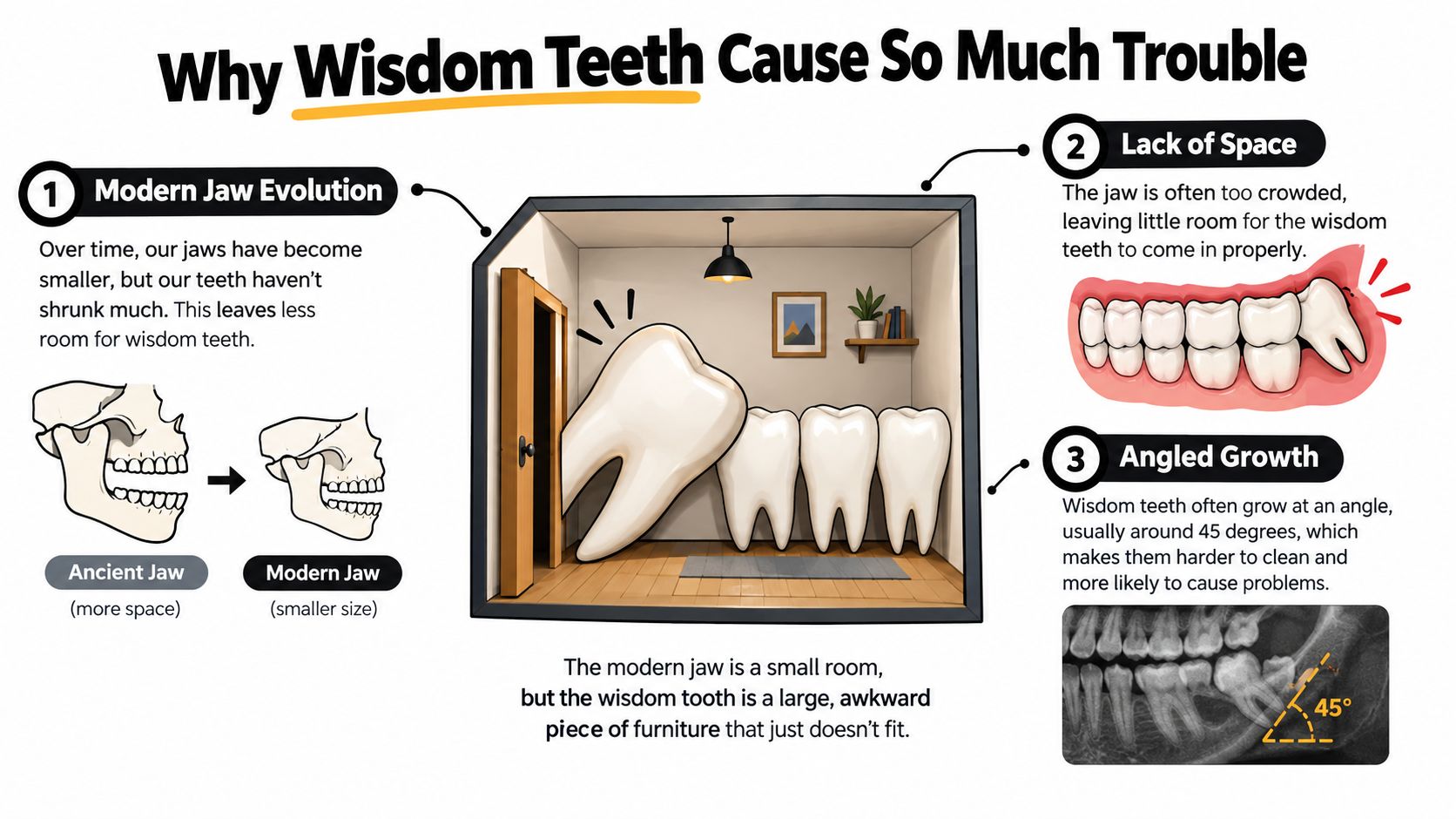
A fully impacted tooth may remain quiet, but its position can still matter. It may press against the second molar, create a difficult-to-clean contact area, or sit near important structures such as the lower jaw nerve or the upper jaw sinus. That doesn't make extraction automatic. It does make imaging important, because the tooth's angle and relationship with nearby anatomy can't be judged reliably from symptoms alone.
The Most Common Signs Something Is Wrong
Patients usually describe wisdom tooth problems in practical terms, not dental terminology. A back tooth feels tight. Chewing becomes one-sided. The gum bleeds when a toothbrush reaches the area. Each detail helps a dentist decide whether inflammation or structural damage is present.
Pain, pressure, and chewing tenderness
Persistent pain or pressure behind the last molar is a common reason for an appointment. The discomfort may feel dull, throbbing, or sharp when biting. It can also seem to spread toward the jaw, ear, or temple, which makes the source harder to identify without an exam.
Tenderness when chewing may reflect inflamed gum tissue, decay, infection around the tooth, or irritation affecting the adjacent second molar. The NICE guidance on wisdom tooth extraction connects removal with identifiable pathology, including persistent infection, unrestorable caries, abscess, cellulitis, osteomyelitis, root resorption, and cyst or tumor involvement.
Swollen, bleeding, or irritated gums
Redness and bleeding around the last molar often mean that the surrounding gum isn't healthy. A soft tissue flap over a partly erupted tooth can trap material beneath it, producing recurrent pericoronitis rather than a one-time irritation.
Stiffness or reduced opening
A jaw that feels tight, or a mouth that won't open normally, deserves prompt assessment. Inflammation can affect the chewing muscles and surrounding tissues. The evidence-based review of impacted third molars notes that pericoronitis may occur with fever, trismus, swollen lymph nodes, and painful swallowing, symptoms that can signal a more significant infection.
Bad breath, unpleasant taste, or facial swelling
Brushing and mouthwash won't permanently solve a bad taste caused by a pocket that keeps collecting bacteria. Facial swelling along the cheek is more concerning because it suggests inflammation has moved beyond a small gum margin. Difficulty swallowing, fever, rapidly increasing swelling, or breathing difficulty requires urgent dental or medical attention.
Lymph nodes and recurring episodes
Tender nodes beneath the jaw can accompany an oral infection. Symptoms may settle and return in cycles, but a quiet interval doesn't prove that the underlying pocket, decay, or impaction has resolved. Recurrent episodes are especially important because they show that the local cause remains active.
Less Obvious Signs Dentists Catch First
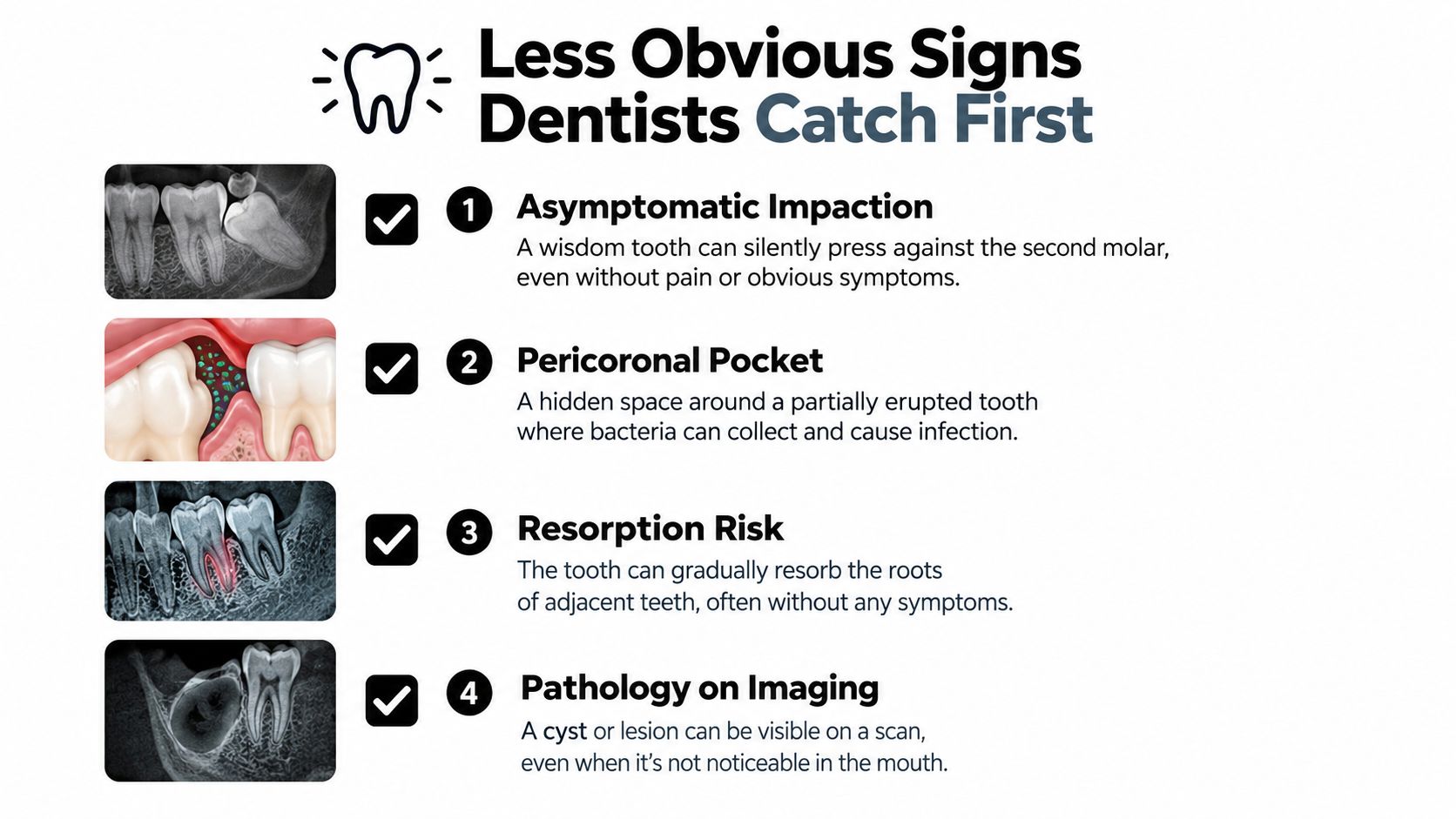
Some of the most important findings don't hurt at all. A wisdom tooth can remain hidden beneath the gum while pressing against the second molar, or a small lesion can develop around the tooth without producing a sensation that a patient can identify. This is why a routine exam and appropriate imaging matter even when the mouth feels normal.
Damage beside the wisdom tooth
A tilted or partially erupted third molar can create a narrow area against the second molar. That space may hold plaque and food, allowing decay to develop on the distal surface of the second molar or contributing to localized periodontal breakdown. Root resorption is another concern. The patient may feel nothing while the neighboring root gradually loses structure.
A dentist checks the gum pocket behind the last erupted molar and examines whether the tooth can be cleaned. Food trapping, a subtle bite change, or new tenderness around the second molar can be clues even when the wisdom tooth itself isn't painful.
Cysts and bone changes
A cyst associated with an impacted tooth can develop slowly. It may hollow out nearby bone or affect surrounding structures before swelling becomes obvious. Enlarged tissue around the crown may be visible on a panoramic image or a three-dimensional scan, even though the patient can't feel it.
Panoramic imaging can show the overall position of the third molar and its relationship with neighboring teeth. A limited periapical image may provide a closer view of a specific area, while cone-beam CT can clarify complex root anatomy and proximity to the nerve or sinus.
Why painless doesn't mean harmless
The Royal College of Surgeons third-molar guidance identifies disease associated with a mandibular third molar as sufficient reason to consider removal, including infection, caries affecting the wisdom tooth or adjacent tooth, periodontal disease, cysts, tumors, and external resorption. A Miami dentist may recommend observation when none of those findings is present, or removal when imaging shows damage despite minimal symptoms.
Early detection can make treatment planning more controlled. It may allow the dental team to assess the roots, nerve canal, bone, and neighboring molar before a sudden infection turns the visit into an emergency.
What Happens During a Wisdom Tooth Evaluation
A consultation starts with context. The dental team reviews current medications, allergies, prior extractions, relevant medical conditions, and concerns involving the jaw or sinus. Patients should mention blood-thinning medication, previous complications with anesthesia, and any recent swelling or difficulty swallowing.
The clinical exam then focuses on the last molars and the tissues around them. The Miami dentist may inspect the gum flap, measure pocketing, check the bite, assess the second molar, and feel the jaw muscles and lymph nodes. These findings help separate a local gum problem from decay, a deeper infection, or another source of pain.
Imaging with a purpose
A panoramic radiograph is commonly used as the first broad view of the wisdom teeth, jawbone, neighboring molars, and general root position. A limited periapical image can add detail when one tooth or root needs closer inspection.
Cone-beam CT isn't required for every patient. It becomes useful when a tooth is impacted, its roots appear close to the inferior alveolar nerve, the upper tooth may relate closely to the sinus, or the two-dimensional image doesn't answer an important surgical question.
Turning findings into a plan
After the exam and imaging, the dentist should explain the diagnosis in plain language. The recommendation may be continued monitoring, referral to an oral surgeon, or extraction in the dental practice when the case and clinical setting are appropriate.
The discussion should include the reason for treatment, alternatives, timing, anesthesia or sedation options, and risks specific to the tooth's location. For lower wisdom teeth, one review reports inferior alveolar nerve injury in about 1% to 8% of cases; the review of nerve injuries after lower third-molar surgery supports discussing that risk as part of informed consent.
Watchful Waiting or Extraction How to Decide
The decision isn't a contest between removing every wisdom tooth and ignoring every quiet one. A useful assessment weighs age and root development, the current symptom pattern, and what imaging shows around the second molar, bone, nerve canal, or sinus.
Patients earlier in adulthood may be considered for removal before root development is complete because anatomy and healing potential can influence surgical planning. Older adults with fully formed roots and denser surrounding bone may face a different risk profile. That doesn't mean an older patient must remove a symptom-free tooth, and it doesn't mean a younger patient should undergo surgery without pathology.
| Factor | Favors Watchful Waiting | Favors Extraction |
|---|---|---|
| Symptoms | No recurring pain, swelling, drainage, or infection | Recurrent pericoronitis, pain, swelling, fever, or drainage |
| Tooth and gum health | The tooth is cleanable and the surrounding gum is healthy | Untreatable decay, periodontal breakdown, or a persistent gum pocket |
| Imaging | No damage, cyst, lesion, or pressure-related change | Cyst, tumor, root resorption, bone loss, or damage to the second molar |
| Position | Fully erupted, functional, and easy to maintain | Impacted, blocked, partly covered, or angled into the neighboring tooth |
| Surgical risk | Anatomy supports observation and routine review | Disease is progressing, or the expected benefit outweighs nerve or sinus risk |
Asymptomatic, pathology-free teeth can often be monitored with examinations and periodic radiographs. By contrast, recurrent infection, cyst formation, root resorption, or untreatable decay affecting the adjacent tooth generally shifts the decision toward extraction.
The practical rule: If an active sign is present, arrange an evaluation now rather than waiting for an emergency visit.
Patients who want a more detailed explanation of timing can review when wisdom teeth should be removed before discussing their own radiographs with a dentist.
What Wisdom Tooth Removal Feels Like at Ultra Smile DentalSpa
At Ultra Smile DentalSpa, the visit starts with a health history, imaging review, and a conversation about how you want to feel during treatment. Local anesthetic numbs the area. If dental anxiety is part of the picture, you can discuss nitrous oxide or IV sedation when clinically appropriate. The team explains the choices before treatment begins. See the available sedation options for wisdom teeth extraction if anxiety may affect your appointment.
A straightforward erupted tooth and an impacted tooth don't require the same surgical plan. A CT scan may help map the roots, nerve canal, or sinus when standard imaging does not show those relationships clearly enough. For a difficult impaction, the surgical team plans access and removal around your anatomy instead of using one approach for every tooth.
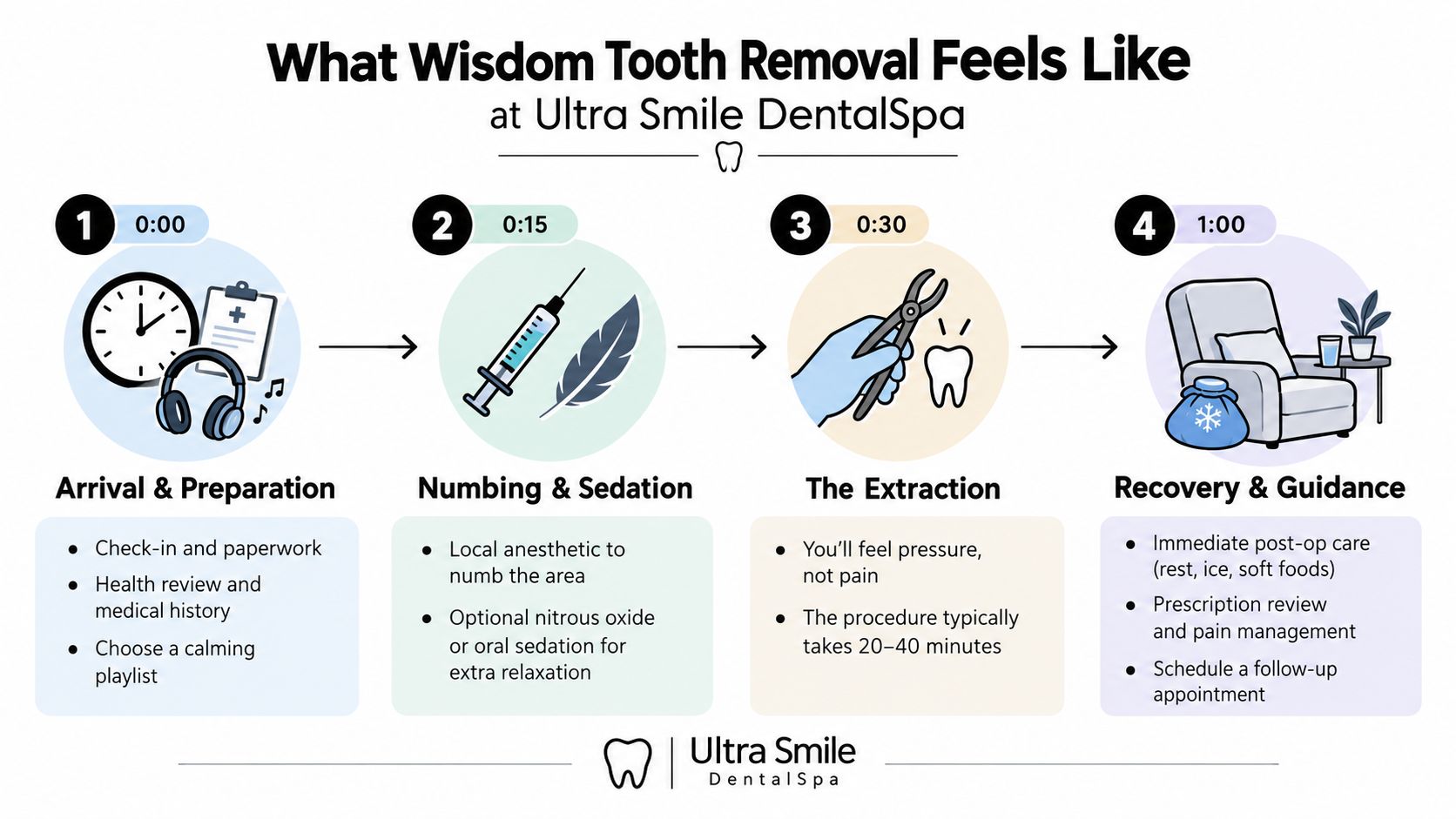
During removal, you may notice pressure, movement, or vibration. Effective numbing should prevent sharp pain. Sterile technique, clear communication, and written after-care instructions make the appointment easier to follow.
The first 48 hours
Swelling and tenderness commonly follow surgery, particularly after an impacted tooth is removed. Your instructions may include cold packs, soft foods, gentle cleaning around the site, and prescribed or recommended pain control. Follow the practice's guidance on gauze, rinsing, activity, and medication rather than relying on general online advice.
Temporary tingling or numbness can occur after lower wisdom tooth removal. Patient guidance describes these symptoms as possible for several weeks, while permanent nerve problems are much less common. The risk depends on factors such as tooth position and its relationship to nearby nerves, which is why imaging and an individualized discussion matter before surgery.
Your Next Step Toward a Healthier Smile in Miami
Many patients ask whether all four wisdom teeth need to come out at once. There isn't one universal answer. A dentist may recommend treating several teeth together when each has disease or a similar surgical plan, while monitoring or staging treatment may make more sense when the findings or risks differ.
Patients also ask about work, travel, and recovery. The appropriate timing depends on whether the tooth is erupted or impacted, how much surgery is required, the patient's health, and the type of work or travel involved. The dental team should give individualized guidance rather than promise a fixed recovery schedule.
Questions worth bringing to the consultation
- Does every tooth show pathology? A recommendation should identify which teeth have infection, decay, periodontal damage, resorption, cystic change, or another reason for removal.
- What does the imaging show? Patients should ask whether the roots relate closely to the nerve canal or sinus and whether additional imaging is needed.
- Can the teeth be monitored safely? Healthy, cleanable, symptom-free teeth may be observed with follow-up, while active disease usually changes the plan.
- What payment options apply? Ultra Smile DentalSpa discusses accepted insurance and options for patients without coverage during treatment planning.
- How soon should a young adult be checked? A new patient exam and dental X-rays can establish the position and condition of wisdom teeth before an unexpected infection interrupts work or travel.
A consultation doesn't force an immediate commitment to surgery. It provides an examination, appropriate imaging, a clear diagnosis, and a recommendation that may be monitoring, extraction, or referral. Patients looking for a dentist near me, an emergency dentist, or related care such as dental implants near me, a cosmetic dentist near me, restorative dentistry, teeth whitening, or other dental services can discuss the broader health of the mouth during the same visit.
Ultra Smile DentalSpa provides wisdom tooth evaluations, dental X-rays, treatment planning, and tooth extraction for Miami patients who need a clear answer about recurring pain or hidden pathology. Schedule a consultation by visiting Ultra Smile DentalSpa, and let the team explain whether monitoring, referral, or removal fits the findings.