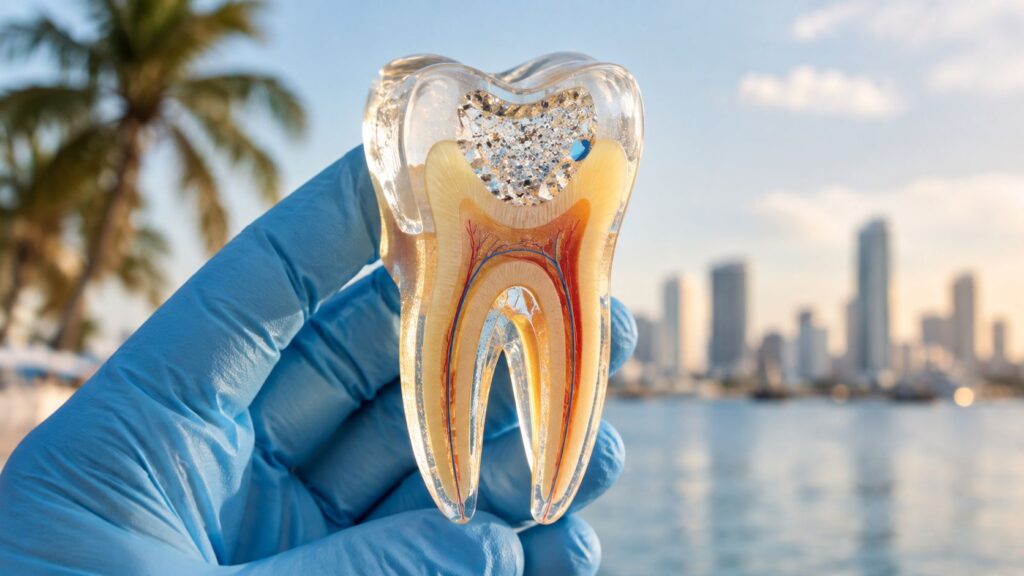
You're sitting in a Miami dental chair after noticing sensitivity when drinking something cold, or perhaps a small dark spot on a tooth has appeared during a mirror check. The dentist recommends a composite filling, and a practical question comes to mind: what is going into the tooth?
Composite fillings are designed to repair decay, cracks, and fractures while blending with natural tooth structure. Their performance comes from careful material engineering, not from “plastic alone. The resin, filler particles, bonding chemistry, pigments, and curing system each affect how the restoration looks, feels, and functions.
Table of Contents
- Why Miami Patients Ask About Composite Filling Materials
- The Core Chemistry Behind Composite Resin Fillings
- How Filler Engineering Determines Filling Performance
- Composite Fillings vs Amalgam and Other Materials
- Benefits of Composite Fillings for Miami Patients
- What to Expect During a Composite Filling Appointment
- Schedule Your Composite Filling Consultation in Miami
Why Miami Patients Ask About Composite Filling Materials
Cold-drink sensitivity or a dark spot on a tooth often leads a Miami dentist to recommend a composite filling. Understanding the material behind that recommendation helps patients weigh appearance, comfort, and long-term function with clearer expectations.
At Ultra Smile DentalSpa, patients from Downtown Miami, Midtown Miami, and Hallandale Beach can discuss restorative options in a setting focused on comfort and clear treatment planning. A dentist in Miami, FL may recommend composite resin for a cavity, chipped tooth, or small fracture. The choice depends on the tooth's location, the amount of damage, bite forces, and overall oral health.
A patient comparing options at a Miami dental practice may ask whether a white filling is safe, whether it can handle chewing, and whether it will remain difficult to notice when smiling. These questions reflect the hidden engineering of the restoration. Filler ratio, particle size, resin chemistry, bonding, and curing all influence how the material behaves in the mouth.
Patient question: “Is composite just colored plastic?
Composite is an engineered blend of resin and inorganic filler, with additional ingredients that help it bond, cure, and match the tooth.
The phrase “white filling can also cause confusion. A clinical guide discussing tooth-colored dental fillings explains that this term is not a precise material standard. It may describe composite resin, glass ionomer, or resin-modified glass ionomer. An examination helps determine which restoration suits the tooth, since these materials are not interchangeable.
Patients searching for a cosmetic dentist near me may prioritize shade matching, while restorative dentistry patients may focus on strength and chewing comfort. Both goals matter. A carefully planned composite restoration should protect the remaining tooth, restore function, and blend naturally with the smile.
The Core Chemistry Behind Composite Resin Fillings
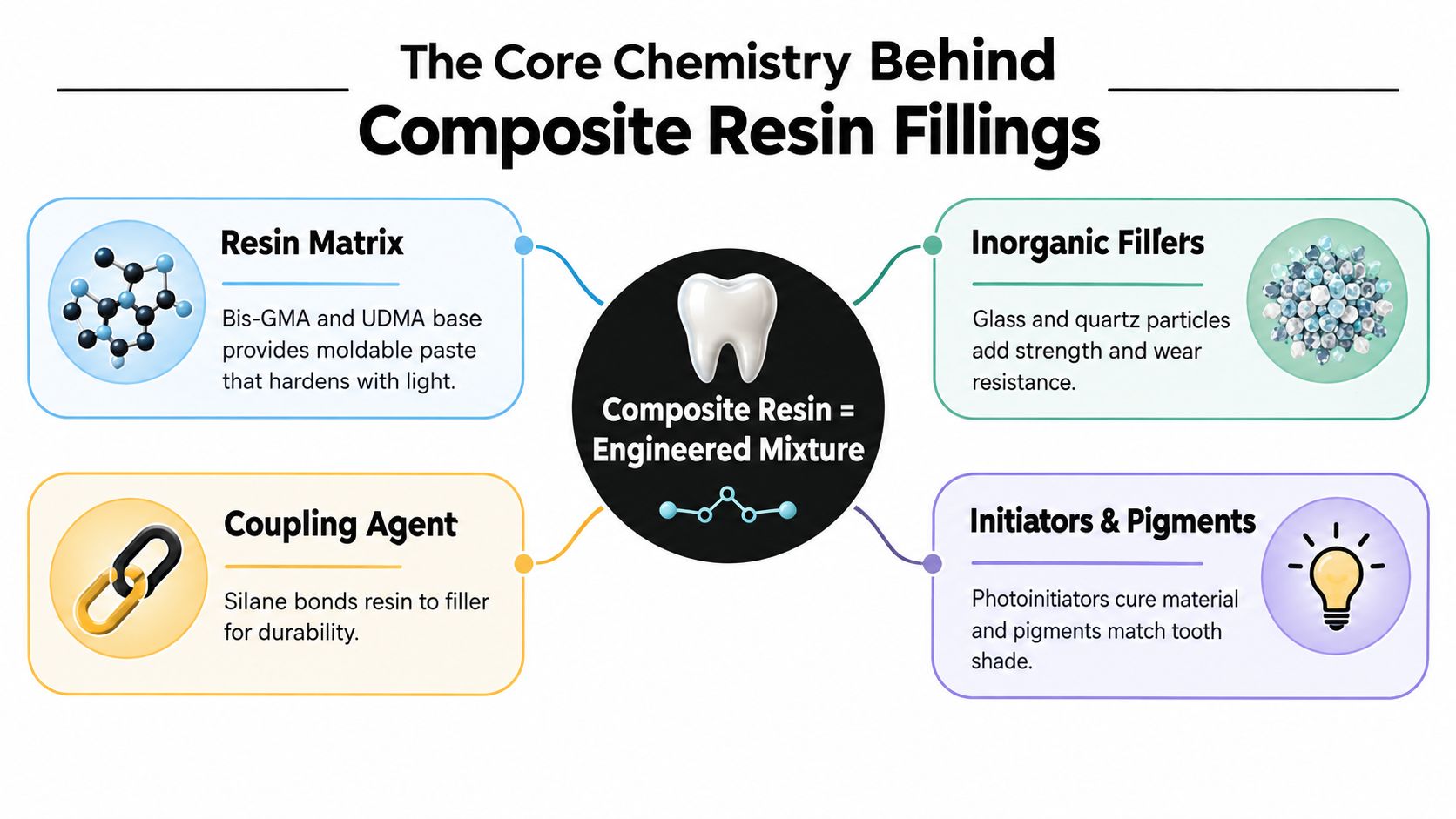
Composite fillings contain two primary structural phases: an organic resin matrix and an inorganic filler. Authoritative material reviews describe filler content commonly ranging from about 50% to 80% by weight or about 30% to 70% by volume in their review of dental composite composition.
The resin matrix
The resin matrix is the workable portion before curing. Modern materials are often built from dimethacrylate monomers such as Bis-GMA, UDMA, and TEGDMA. In simple terms, this phase gives the dentist a moldable paste that can be adapted to the prepared tooth and bonded to the surrounding structure.
A useful comparison is flexible glue. The resin helps the material spread, adapt, and harden, but resin by itself would not provide the same resistance to chewing forces that a properly reinforced composite can offer.
The inorganic filler
The filler phase may include glass, silica, quartz, or oxide-based particles such as barium, strontium, zinc, aluminum, zirconium, or colloidal silica. These particles function somewhat like reinforcing material in concrete. They improve strength, hardness, wear resistance, and the material's ability to maintain its shape.
The filler also helps reduce shrinkage during curing. That matters because excessive shrinkage can place stress on the bonded interface and contribute to marginal gaps or microleakage. The exact ratio and particle design therefore influence how a filling behaves after the curing light hardens it.
The supporting ingredients
Composite formulations also contain coupling agents, photoinitiators, pigments, and stabilizers. A silane coupling agent helps connect the inorganic filler to the resin matrix. Photoinitiators allow the material to harden when exposed to a dental curing light, while pigments help the dentist select a shade that blends with the surrounding tooth.
Some premium posterior composites report filler contents as high as 84 wt% to 92 wt%, according to the detailed review linked above. Those figures reinforce an important point: “composite describes a family of resin-and-filler systems, not one identical substance used for every tooth.
Patients interested in how dental materials are selected can review advanced dental materials at Ultra Smile DentalSpa. The clinical goal remains practical: select a material whose handling, strength, appearance, and bonding characteristics suit the specific restoration.
How Filler Engineering Determines Filling Performance
A filling's performance depends on more than the resin base. The hidden engineering lies in the filler's size, shape, concentration, and distribution. These choices affect strength, polish, wear resistance, translucency, and how chewing forces travel through the restoration. The bond between filler and resin also matters, as explained in this discussion of composite filler engineering and coupling chemistry.
Particle size changes the surface
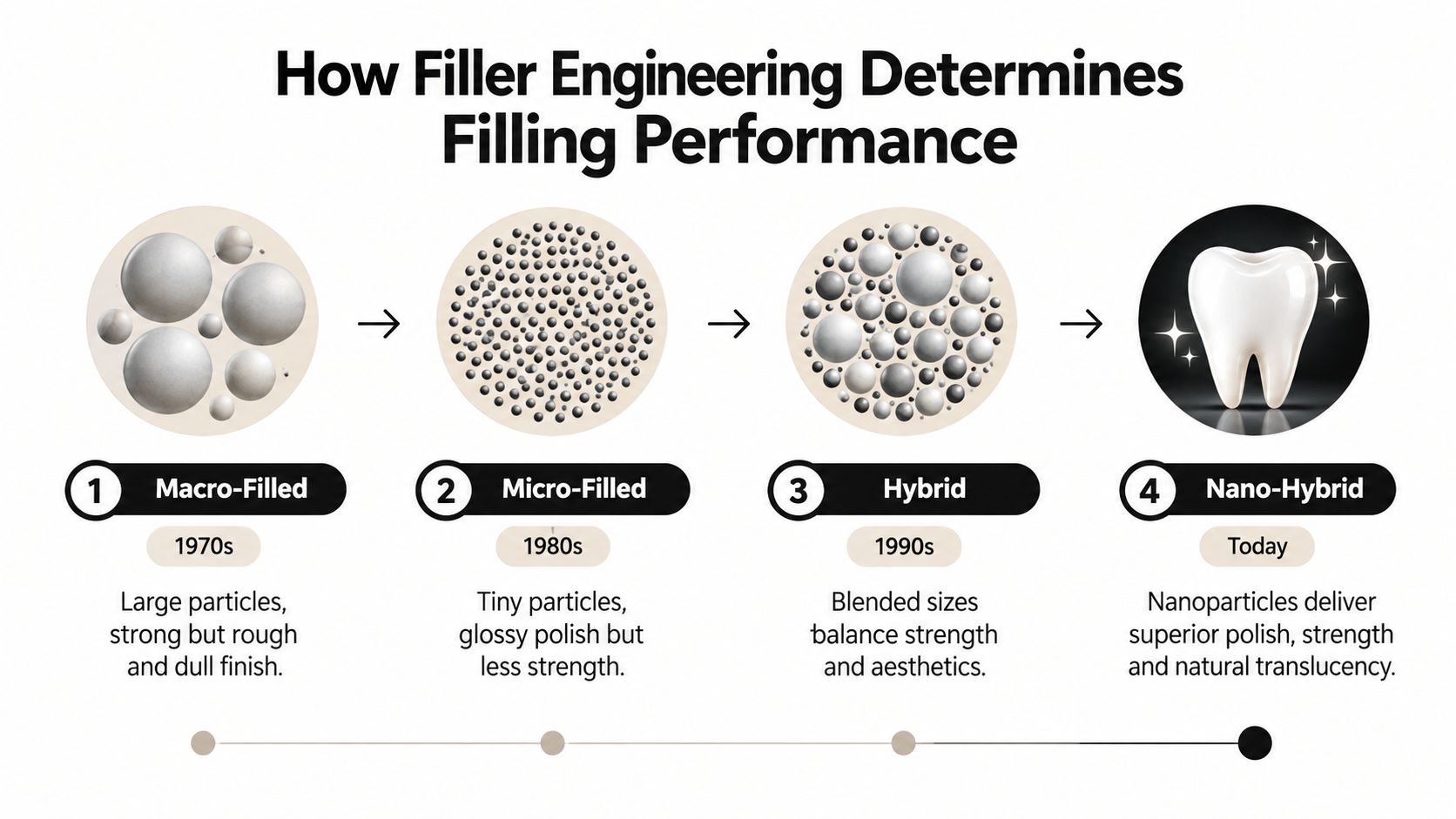
Earlier macrofilled composites used particles roughly 5 to 25 micrometers across. Microfilled systems used particles around 0.04 to 0.1 micrometer, according to the documented history of composite resin development in this dental materials timeline. Larger particles could support strength, but they were harder to polish smoothly and could leave a rougher-looking surface as the restoration aged.
Microfilled materials produced a smoother, glossier finish because their particles were much smaller. Their tradeoff involved strength and the amount of filler the resin could hold. Modern microhybrid and nanohybrid materials combine particle sizes to balance a natural-looking polish with resistance to chewing and wear.
The filler needs a chemical connection
The silane coupling agent introduced earlier lets filler particles carry chewing forces instead of concentrating stress at the interface. Particle shape also affects how tightly the particles pack and how easily resin flows around them.
A well-designed formula can resist deformation while preserving a surface that looks natural. Radiopaque fillers, including barium glass or zirconia-silica, may help dentists identify the restoration on dental X-rays.
A review in the Journal of Clinical and Diagnostic Research notes that some microhybrid systems contain up to 78% filler by weight in its discussion of resin composite materials. This is not a universal target for every filling. It shows why dentists match a material to its purpose. A composite selected for a front tooth may prioritize polish and translucency, while one used for a molar may place greater emphasis on chewing resistance.
Composite Fillings vs Amalgam and Other Materials
A patient choosing a filling is comparing more than color. Composite is a tooth-colored resin strengthened with powdered glass, as described in FDA-oriented guidance on tooth-colored filling materials. Amalgam is metal-based, while glass ionomer and resin-modified glass ionomer are separate categories of tooth-colored restorative materials.
The recommendation depends on the tooth, the restoration's size and location, moisture control, bite forces, cosmetic goals, and the patient's preferences. Those factors determine whether the material's handling, strength, appearance, and bonding method fit the situation.
| Material | Aesthetics | Durability | Safety | Best Use Case |
|---|---|---|---|---|
| Composite resin | Blends with natural tooth shade | Performance depends on its formula, placement, and tooth location | Metal-free resin-and-filler material | Visible teeth, bonded restorations, and small to moderate repairs |
| Amalgam | Metallic appearance | Long clinical history and useful resistance to heavy chewing | Contains metal components, including mercury | Back teeth or other situations where a dentist determines a metal restoration is appropriate |
| Glass ionomer | Tooth-colored, though appearance varies | Generally wears more quickly than many composite options | Tooth-colored cement; its properties suit selected clinical needs | Non-chewing surfaces, such as root-surface cavities in patients with high cavity risk or young children |
| Resin-modified glass ionomer | Tooth-colored | Combines glass-ionomer and resin characteristics | A different material category from composite resin | Areas where fluoride release, moisture tolerance, and easier handling may influence the choice |
| Ceramic restoration | Highly aesthetic | Rigid and wear-resistant, with case-specific fracture considerations | Ceramic-based option | Larger or more demanding restorations when a dentist recommends an indirect approach |
For a Miami patient who wants a natural-looking smile, composite's main advantage is shade matching. Its bonding process may also support a more conservative preparation because the material adheres to tooth structure instead of relying only on mechanical retention.
Amalgam has a long history of use and can resist heavy chewing, but its metallic appearance may not suit patients who want the repair to blend with the tooth. Ceramic can provide a highly aesthetic result, yet it usually involves an indirect restoration and a different treatment process.
“White filling describes appearance, not the complete material or its clinical use. Ask which material is recommended, why it fits that tooth, how moisture will be controlled, and how the restoration will be checked during routine cleanings and exams.
Benefits of Composite Fillings for Miami Patients
A composite filling can solve a functional problem without making the repair visually obvious. The dentist selects a shade, places the material against prepared tooth structure, and shapes the surface so the restoration supports comfortable chewing and a natural smile.

Appearance and tooth preservation
Composite resin is especially useful when a restoration is visible during speaking or smiling. Pigments and multiple shades allow the dentist to approximate the surrounding enamel and dentin rather than placing a dark metallic patch.
The material also bonds to tooth structure. That can allow the dentist to preserve more healthy tissue than a preparation designed around a nonbonded restoration, although the amount removed still depends on the decay, fracture, and structural condition of the tooth.
Strength comes from the formula
Modern commercial composites often contain 70% to 80% filler by weight, a range associated with improved performance compared with older resin-only materials in this review of contemporary composite materials. The exact product and placement technique still matter, particularly on posterior teeth that receive substantial bite forces.
For Miami patients, the practical benefits may include:
- Natural appearance: The restoration can be shaped and shaded to blend with neighboring teeth.
- Bonded support: Adhesion can help reinforce the remaining tooth structure.
- Functional repair: A filling can restore a damaged chewing surface and reduce sensitivity caused by exposed or decayed areas.
- Cosmetic flexibility: Patients already considering teeth whitening or other cosmetic dentistry can discuss how existing restorations may respond to future shade changes.
A composite filling doesn't prevent every future dental problem. Daily hygiene, balanced eating habits, protection from grinding, and regular dental exams remain important. Patients with severe pain, swelling, a broken tooth, or a lost filling should contact an emergency dentist promptly rather than waiting for a routine visit.
This short video offers another visual look at composite restoration care:
What to Expect During a Composite Filling Appointment
A composite filling appointment begins with an evaluation, not an automatic material choice. The dentist may use dental X-rays, a visual exam, and a new patient exam when appropriate to determine whether decay is present and whether the tooth needs a filling, a crown, root canal treatment, or another form of care.
At Ultra Smile DentalSpa, the clinical visit is paired with comfort-focused details such as refreshments, custom aromatherapy, streaming entertainment, and a soothing hot towel finish. The practice also emphasizes transparent treatment planning, modern technology, safety standards, and premium dental materials.
The clinical sequence
The process generally follows a clear order:
- Numbing the area: Local anesthetic helps keep the procedure comfortable. Patients may feel pressure or vibration, but they should tell the dental team if discomfort occurs.
- Removing damaged tooth structure: The dentist clears decay or compromised material while preserving healthy tissue whenever clinically possible.
- Preparing the surface: Etching and bonding steps create the conditions needed for adhesion between tooth structure and composite.
- Placing the material: The dentist adds the resin composite in controlled layers, adapting it to the cavity and surrounding anatomy.
- Curing each layer: A specialized dental light hardens the composite through its light-activated initiator system.
- Shaping and polishing: The dentist adjusts the restoration to the patient's bite and smooths the surface for comfort and appearance.
Patients can review the composite filling process at Ultra Smile DentalSpa before an appointment. Understanding each step often makes the visit feel more manageable, especially for patients with dental anxiety.
A broader care plan may also include professional cleaning and exams, dental X-rays, teeth whitening, or treatment for other concerns. If a tooth cannot be restored, the dentist may discuss tooth extraction and replacement options such as dental implants near me, depending on the examination.
Schedule Your Composite Filling Consultation in Miami
Composite fillings combine resin with inorganic filler, bonding agents, curing ingredients, pigments, and stabilizers. The filler's particle size, shape, and concentration affect how smoothly the material polishes, how it handles chewing forces, and how closely it matches the tooth. Resin chemistry helps these components work together, which is why the material can balance appearance, durability, and safety.
A consultation with a Miami dentist can determine whether composite suits a cavity, fracture, chipped tooth, or cosmetic concern. Ultra Smile DentalSpa serves patients in Downtown Miami, Midtown Miami, and Hallandale Beach. Care may include restorative and cosmetic dentistry, dental implants, wisdom teeth extraction, emergency dental services, and routine exams and cleanings.
Patients can ask about insurance options, accommodations without coverage, complimentary yearly whitening, and bilingual staff when planning ongoing care.
Schedule an evaluation for sensitivity, decay, a chipped tooth, or a loose restoration. Urgent pain, swelling, trauma, or a lost filling calls for an emergency dentist rather than delay.
If you are weighing composite against another material, Ultra Smile DentalSpa can explain the options during your consultation. Visit Ultra Smile DentalSpa to request an appointment in Miami, including Downtown Miami, Midtown Miami, or Hallandale Beach.